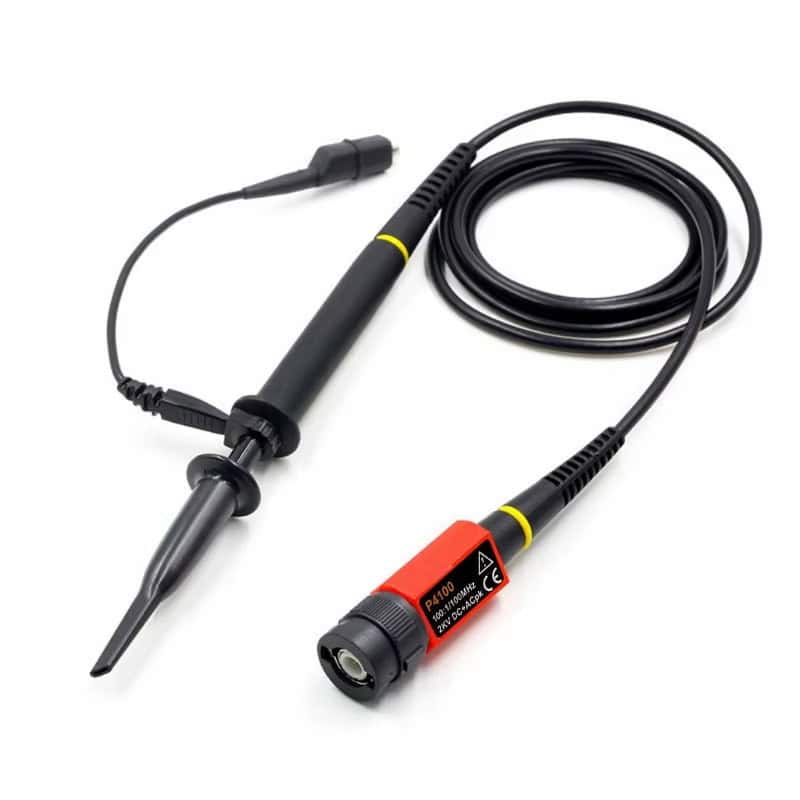
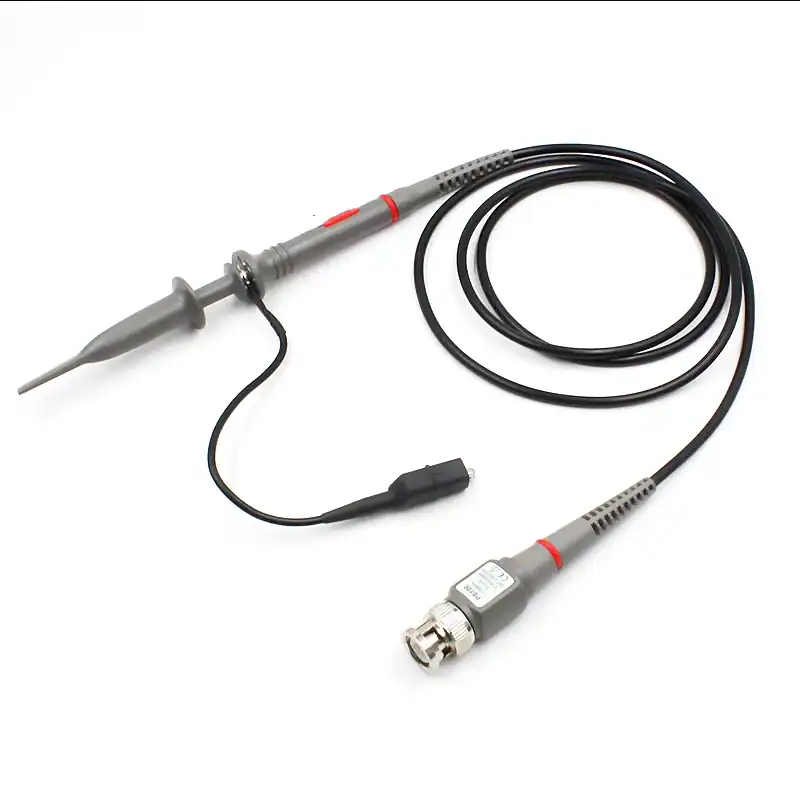
A quality probe transfers signals accurately without distorting the waveform or loading the circuit excessively.
FNIRSI oscilloscope probes feature switchable 1X and 10X attenuation settings. The 1X setting passes signals directly for maximum sensitivity. The 10X setting reduces signal amplitude by a factor of ten while increasing input impedance, which minimises circuit loading and extends usable bandwidth.
Proper probe selection affects every measurement your oscilloscope makes. The wrong probe bandwidth limits your effective measurement capability regardless of how advanced your oscilloscope is.
How Oscilloscope Probes Work
Passive probes use resistive and capacitive voltage dividers to scale signals. At the 10X setting, a 9 megohm resistor in the probe tip combines with the oscilloscope’s 1 megohm input impedance to create a 10:1 divider. Compensation capacitors maintain flat frequency response across the probe’s bandwidth.
The probe tip contacts your circuit while the ground clip connects to the circuit’s reference point. This completes the measurement path and allows the oscilloscope to display the voltage difference between tip and ground.
Ground lead length affects high-frequency measurement accuracy. Long ground leads add inductance that causes ringing and overshoot on fast edges. Short ground connections or spring-tip ground contacts improve signal fidelity for digital and high-speed circuits.
Probe compensation adjusts the capacitive divider to match your specific oscilloscope. An uncompensated probe shows distorted square waves with either overshoot or rounded corners. Most oscilloscopes include a compensation signal output for this adjustment.
Why Probe Quality Matters
Bandwidth determines the highest frequency a probe can accurately transfer. A probe rated at 100MHz passes signals up to that frequency with acceptable accuracy. Higher frequencies experience increasing attenuation and phase shift.
The rule of thumb suggests probe bandwidth should exceed your signal frequency by at least five times for accurate amplitude measurements. Measuring a 20MHz signal accurately requires a 100MHz or faster probe.
Input capacitance loads the circuit under test. Lower capacitance means less loading effect. A typical 10X probe presents around 10-15 picofarads to the circuit. At the 1X setting, capacitance increases significantly, which can affect high-impedance circuits.
Rise time specification indicates how fast a probe can respond to signal transitions. Faster rise times capture sharp edges more accurately. This matters when measuring digital signals with nanosecond transitions.
Types of Oscilloscope Probes
Passive voltage probes suit most general-purpose measurements. These affordable probes handle signals from millivolts to hundreds of volts depending on attenuation setting. They require no power supply and work with any compatible oscilloscope.
High-voltage probes measure signals exceeding standard probe ratings. These specialised probes feature additional attenuation and insulation for safely measuring mains voltages, power supplies, and high-voltage circuits.
Current probes measure current flow without breaking the circuit. Clamp-style current probes surround a conductor and sense the magnetic field produced by current. These convert current measurements to voltage signals your oscilloscope can display.
Active probes include built-in amplifiers powered by the oscilloscope or external supply. Active designs achieve lower input capacitance and higher bandwidth than passive probes. These suit demanding high-speed digital and RF measurements.
Differential probes measure voltage between two points that are both above ground. Standard single-ended probes reference everything to ground. Differential probes safely measure floating signals like motor drives and bridge circuits.
Matching Probes to Your Oscilloscope
Probe bandwidth should match or exceed your oscilloscope bandwidth. Connecting a 60MHz probe to a 100MHz oscilloscope limits your system bandwidth to 60MHz regardless of oscilloscope capability.
Compensation range must cover your oscilloscope’s input capacitance. Probes specify a compensation range such as 10-35 picofarads. Your oscilloscope input capacitance must fall within this range for proper compensation.
Connector type must match your oscilloscope input. BNC connectors are standard on most oscilloscopes. Some compact and handheld oscilloscopes use proprietary connectors requiring specific probe models.
Attenuation settings must be recognised by your oscilloscope. Many oscilloscopes detect 10X probes automatically and adjust vertical scale accordingly. Others require manual attenuation setting in the channel menu.
Probe Care and Maintenance
Store probes in protective cases to prevent tip damage and cable stress. Bent or broken tip contacts cause intermittent connections and unreliable measurements.
Inspect cables regularly for cracks, kinks, and damage. Damaged insulation creates safety hazards when measuring higher voltages. Frayed cables also introduce noise into measurements.
Keep spare ground leads and accessories available. Ground clips and spring contacts wear with use. Replacement parts restore measurement quality without purchasing complete new probes.
Clean probe tips with isopropyl alcohol to remove flux residue and contamination. Dirty contacts increase contact resistance and reduce measurement accuracy.
Probe Accessories
Ground lead sets provide various lengths and connection styles. Short leads suit high-frequency work. Longer leads reach awkward test points. Spring-tip grounds offer convenient hands-free connections.
Probe tip adapters convert between connection styles. IC clips grip component leads. Sprung hooks attach to wire loops and component legs. Fine-pitch adapters reach closely spaced surface mount pins.
Probe holders keep probes organised and protected on your workbench. Stands hold probes upright between uses. Hooks mount probes on oscilloscope handles or bench edges.
Pair With Your Oscilloscope
Quality probes maximise the capability of your oscilloscope investment. Browse our digital oscilloscopes to find instruments matching your measurement requirements.
For portable measurement work, handheld oscilloscope multimeters combine waveform display with multimeter functions in compact form factors.
Workbench setups benefit from benchtop oscilloscopes offering larger displays and expanded measurement features.
UK Delivery and Support
Orders ship from our UK warehouse within 1-2 business days. Royal Mail delivers to most UK addresses in 24-48 hours.
Every oscilloscope probe includes a 12 month guarantee and 60 day easy return period. UK consumer protection applies to every purchase, with our policies fully compliant with Distance Selling Regulations. Customer service responds within 1 business day.
Every probe we sell is genuine FNIRSI equipment with full manufacturer warranty coverage.
Shop now to find the oscilloscope probes that match your measurement needs.
Frequently Asked Questions
Where can I find a budget oscilloscope probe?
FNIRSI oscilloscope probes offer reliable measurement performance at accessible prices. Our range includes passive probes with switchable 1X/10X attenuation suitable for most electronics work. All probes ship from our UK warehouse with fast Royal Mail delivery, 12 month guarantee, and 60 day easy returns.
What does 10X attenuation mean on an oscilloscope probe?
The 10X setting divides the input signal by ten before it reaches your oscilloscope. A 50V signal appears as 5V on the display. Your oscilloscope compensates by multiplying readings back up, showing the true voltage. The benefit is reduced circuit loading and extended bandwidth compared to the 1X setting. Use 10X for most measurements and switch to 1X only when measuring very small signals that need maximum sensitivity.
How do I know if my probe needs compensation?
Connect your probe to the oscilloscope’s compensation signal output, usually a small square wave around 1kHz. View the waveform on screen. A properly compensated probe shows clean square corners. Overshoot indicates over-compensation. Rounded corners indicate under-compensation. Adjust the small screw or trimmer on the probe body until corners appear square. Repeat this check whenever you move a probe between oscilloscopes.