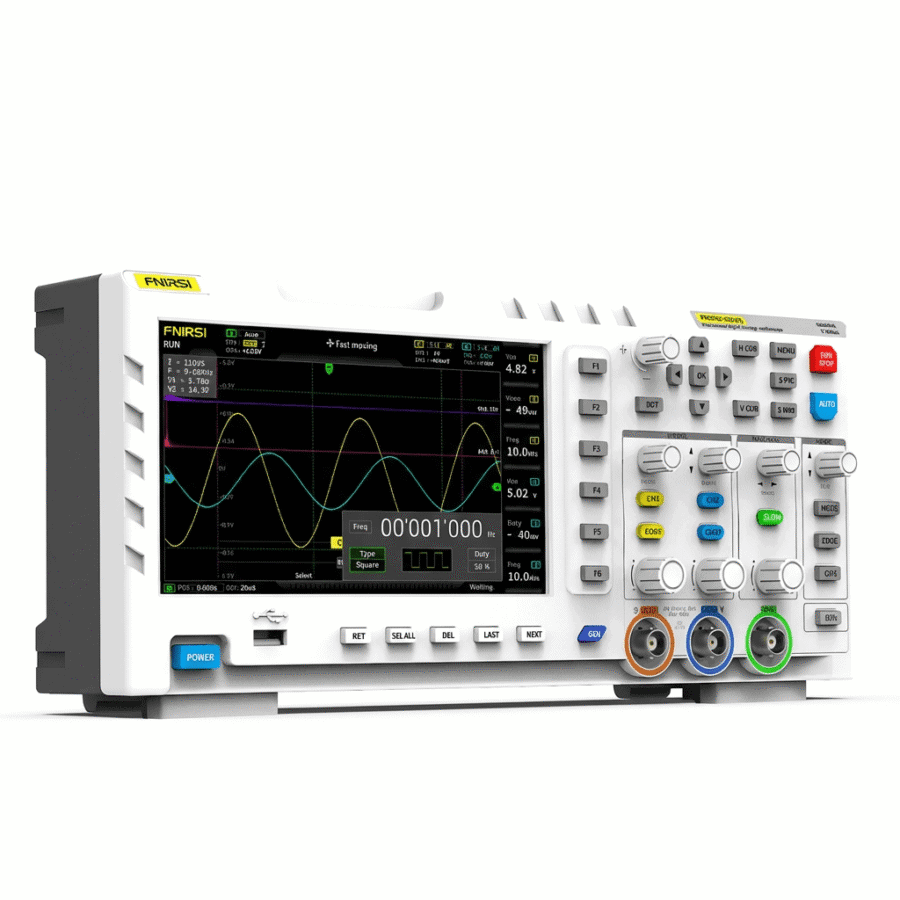
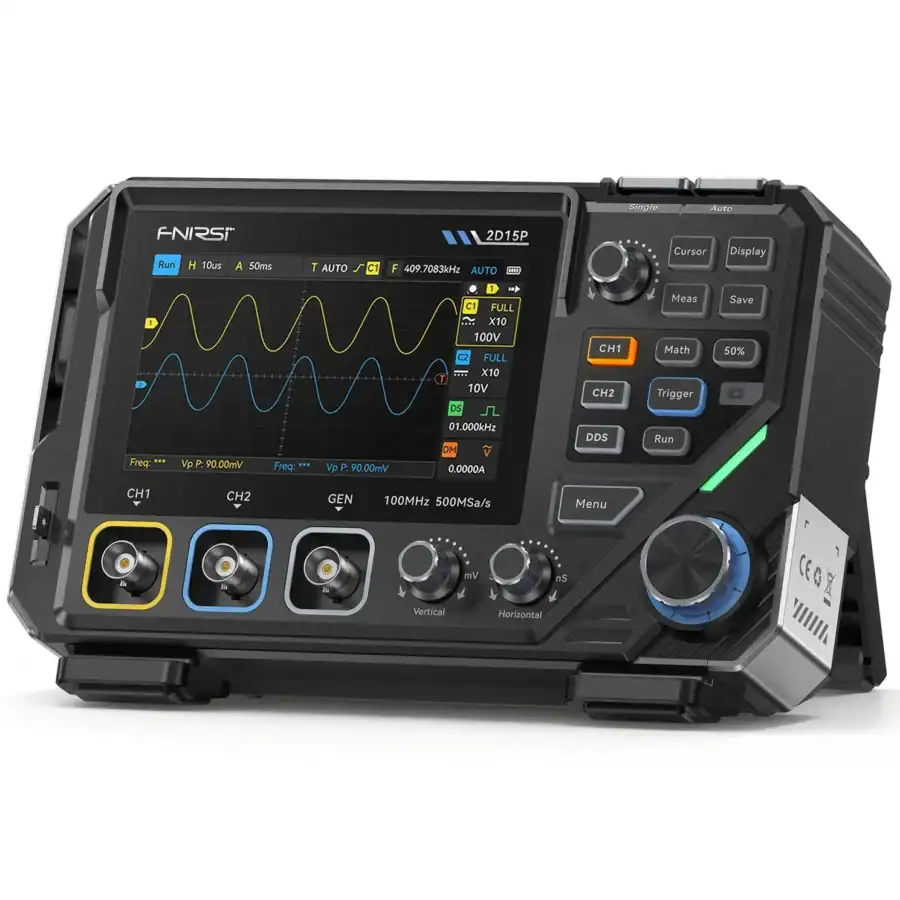
Benchtop oscilloscopes provide full-featured waveform analysis for permanent workshop installation.
These instruments offer larger displays, deeper memory, and more advanced features than portable alternatives, making them the preferred choice for serious electronics work.
FNIRSI benchtop oscilloscopes feature displays from 7 inches upward with bandwidth options reaching 350MHz. Sample rates up to 1GSa/s capture fast signals accurately. Deep memory stores millions of sample points for extended capture and detailed zoom analysis.
A proper benchtop oscilloscope transforms your electronics capability. The larger screen shows waveform detail clearly. Extended features automate complex measurements. Mains power eliminates battery limitations during long debugging sessions.
Why Choose a Benchtop Oscilloscope?
Display size improves waveform visibility significantly. A 7-inch or larger screen shows multiple channels clearly with room for measurement readouts. Fine signal details become visible without zooming. Extended viewing sessions cause less eye strain on larger displays.
Deep memory captures longer time periods at full sample rate. Shallow memory forces trade-offs between capture duration and sample rate. Deep memory lets you capture entire events while maintaining detail for zoomed analysis of specific sections.
Advanced triggering isolates specific events in complex signals. Edge triggering suits basic work, but pulse width, video, runt, and pattern triggers capture events that simpler instruments miss. Complex triggers save hours of searching through captures.
Processing power enables sophisticated analysis. FFT displays show frequency content. Waveform math combines channels for power and differential measurements. Protocol decoding interprets serial bus traffic automatically.
Mains power operation provides consistent performance without battery concerns. Long debugging sessions proceed without charging interruptions. Full display brightness and processing power operate continuously.
Who Uses Benchtop Oscilloscopes?
Professional repair technicians need reliable instruments for daily use. Benchtop oscilloscopes handle continuous operation in busy repair shops. Larger displays reduce eye strain during extended fault-finding sessions.
Product developers test prototypes and verify designs meet specifications. Deep memory captures long sequences for analysis. Advanced triggers isolate intermittent faults. Documentation features export waveforms for reports.
Educational institutions equip teaching laboratories with capable instruments. Students learn proper measurement technique on professional-grade equipment. Multiple workstations require instruments that survive shared use.
Serious hobbyists building advanced projects appreciate professional features. RF work, high-speed digital design, and precision analogue projects benefit from capabilities beyond basic handheld instruments.
Research applications require detailed waveform analysis. Deep memory and high sample rates capture events for thorough investigation. Export capabilities support data analysis in external software.
Audio engineers characterise amplifiers, analyse distortion, and verify filter performance. Large displays show FFT spectra clearly. Multiple channels compare input and output simultaneously.
Benchtop vs Portable Oscilloscopes
Benchtop oscilloscopes excel where specifications matter most. Higher bandwidth options reach 350MHz compared to typical 100MHz portable limits. Deeper memory stores millions versus thousands of samples. Larger displays show detail portable screens cannot match.
Portable oscilloscopes win on flexibility. Handheld oscilloscopes travel to measurement locations. Battery power works without mains supply. Compact size fits tool bags and cramped spaces.
Tablet oscilloscopes offer middle ground with larger touchscreens than handhelds while remaining portable. These suit users wanting more display area without full benchtop commitment.
Many users own both types. A benchtop oscilloscope serves as the primary workshop instrument. A handheld oscilloscope handles field service and locations away from the bench.
Key Specifications to Consider
Bandwidth determines your highest measurable frequency. Match bandwidth to your fastest signals using the five-times rule for accurate amplitude measurement. A 350MHz oscilloscope accurately measures signals up to approximately 70MHz.
Sample rate must exceed bandwidth adequately. Look for at least 5x bandwidth in sample rate. A 350MHz oscilloscope should offer at least 1.75GSa/s, preferably higher for optimal waveform reconstruction.
Memory depth affects capture capability at full sample rate. Deeper memory captures longer events without sacrificing detail. Look for memory measured in megapoints rather than kilopoints for professional work.
Display size and resolution affect usability during extended sessions. Larger displays reduce eye strain and show more detail. Higher resolution displays render waveforms more accurately.
Channel count should match your measurement complexity. Dual-channel suits most applications. Four channels help with complex digital systems. Explore multi-channel oscilloscopes for expanded input options.
Connectivity enables data export and remote control. USB ports transfer screenshots and waveform data. LAN connectivity suits automated test systems.
Advanced Features
Protocol decoding interprets serial communication automatically. I2C, SPI, UART, CAN, and other protocols display as decoded data alongside raw waveforms. This accelerates embedded development and debugging.
FFT analysis shows signal frequency content. Identify harmonics, noise sources, and interference without separate spectrum analyser equipment. Compare spectra across different operating conditions.
Waveform math combines channels mathematically. Add, subtract, multiply, and apply functions to captured signals. Calculate power from voltage and current waveforms. Show differential signals from single-ended measurements.
Mask testing compares waveforms against defined boundaries. Pass/fail testing catches deviations automatically. Production testing and quality verification benefit from automated comparison.
Segmented memory captures multiple events efficiently. Store many short captures in memory that would otherwise hold one long capture. Trigger on rare events and accumulate occurrences for analysis.
Essential Accessories
Quality probes determine actual measurement performance. Oscilloscope probes matching your oscilloscope bandwidth ensure the complete system performs to specification.
Probe accessories extend measurement capability. Current probes measure current without breaking circuits. Differential probes measure floating signals safely. High-voltage probes handle mains and power electronics.
Rack mounting hardware suits professional installations. Standard 19-inch rack compatibility integrates oscilloscopes into test systems and production environments.
Pair With Other Test Equipment
Complete your bench setup with complementary instruments. A digital multimeter provides quick static measurements that oscilloscopes handle less conveniently.
Signal sources for testing require waveform generation. Oscilloscopes with signal generators include built-in outputs. Separate handheld signal generators offer additional flexibility.
Controlled power for circuits under test comes from bench power supplies. Adjustable voltage and current with monitoring complement oscilloscope measurements.
Component verification catches faulty parts before installation. Component testers for electronics quickly identify defective components.
UK Delivery and Support
Orders ship from our UK warehouse within 1-2 business days. Royal Mail delivers to most UK addresses in 24-48 hours.
Every benchtop oscilloscope includes a 12-month guarantee and 60-day easy return period. UK consumer protection applies to every purchase, with our policies fully compliant with Distance Selling Regulations. Customer service responds within 1 business day.
Every oscilloscope we sell is genuine FNIRSI equipment with full manufacturer warranty coverage.
Shop now to find the benchtop oscilloscope that matches your workshop requirements.
Frequently Asked Questions
Where can I find a budget benchtop oscilloscope?
FNIRSI benchtop oscilloscopes deliver professional measurement capability at accessible prices. Our range includes instruments with bandwidth up to 350MHz, deep memory for extended capture, and advanced features like protocol decoding and FFT analysis. Large displays from 7 inches provide clear waveform visibility. All models ship from our UK warehouse with fast Royal Mail delivery, 12-month guarantee, and 60-day easy returns.
What display size do I need for a benchtop oscilloscope?
A 7-inch display suits most benchtop applications and represents the common size for budget instruments. This provides adequate space for dual-channel waveforms with measurement readouts visible alongside. Larger displays of 10 inches or more improve visibility for four-channel work and extended sessions but cost more. Consider how long you typically spend viewing waveforms and whether eye strain affects your current setup.
Is a benchtop oscilloscope better than a handheld?
Benchtop oscilloscopes offer higher specifications including more bandwidth, deeper memory, larger displays, and more advanced features. They suit workshop use where mains power is available and portability is unnecessary. Handheld oscilloscopes sacrifice some specifications for portability, battery power, and compact size. Neither type is universally better. Choose benchtop for your primary workshop instrument and best measurement capability. Choose handheld for field service, portable use, or supplementing a bench instrument with portable capability.