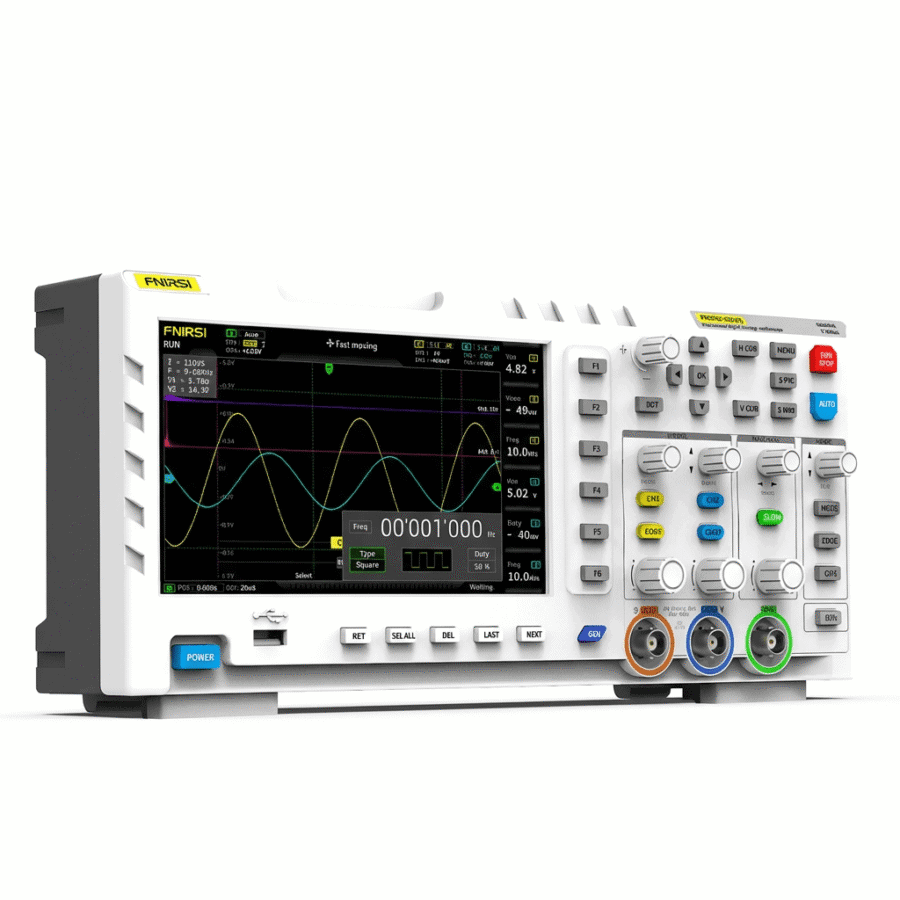
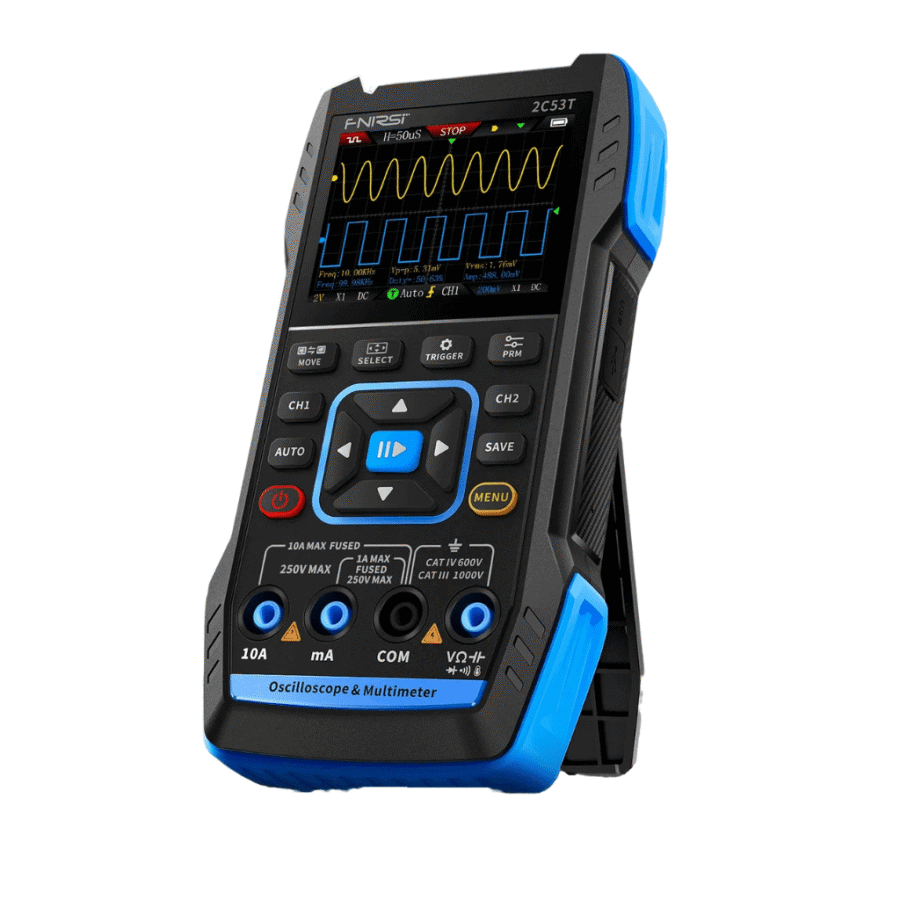
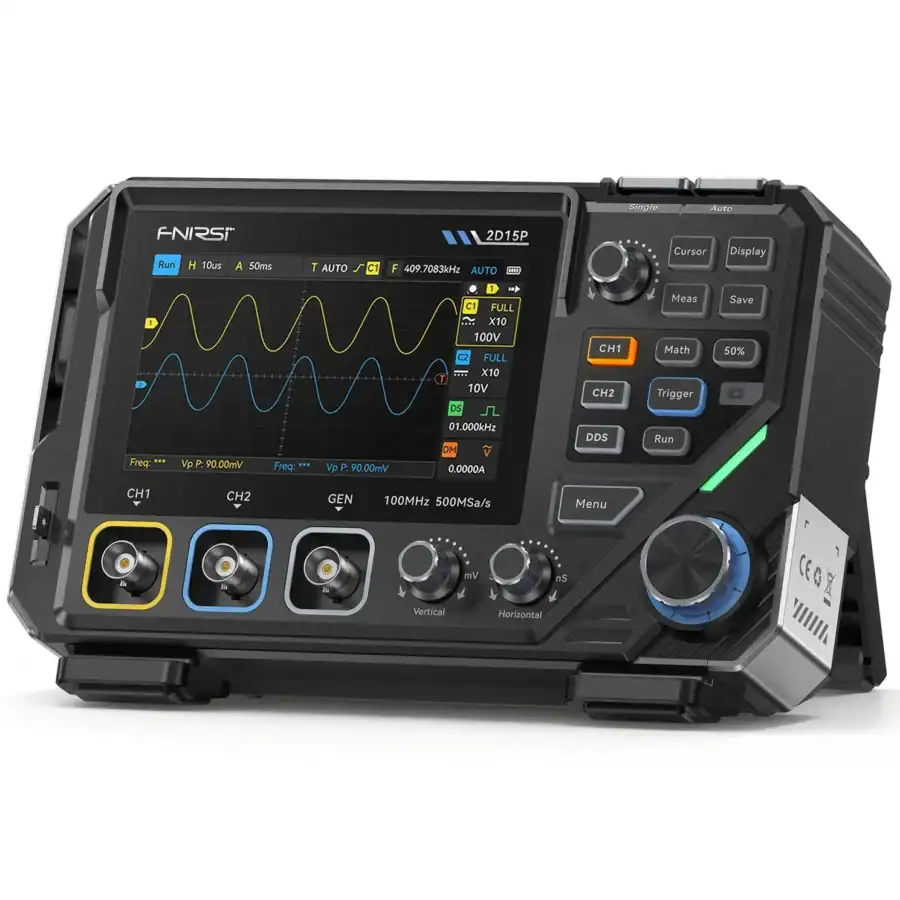
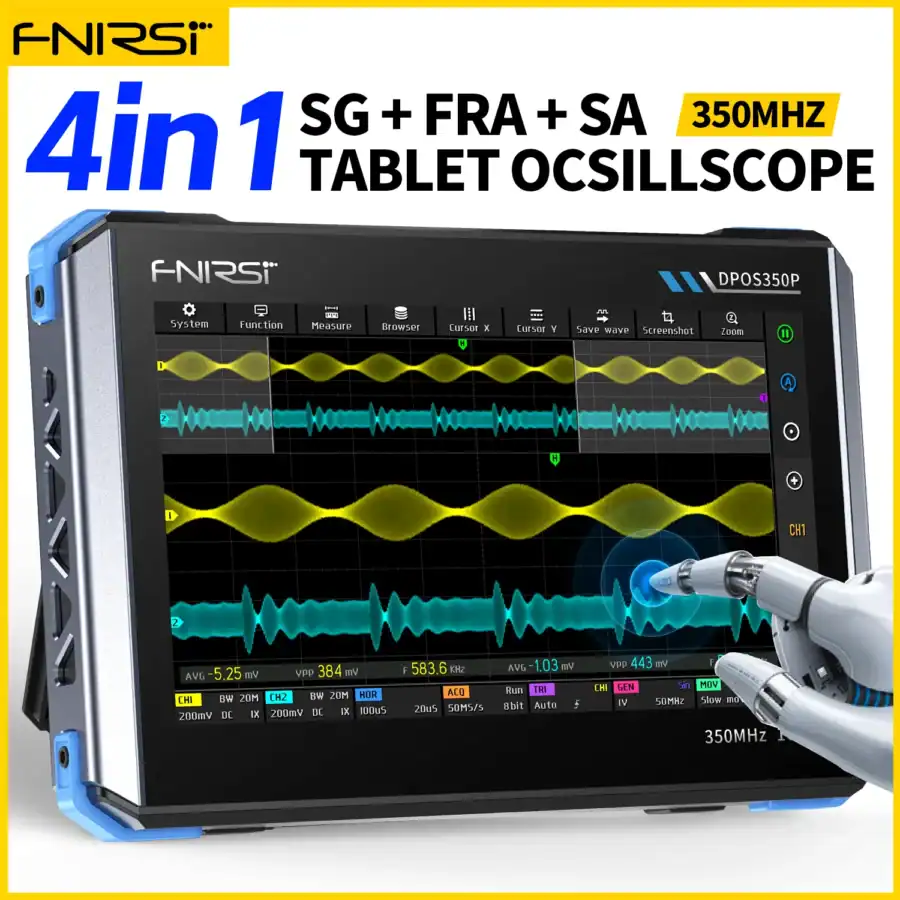
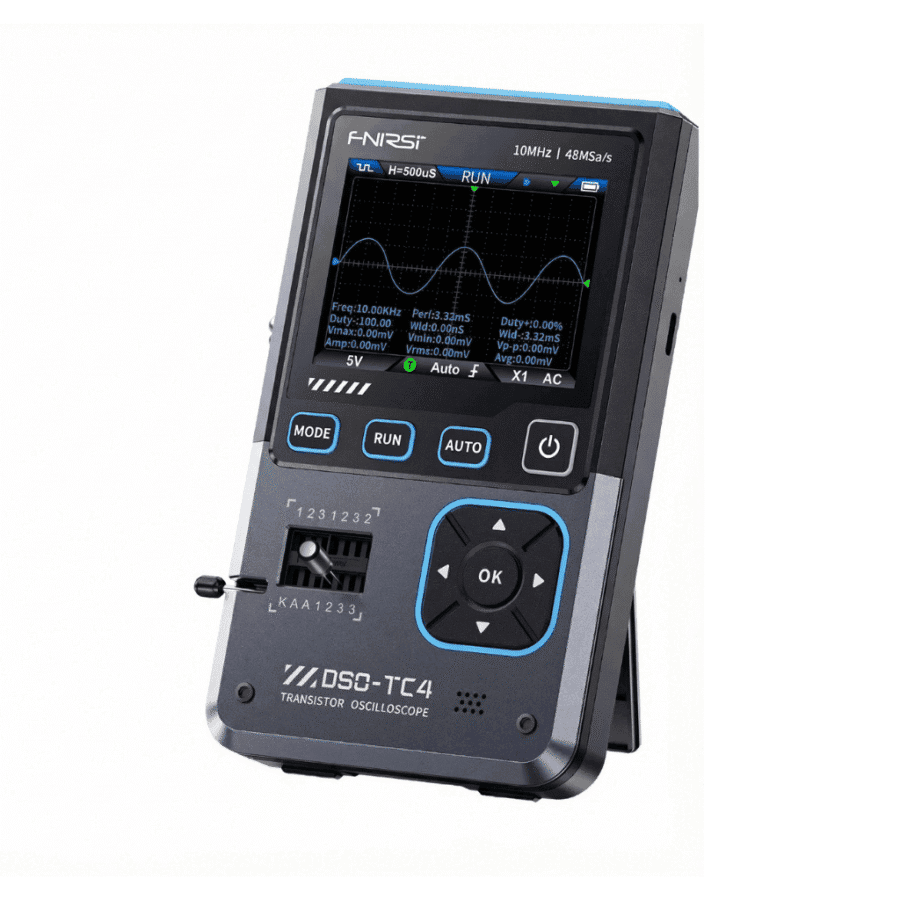
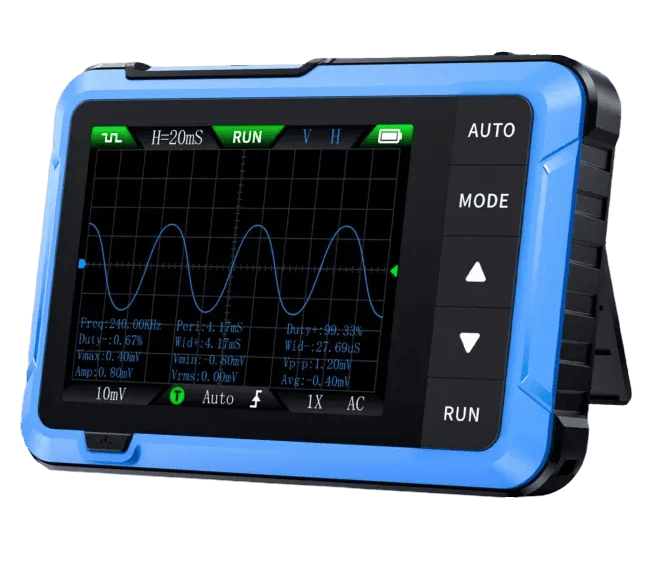
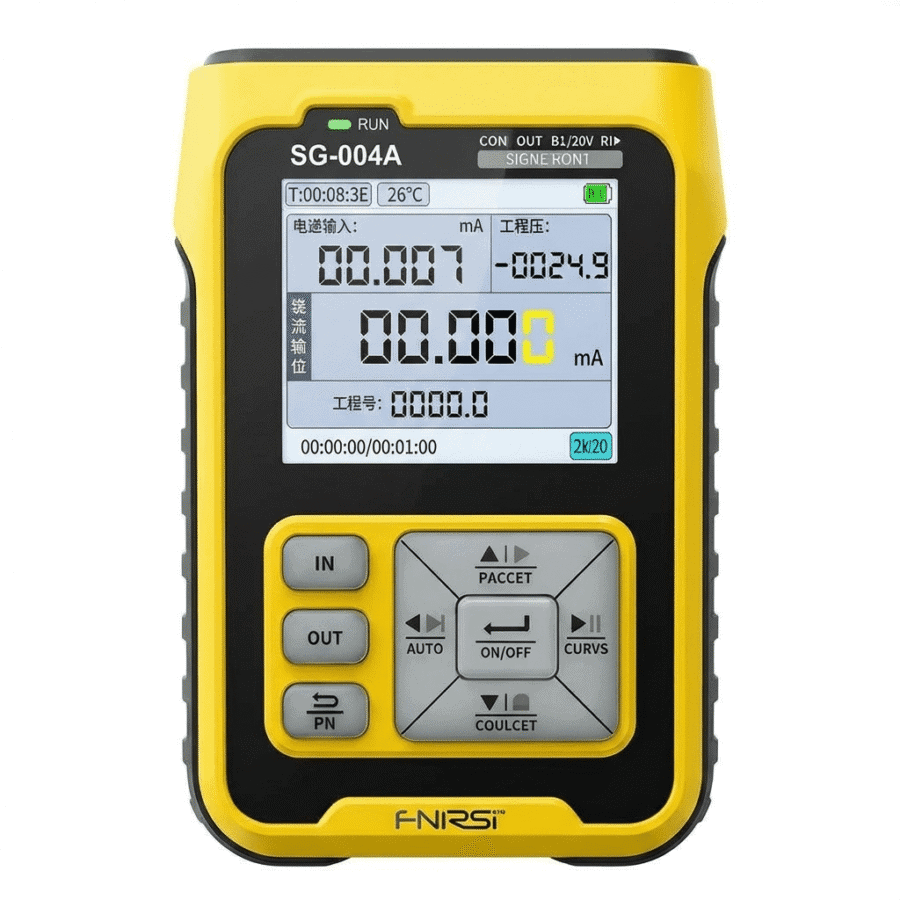
Oscilloscopes with signal generators combine waveform measurement and waveform generation in single instruments.
These integrated devices let you inject test signals into circuits while simultaneously viewing the response, eliminating the need for separate equipment.
FNIRSI oscilloscopes with signal generators output sine waves, square waves, triangle waves, and other waveforms at frequencies from fractions of a hertz to megahertz ranges. Adjustable amplitude and frequency controls match output signals to your testing requirements while the oscilloscope section captures circuit response.
Stimulus-response testing becomes straightforward when one instrument handles both functions. Generate a known input signal, measure the output, and characterise circuit behaviour without coordinating multiple devices.
How Integrated Signal Generators Work
The signal generator section produces waveforms using direct digital synthesis or analogue oscillator circuits. Digital synthesis offers precise frequency control and multiple waveform types. Output amplifiers scale the signal to useful voltage levels.
Generator output connects to the circuit under test, typically through a dedicated output terminal. The oscilloscope inputs then measure circuit response at any point you choose to probe.
Having both functions in one instrument simplifies connections and eliminates synchronisation concerns. The generator output serves as a known reference while you explore how signals propagate through circuit stages.
Frequency ranges vary by model. Basic integrated generators produce signals to hundreds of kilohertz. Advanced models extend into megahertz ranges suitable for RF and high-speed digital testing.
Why Combined Instruments Make Sense
Space efficiency matters on crowded workbenches. One instrument replaces two, freeing desk space for projects and other tools. Storage becomes simpler with fewer separate devices to organise.
Cost savings benefit budget-conscious users. Purchasing combined functionality typically costs less than equivalent separate instruments. This makes proper test capability accessible to more users.
Portability improves with fewer devices to transport. Field service carrying one instrument instead of two reduces kit weight and setup time at job sites.
Simplified workflow speeds testing. No switching between instruments or coordinating settings across devices. Adjust generator output and observe results immediately on the same screen.
Beginners appreciate reduced complexity. Learning one interface rather than two separate instruments lowers the barrier to effective testing. Combined devices encourage experimentation that separate equipment might discourage.
Who Uses Oscilloscopes with Signal Generators?
Electronics hobbyists test amplifiers, filters, and signal processing circuits. Inject audio frequencies through amplifier stages and measure gain at each point. Sweep filter inputs and observe frequency response directly.
Students learning electronics explore stimulus-response relationships hands-on. Generate square waves to test integrator and differentiator circuits. Apply sine waves to resonant circuits and observe frequency-dependent behaviour.
Repair technicians inject signals to trace faults through equipment. When a circuit produces no output, injecting signals at various points locates where the signal path fails. This technique isolates faults faster than passive observation alone.
Audio enthusiasts characterise amplifier performance and verify modifications. Measure frequency response, check for oscillation, and verify gain settings with controlled test signals.
Amateur radio operators test receivers and transmitters. Signal injection verifies receiver sensitivity and selectivity. Output measurement confirms transmitter stages function correctly.
Educators demonstrate circuit principles with visible, measurable results. Generate waveforms that show theoretical concepts in practical operation. Students see exactly how circuits respond to known inputs.
Types of Integrated Signal Generators
Arbitrary waveform generators produce standard waves plus custom user-defined shapes. Upload specific waveforms for specialised testing. These offer maximum flexibility for unusual test requirements.
Function generators output standard waveforms including sine, square, triangle, and sawtooth. Adjustable frequency and amplitude cover most general testing needs. These suit the majority of hobbyist and educational applications.
Pulse generators specialise in digital timing signals. Adjustable pulse width, duty cycle, and rise time parameters suit digital circuit testing and timing verification.
Most FNIRSI oscilloscopes with signal generators include function generator capability producing multiple standard waveforms across useful frequency ranges.
Key Specifications to Consider
Oscilloscope bandwidth determines measurement capability independent of generator function. Match bandwidth to your measurement needs using the five-times rule for accurate amplitude readings. A 100MHz oscilloscope suits most hobbyist applications.
Generator frequency range should cover your testing requirements. Audio testing needs generators reaching at least 20kHz. General electronics work benefits from megahertz capability. RF testing requires higher frequencies still.
Waveform types affect testing flexibility. Sine waves suit frequency response testing. Square waves reveal transient response and rise time. Triangle waves test linearity. More waveform options enable more test scenarios.
Output amplitude range must match circuit requirements. Low-level signals suit sensitive inputs. Higher amplitude drives circuits with gain less than unity. Check both minimum and maximum output specifications.
Frequency accuracy matters for precise measurements. Digital synthesis typically provides better accuracy than analogue oscillators. Specified accuracy indicates how closely actual frequency matches selected frequency.
Output impedance affects signal delivery to circuits. Standard 50-ohm output impedance suits most applications. High-impedance loads receive full output voltage. Low-impedance loads may require consideration of voltage division.
Testing Applications
Frequency response measurement sweeps input frequency while measuring output amplitude. Plot gain versus frequency to characterise amplifier and filter behaviour. Identify bandwidth limits and resonance peaks.
Gain measurement compares input and output amplitudes at specific frequencies. Calculate amplifier gain directly from oscilloscope measurements. Verify designs meet specifications.
Phase measurement compares input and output timing relationships. Filters and amplifiers shift signal phase depending on frequency. Oscilloscope dual-channel display shows phase relationships directly.
Rise time testing applies square waves and measures output transition speed. Amplifier and cable bandwidth limits appear as slowed rise times. This reveals high-frequency performance limits.
Distortion observation compares input and output waveforms visually. Clipping, crossover distortion, and saturation effects become visible when viewing both signals together.
Component testing uses signal injection to verify circuit sections. Inject signals at test points and verify expected responses appear. This locates faults in non-functioning circuits.
Compare with Separate Instruments
Separate oscilloscopes and signal generators offer some advantages. Higher-end standalone generators provide more output power, better frequency accuracy, and additional features. Dedicated oscilloscopes may offer deeper specifications without generator cost affecting the budget.
Combined instruments suit users prioritising convenience, portability, and value. The integrated approach works well for general testing where ultimate generator specifications matter less than practical workflow.
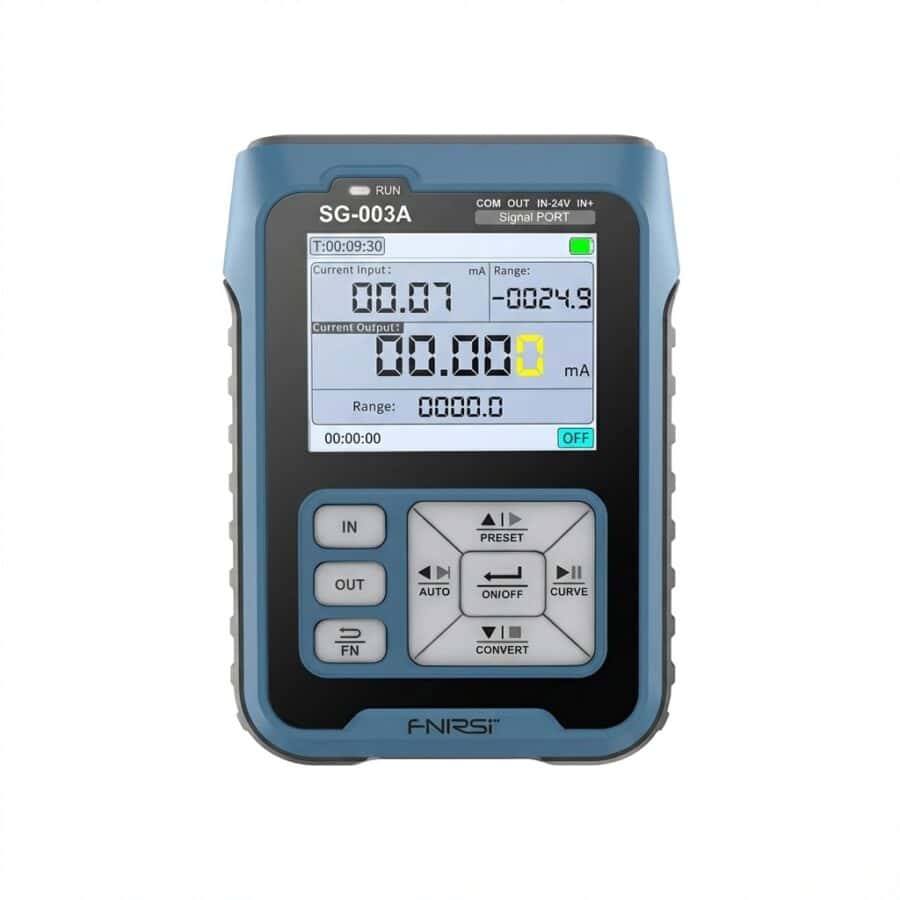
For maximum signal generator capability alongside your oscilloscope, explore handheld signal generators as dedicated instruments. These offer portable waveform generation independent of oscilloscope selection.
Pair With Other Test Equipment
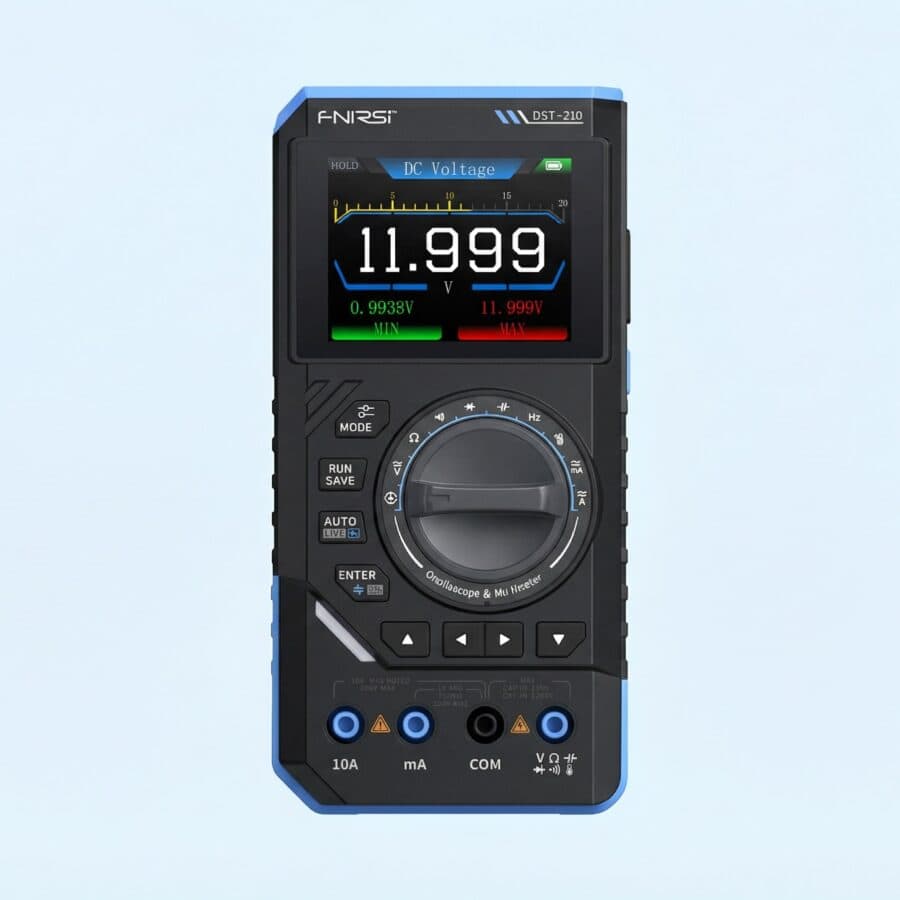
Complete your measurement setup with complementary instruments. A digital multimeter measures DC levels and resistance that oscilloscopes handle less conveniently.
Controlled power for circuits under test comes from bench power supplies. Adjustable voltage and current complement oscilloscope measurements during development.
Component verification before assembly catches faulty parts. Component testers for electronics confirm parts function correctly before circuit installation.
Quality probes ensure accurate measurements. Oscilloscope probes matched to your bandwidth prevent probes from limiting system performance.
UK Delivery and Support
Orders ship from our UK warehouse within 1-2 business days. Royal Mail delivers to most UK addresses in 24-48 hours.
Every oscilloscope with signal generator includes a 12-month guarantee and 60-day easy return period. UK consumer protection applies to every purchase, with our policies fully compliant with Distance Selling Regulations. Customer service responds within 1 business day.
Every instrument we sell is genuine FNIRSI equipment with full manufacturer warranty coverage.
Shop now to find the oscilloscope with signal generator that matches your testing requirements.
Frequently Asked Questions
Where can I find a budget oscilloscope with signal generator?
FNIRSI oscilloscopes with built-in signal generators deliver integrated stimulus-response capability at accessible prices. Our range includes handheld and tablet form factors with oscilloscope bandwidths up to 100MHz and signal generator outputs covering audio through megahertz frequencies. All models ship from our UK warehouse with fast Royal Mail delivery, 12-month guarantee, and 60-day easy returns.
What waveforms can built-in signal generators produce?
Most FNIRSI oscilloscopes with signal generators output sine waves, square waves, triangle waves, and sawtooth waves as standard. Some models include additional waveforms like pulse and noise outputs. Arbitrary waveform capability on advanced models allows custom user-defined shapes. Frequency ranges typically extend from below 1Hz to several megahertz depending on model, covering audio testing through general electronics applications.
Do I need a separate signal generator or is built-in enough?
Built-in signal generators suit most hobbyist, educational, and general repair applications. They provide convenient waveform generation without additional equipment cost or bench space. Separate signal generators offer advantages when you need higher output power, wider frequency ranges, better accuracy, or modulation capabilities beyond basic built-in functions. For most users starting out or working on general electronics projects, integrated signal generators provide sufficient capability without the added complexity and cost of separate instruments.