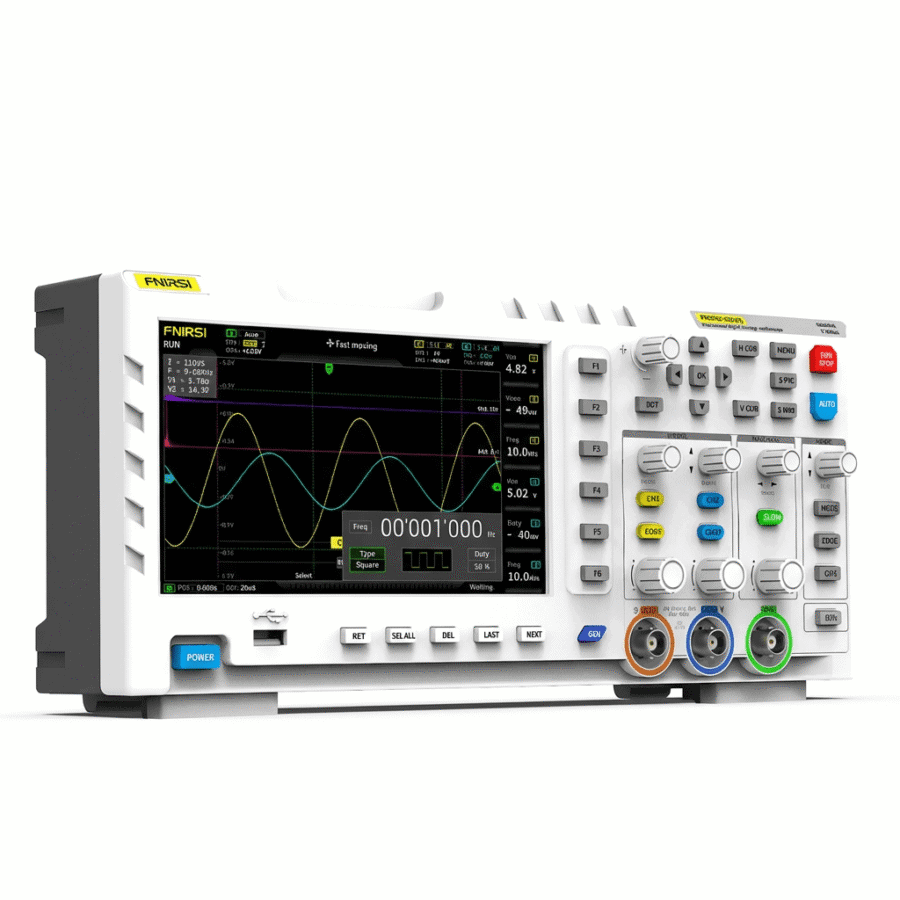
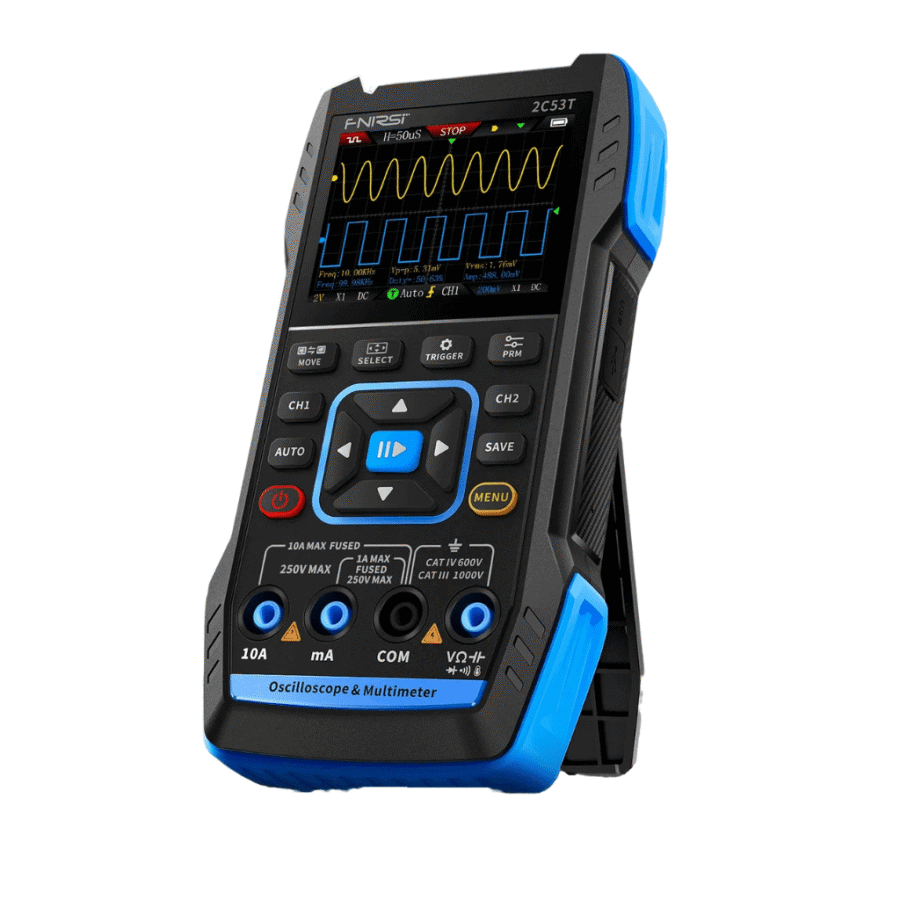
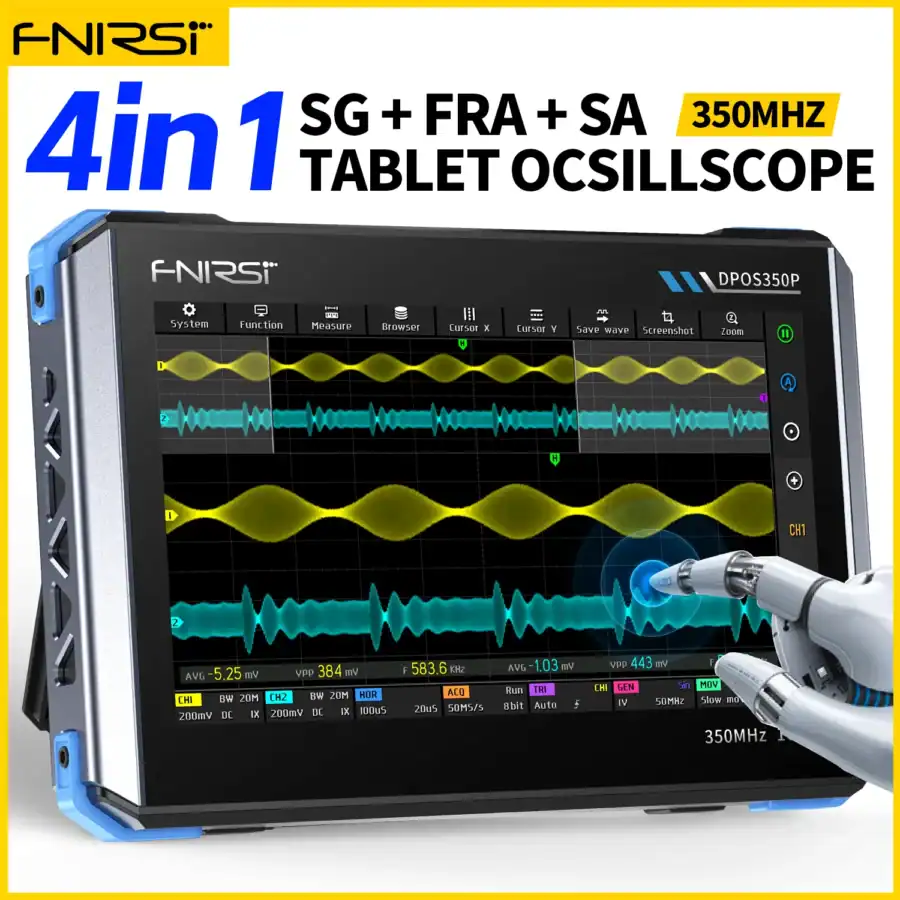
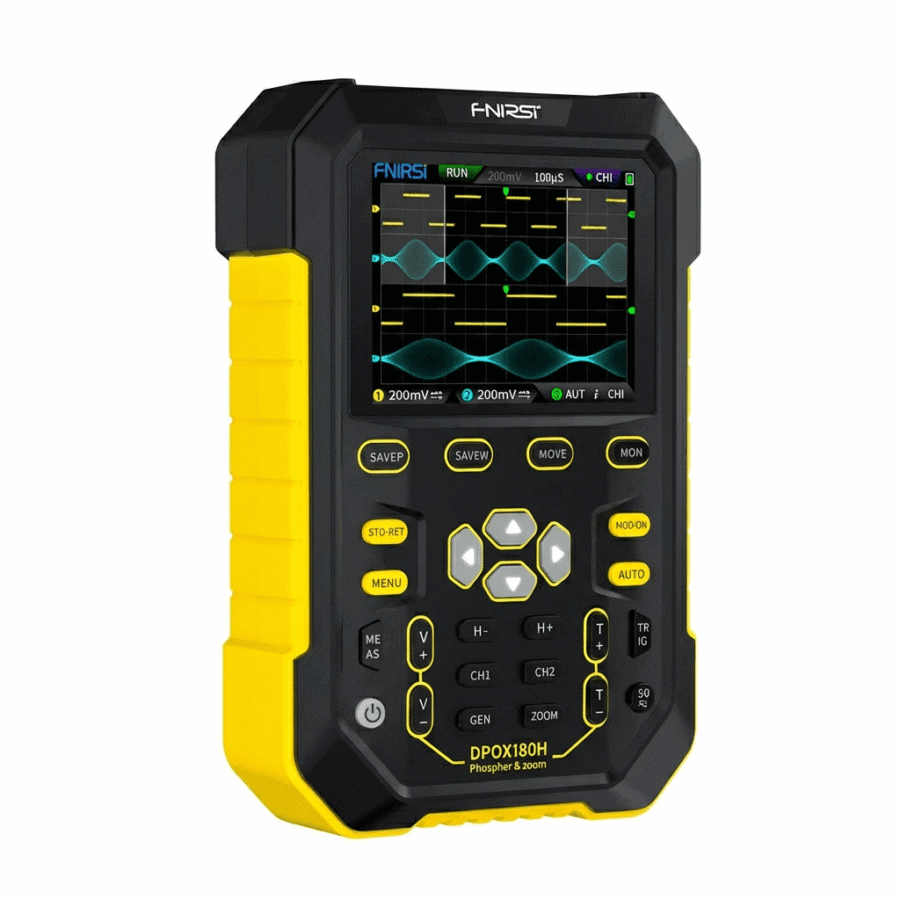
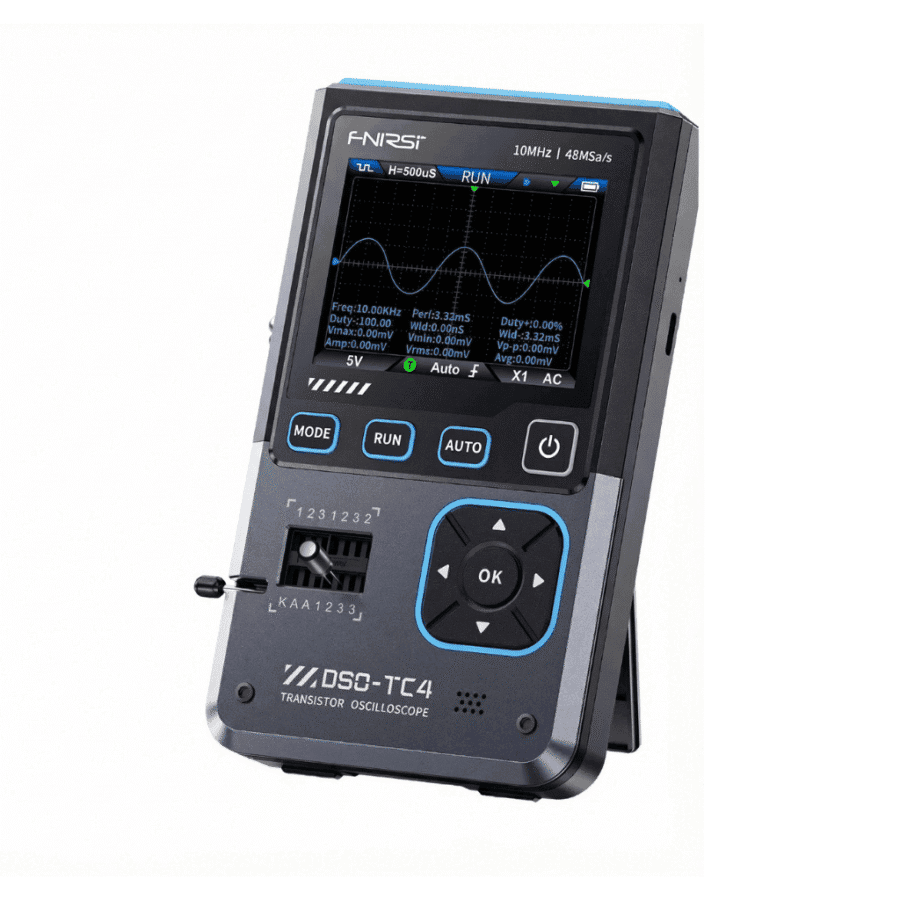
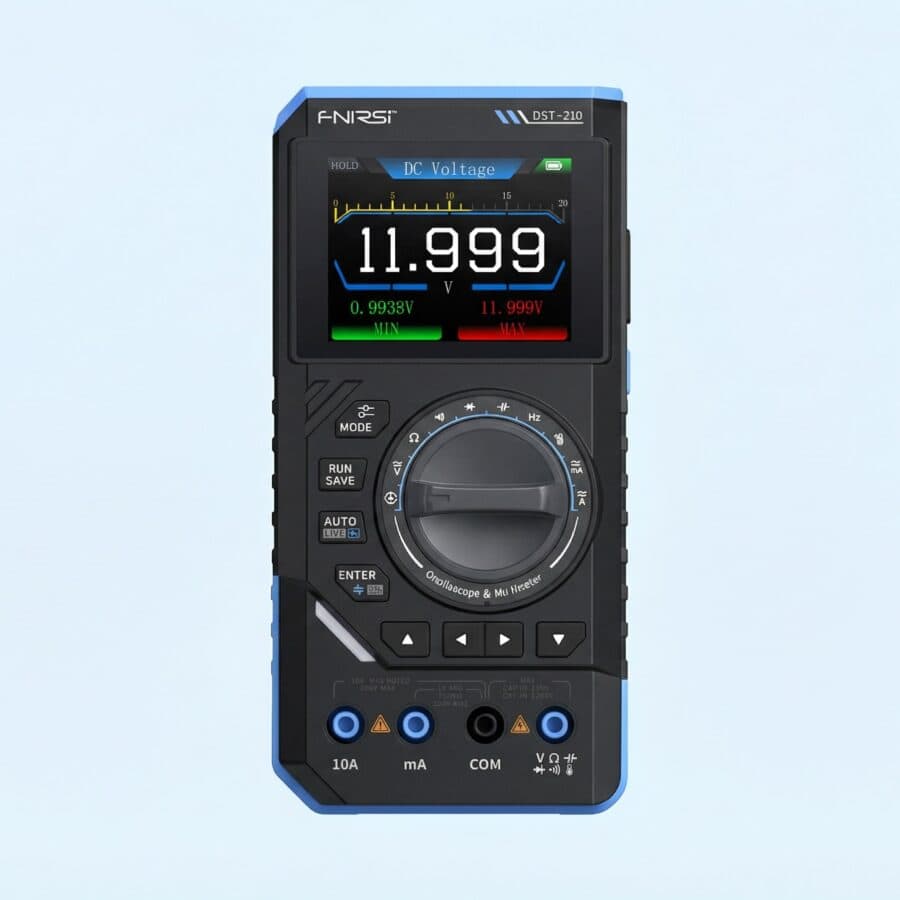
Handheld oscilloscope multimeters combine waveform display and standard multimeter functions in single portable instruments.
These 2-in-1 devices measure voltage, current, and resistance while also showing signal waveforms on built-in screens.
FNIRSI handheld oscilloscope multimeters feature oscilloscope bandwidths up to 100MHz alongside True RMS multimeter capability. Compact designs weigh under 500 grams with battery operation for portable use. One instrument replaces two, reducing cost, weight, and tool bag space.
Combined functionality transforms portable testing capability. View waveforms and measure static values without switching between separate instruments or carrying additional equipment.
Why Choose a Combined Instrument?
Reduced equipment count simplifies fieldwork. One instrument handles tasks that previously required both oscilloscope and multimeter. Less equipment to carry, connect, and manage speeds diagnosis at job sites.
Cost savings benefit budget-conscious users. Purchasing combined functionality costs less than equivalent separate instruments. This makes comprehensive test capability accessible to more users.
Workflow efficiency improves when measurements happen faster. Switch between oscilloscope and multimeter modes instantly without putting down one instrument to pick up another. Faster testing means faster diagnosis.
Space efficiency matters in tool bags and compact workspaces. A single combined instrument takes less space than two separate devices. Storage and transport become simpler.
Consistent interface reduces learning time. Master one instrument instead of two different interfaces. Similar controls and menu structures across measurement modes speed proficiency development.
Who Uses Oscilloscope Multimeters?
Field service technicians need comprehensive measurement capability in portable form. Oscilloscope multimeters provide both static readings and waveform analysis at customer sites. One instrument handles diverse diagnostic requirements.
Repair technicians working on mobile phones, laptops, and consumer electronics appreciate compact instruments that fit alongside microscopes and hot air stations. Combined devices reduce bench clutter in cramped repair spaces.
Electronics hobbyists building Arduino and Raspberry Pi projects benefit from instruments matching portable workstyles. Measure supply voltages with the multimeter, then switch to oscilloscope mode to view I2C or SPI signals.
Automotive enthusiasts diagnose vehicle electrical systems with both DC voltage measurement and waveform analysis. Check battery voltage, then view sensor signals and injector pulses without changing instruments.
Students learning electronics develop skills with both measurement types using one affordable device. Understanding relationships between static measurements and dynamic waveforms builds comprehensive diagnostic intuition.
HVAC technicians measure thermocouple outputs and control signals. Multimeter mode checks temperature sensors while oscilloscope mode verifies control board outputs.
What Functions Combine?
Oscilloscope functions display voltage versus time waveforms. View signal shapes, measure frequency and amplitude, and analyse circuit behaviour. Bandwidth ratings indicate highest measurable frequencies, typically reaching 100MHz in quality handheld devices.
DC voltage measurement checks batteries, power supplies, and bias levels. Ranges typically span millivolts through hundreds of volts for comprehensive DC testing.
AC voltage measurement with True RMS capability accurately measures non-sinusoidal waveforms from modern electronics. Switch-mode power supplies and motor drives produce waveforms that True RMS handles correctly.
Current measurement determines circuit power consumption. DC current ranges suit electronics testing. AC current measurement helps diagnose motor and transformer circuits.
Resistance measurement verifies component values and connection integrity. Continuity mode with audible beeper speeds wiring verification.
Capacitance measurement tests capacitors directly without separate instruments. Verify values before installation and check suspect components during troubleshooting.
Additional functions vary by model. Some include frequency counting, duty cycle measurement, diode testing, and temperature measurement via thermocouple input.
Key Specifications to Consider
Oscilloscope bandwidth determines measurable signal frequency range. A 100MHz oscilloscope multimeter handles most portable measurement applications including Arduino, automotive sensors, and audio circuits.
Sample rate should exceed bandwidth by at least five times for accurate waveform capture. A 100MHz bandwidth needs at least 500MSa/s sampling for proper waveform reconstruction.
Multimeter accuracy affects measurement precision. Typical handheld accuracy of ±0.5% to ±1% suits most field service and troubleshooting applications.
Display count indicates multimeter resolution. A 6000-count display shows readings like 5.999V with 1mV resolution. Higher counts provide finer resolution for precision work.
True RMS capability ensures accurate AC measurements on non-sinusoidal waveforms. This matters when measuring modern electronics with switching power supplies.
Battery life affects portable operation duration. Combined instruments may consume more power than single-function devices. Check runtime specifications against your typical work sessions.
Safety ratings matter for mains voltage work. CAT II suits electronics and appliances. CAT III covers distribution wiring. Choose ratings matching your highest-risk measurements.
Comparing Combined vs Separate Instruments
Combined instruments offer convenience, cost savings, and portability advantages. One device handles both measurement types. Less equipment to purchase, carry, and maintain.
Separate instruments may offer higher specifications in each category. A dedicated handheld oscilloscope might provide deeper memory or more advanced triggering. A dedicated handheld multimeter might offer higher accuracy or additional measurement ranges.
Most users find combined instruments provide sufficient capability for typical applications. The convenience of single-device operation outweighs modest specification differences for field service, hobby, and educational use.
Power users with demanding requirements in both categories may prefer separate optimised instruments. However, combined devices serve as excellent starting points and remain valuable even after purchasing dedicated equipment.
Popular Models
The FNIRSI 2C23T combines 100MHz oscilloscope capability with comprehensive multimeter functions. Dual-channel oscilloscope input captures two signals simultaneously. The compact handheld form factor suits field service and portable use.
The DSO-TC3 adds component testing to oscilloscope and multimeter functions. This 3-in-1 device identifies transistors, measures capacitor ESR, and tests diodes alongside standard oscilloscope and multimeter operation.
Models like these demonstrate the multifunction approach that reduces equipment count while maintaining genuine measurement capability.
Pair With Other Test Equipment
Combined instruments handle many tasks independently but work well alongside specialised tools. Signal injection requires waveform sources that handheld signal generators provide.
Component verification beyond basic testing benefits from dedicated component testers for electronics with advanced identification and measurement capability.
Controlled power for circuits under test comes from bench power supplies. Adjustable voltage and current complement oscilloscope multimeter measurements.
USB power analysis suits modern charging diagnostics. USB testers measure voltage, current, and power through USB connections.
Quality probes maximise oscilloscope performance. Oscilloscope probes matched to your bandwidth ensure accurate signal transfer.
UK Delivery and Support
Orders ship from our UK warehouse within 1-2 business days. Royal Mail delivers to most UK addresses in 24-48 hours.
Every handheld oscilloscope multimeter includes a 12-month guarantee and 60-day easy return period. UK consumer protection applies to every purchase, with our policies fully compliant with Distance Selling Regulations. Customer service responds within 1 business day.
Every instrument we sell is genuine FNIRSI equipment with full manufacturer warranty coverage.
Shop now to find the handheld oscilloscope multimeter that matches your portable testing needs.
Frequently Asked Questions
Where can I find a budget handheld oscilloscope multimeter?
FNIRSI handheld oscilloscope multimeters deliver combined functionality at accessible prices. Our range includes models with oscilloscope bandwidths up to 100MHz alongside True RMS multimeter capability with features like capacitance measurement and continuity testing. Some models add component testing for 3-in-1 functionality. All instruments ship from our UK warehouse with fast Royal Mail delivery, 12-month guarantee, and 60-day easy returns.
Is a combined oscilloscope multimeter as good as separate instruments?
Combined instruments provide genuine capability in both measurement types suitable for most field service, hobby, and educational applications. Dedicated single-function instruments may offer higher specifications like deeper oscilloscope memory or higher multimeter accuracy. For typical portable use, combined instruments deliver practical performance while reducing cost, weight, and complexity. Most users find combined devices sufficient for their needs, with separate instruments becoming worthwhile only when specific advanced requirements arise.
What is the advantage of having both oscilloscope and multimeter in one device?
The primary advantage is convenience. Switch between waveform viewing and static measurement instantly without changing instruments. Carry one device instead of two. Spend less overall than purchasing equivalent separate equipment. Learn one interface rather than two. For field service, repair work, and portable testing, these benefits translate to faster diagnosis with less equipment to manage. The integrated approach suits users who need both measurement types regularly but do not require the highest specifications available in either category.