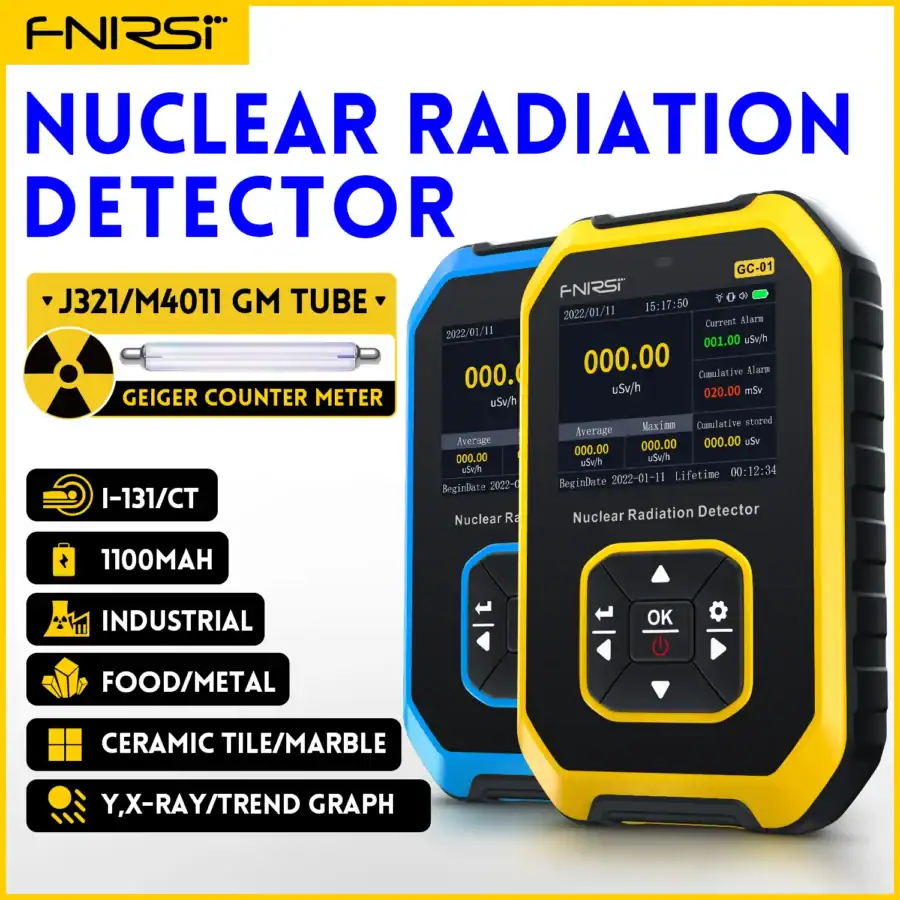
These handheld devices display radiation levels instantly, helping you identify sources and assess exposure risks.
FNIRSI radiation detectors use Geiger-Müller tubes to detect alpha, beta, gamma, and X-ray radiation. The detector counts radioactive particles and displays readings in standard units like microsieverts per hour (μSv/h) or counts per minute (CPM). Built-in alarms alert you when radiation exceeds safe thresholds.
Electromagnetic field meters measure non-ionising radiation from electrical equipment, power lines, and wireless devices. These EMF detectors display field strength in milligauss (mG) or microtesla (μT) for magnetic fields and volts per metre (V/m) for electric fields.
Why Measure Radiation?
Background radiation exists everywhere. Natural sources include cosmic rays, radon gas from soil, and radioactive minerals in building materials. Knowing your baseline helps you identify unusual readings that warrant investigation.
Ionising radiation at high levels damages living cells. Geiger counters help you verify that environments remain within safe exposure limits. This matters when working with radioactive materials, assessing property, or satisfying personal curiosity about your surroundings.
Electromagnetic fields from household electronics, WiFi routers, mobile phone masts, and power infrastructure concern many people. EMF meters let you measure actual field strengths rather than guessing about exposure levels.
Antique collectors use radiation detectors to test vintage items. Some older products contain radioactive materials including uranium glass, radium dial watches, and certain ceramic glazes. A quick scan confirms whether items require special handling.
Who Uses Radiation Detectors?
Homeowners test properties for radon gas accumulation and general background radiation. Radon is the second leading cause of lung cancer after smoking. Elevated readings indicate the need for ventilation improvements.
Mineral collectors and geology enthusiasts identify radioactive specimens in their collections. Uranium ore, thorite, and autunite samples emit detectable radiation. A Geiger counter adds scientific measurement to the hobby.
Urban explorers and abandoned building investigators check locations before entry. Former industrial sites, hospitals, and research facilities may contain residual contamination.
Electronics hobbyists experiment with radioactive sources for education and projects. Cloud chambers, scintillation detectors, and nuclear physics experiments require accurate radiation measurement.
Health-conscious individuals monitor EMF exposure in homes and workplaces. Concerns about long-term effects from wireless technology and electrical infrastructure drive interest in personal EMF measurement.
First responders and security personnel screen for radiological hazards. Portable Geiger counters provide immediate field assessment capability.
Types of Radiation Detectors
Geiger counters detect ionising radiation using gas-filled tubes. When radiation passes through the tube, it ionises the gas and creates an electrical pulse. The detector counts these pulses and converts them to dose rate readings. Geiger counters detect gamma rays reliably and beta particles with varying sensitivity depending on tube design.
EMF meters measure electromagnetic field strength from electrical and wireless sources. Separate sensors detect electric fields and magnetic fields. Some meters measure radio frequency radiation from mobile phones, WiFi, and broadcast transmitters.
Combination devices include both Geiger counter and EMF meter functions in a single handheld unit. These provide comprehensive environmental monitoring without carrying multiple instruments.
Dosimeters track cumulative radiation exposure over time. Unlike Geiger counters that show instantaneous readings, dosimeters record total dose received during a period. This suits occupational monitoring and long-term environmental assessment.
Key Specifications to Consider
Radiation types detected vary between models. Basic Geiger counters detect gamma and high-energy beta radiation. Advanced models with end-window tubes also detect lower-energy beta and alpha particles. Check that the detector covers the radiation types you need to measure.
Measurement range determines the highest and lowest readings the device can display. A range from 0.01 μSv/h to several mSv/h covers most civilian applications from background monitoring to identifying significant contamination.
Sensitivity affects how quickly the detector responds to radiation sources. Higher sensitivity means faster detection of low-level sources and more accurate readings in short measurement periods.
Alarm thresholds let you set warning levels for automatic alerts. Audible and visual alarms notify you immediately when radiation exceeds your chosen limit.
Data logging records measurements over time for later analysis. This helps track environmental changes and document survey results.
Understanding Radiation Units
Microsieverts per hour (μSv/h) express dose rate accounting for biological effect. Normal background radiation ranges from 0.1 to 0.3 μSv/h in most locations. Readings above 0.5 μSv/h may warrant investigation.
Counts per minute (CPM) show raw detector output without conversion to dose. CPM readings vary with detector sensitivity, so they suit relative comparisons rather than absolute dose assessment.
Millisieverts (mSv) measure cumulative dose. Annual background exposure averages 2-3 mSv for most people. Medical imaging adds variable amounts depending on procedure type.
Milligauss (mG) and microtesla (μT) measure magnetic field strength. Household appliances typically produce fields from 0.1 to several hundred milligauss depending on distance and device type.
Pair With Other Test Equipment
Radiation detectors complement other environmental monitoring tools. When investigating electrical installations, a digital multimeter measures voltage, current, and continuity in wiring systems.
For troubleshooting electronic equipment that may produce interference, a handheld oscilloscope reveals signal characteristics and noise sources.
Browse our full range of electronic test equipment for comprehensive diagnostic capabilities across multiple applications.
UK Delivery and Support
Orders ship from our UK warehouse within 1-2 business days. Royal Mail delivers to most UK addresses in 24-48 hours.
Every radiation detector includes a 12 month guarantee and 60 day easy return period. UK consumer protection applies to every purchase, with our policies fully compliant with Distance Selling Regulations. Customer service responds within 1 business day.
Every radiation detector we sell is genuine FNIRSI equipment with full manufacturer warranty coverage.
Shop now to find the radiation detector that matches your monitoring requirements.
Frequently Asked Questions
Where can I find a budget radiation detector?
FNIRSI radiation detectors offer reliable measurement capability at accessible prices. Our range includes Geiger counters for ionising radiation, EMF meters for electromagnetic fields, and combination devices covering both. All models feature clear displays and adjustable alarm thresholds. Orders ship from our UK warehouse with fast Royal Mail delivery, 12 month guarantee, and 60 day easy returns.
Are radiation detectors safe to use?
Radiation detectors are completely safe. They passively measure existing radiation in your environment without producing any radiation themselves. The Geiger-Müller tube simply detects particles that are already present. You can safely use these devices anywhere including homes, workplaces, and outdoor locations.
What is a normal background radiation reading?
Normal background radiation typically ranges from 0.1 to 0.3 microsieverts per hour (μSv/h) in most UK locations. Readings vary based on local geology, altitude, building materials, and proximity to natural radioactive sources. Granite areas and higher altitudes tend toward the upper end of normal ranges. Consistent readings significantly above 0.5 μSv/h may warrant further investigation.