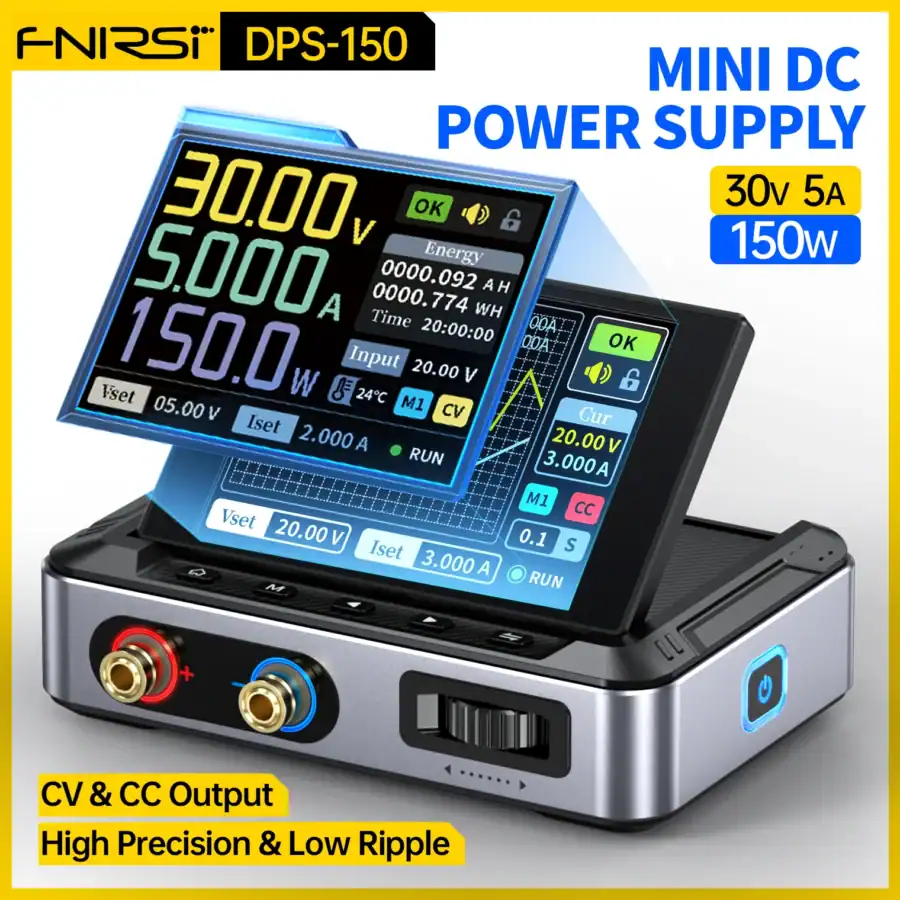
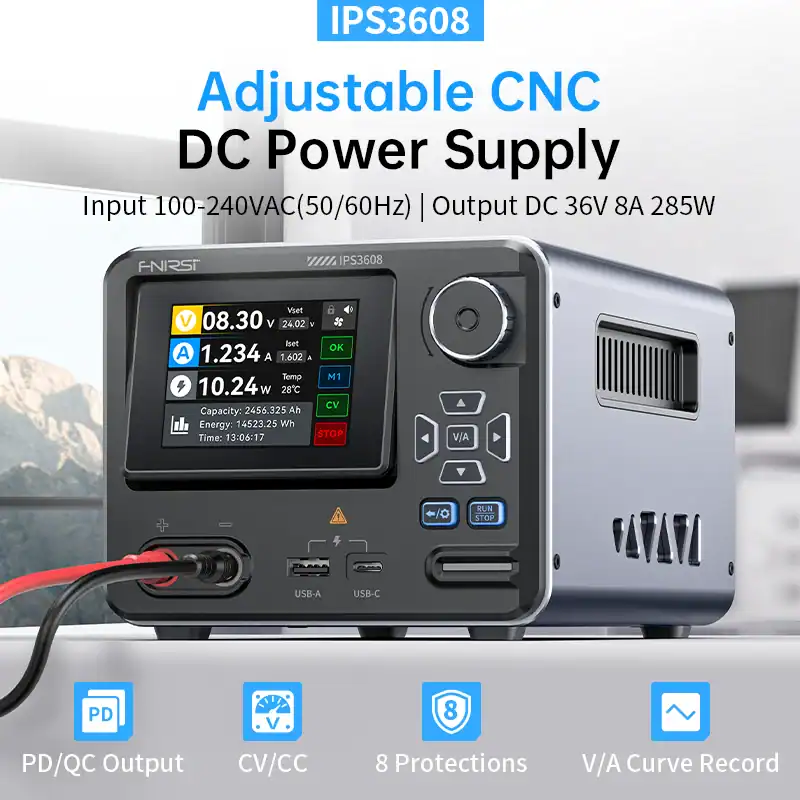
Essential workbench tools replace batteries and fixed adapters with precisely controlled power that you can adjust to match any circuit requirement.
FNIRSI bench power supplies feature digital displays showing voltage and current simultaneously. Adjustable output ranges cover common electronics needs from millivolts to 30V or higher. Current limiting protects your circuits by preventing excessive current flow that could damage components.
Every electronics workbench benefits from a proper bench power supply. Variable output lets you test circuits at different voltages. Current limiting prevents damage during development. Precise readouts confirm exactly what power your circuit receives.
How Bench Power Supplies Work
The power supply converts mains AC to regulated DC output. Linear power supplies use transformers and linear regulators to produce clean, low-noise output. Switch-mode power supplies use high-frequency switching for efficient conversion in compact packages.
Voltage regulation maintains constant output regardless of load changes. When your circuit draws more current, the power supply compensates to keep voltage stable. Quality supplies maintain regulation within millivolts across their full current range.
Current limiting restricts maximum output current to your chosen value. When a circuit tries to draw more than the limit, the supply reduces voltage to maintain safe current. This protects both the supply and your circuit from overcurrent damage.
Constant voltage mode maintains set voltage while current varies with load demand. Constant current mode maintains set current while voltage adjusts automatically. Most bench work uses constant voltage mode with current limiting as protection.
Why Adjustable Power Matters
Different circuits require different voltages. A 3.3V microcontroller needs different power than a 12V motor driver or 24V industrial sensor. Adjustable output lets one supply serve all these applications.
Testing at various voltages reveals circuit behaviour across operating conditions. You can verify that circuits function correctly at minimum and maximum specified voltages. This catches problems before they affect real-world performance.
Current monitoring shows how much power your circuit consumes. This information helps select appropriate batteries, design power distribution, and identify faults. Excessive current often indicates shorts or failed components.
Overcurrent protection saves components during development. Wiring errors and component failures happen during prototyping. Current limiting contains damage to the fault location rather than destroying entire circuits.
Who Uses Bench Power Supplies?
Electronics hobbyists power Arduino, Raspberry Pi, and custom projects during development. Adjustable voltage matches any project requirement. Current monitoring reveals power consumption for battery selection.
Students learning electronics explore voltage and current relationships hands-on. Adjustable supplies demonstrate Ohm’s law practically. Current limiting prevents expensive mistakes while skills develop.
Repair technicians power devices under test without original adapters. Adjustable output matches any equipment requirement. Current limiting protects partially functioning devices during diagnosis.
Product developers test prototypes across voltage ranges and load conditions. Programmable supplies automate test sequences. Data logging records performance for analysis and documentation.
Battery charger designers need precise voltage and current control. Bench supplies simulate charging profiles for development and testing. Current monitoring verifies charge algorithms perform correctly.
LED lighting designers test strips and modules at various drive currents. Current control sets exact brightness levels. Voltage readout confirms forward voltage across LED strings.
Types of Bench Power Supplies
Single output supplies provide one adjustable channel. These suit most hobbyist and repair applications where one voltage serves the circuit under test. Compact designs save bench space.
Dual output supplies offer two independent channels. These power circuits requiring multiple voltages simultaneously. Positive and negative outputs enable split-rail supply for operational amplifiers and audio circuits.
Triple output supplies typically provide two adjustable channels plus a fixed 5V or 3.3V output. The fixed channel powers logic while adjustable channels serve analogue sections.
Programmable supplies accept commands via USB or other interfaces. Software control enables automated testing, voltage sequencing, and data logging. These suit production testing and automated development workflows.
Portable power supplies operate from batteries or USB power. Compact designs suit field work and locations without mains power. Lower output power limits applications compared to mains-powered units.
Key Specifications to Consider
Voltage range must cover your highest expected requirement. Common ranges include 0-30V and 0-60V. Higher voltage supplies suit industrial and automotive applications. Most hobbyist work stays within 0-30V.
Current capacity determines maximum load. Small supplies provide 2-3A suitable for microcontroller projects. Larger supplies offer 5-10A for motor testing and higher power applications. Match capacity to your heaviest expected load.
Output power limits total watts available. A 30V 5A supply provides up to 150W maximum. Output power may limit combinations of voltage and current below individual maximums.
Resolution affects adjustment precision. Coarse adjustment suits general use. Fine resolution suits precision applications requiring exact voltage settings. Four-digit displays show millivolt resolution.
Noise and ripple matter for sensitive circuits. Linear supplies produce very low noise suitable for analogue and RF work. Switch-mode supplies offer efficiency but may introduce measurable ripple.
Protection features safeguard your work. Overvoltage protection prevents output exceeding safe levels. Overtemperature protection shuts down before damage occurs. Reverse polarity protection survives connection errors.
Power Supply Accessories
Banana plug leads connect supplies to breadboards and test points. Quality leads with proper current ratings ensure reliable connections. Multiple colours help identify positive and negative connections.
Binding post adapters convert banana outputs to other connector types. Alligator clips suit temporary connections. Probe tips reach small test points. Spade lugs connect to screw terminals.
Extension cables reach distant test locations. Heavier gauge cables prevent voltage drop at higher currents. Keep cables as short as practical for best regulation.
Pair With Other Test Equipment
Verify circuit operation with proper measurement instruments. A digital multimeter confirms voltage at the circuit and measures current consumption independently.
For signal analysis during powered testing, a digital oscilloscope shows waveform behaviour and power supply ripple effects.
Signal injection testing requires waveform sources. Handheld signal generators produce test signals while your bench supply powers the circuit under test.
Component verification before installation prevents wasted effort. Component testers for electronics confirm parts function correctly before applying power.
UK Delivery and Support
Orders ship from our UK warehouse within 1-2 business days. Royal Mail delivers to most UK addresses in 24-48 hours.
Every bench power supply includes a 12-month guarantee and 60-day easy return period. UK consumer protection applies to every purchase, with our policies fully compliant with Distance Selling Regulations. Customer service responds within 1 business day.
Every power supply we sell is genuine FNIRSI equipment with full manufacturer warranty coverage.
Shop now to find the bench power supply that matches your electronics work.
Frequently Asked Questions
Where can I find a budget bench power supply?
FNIRSI bench power supplies deliver adjustable voltage and current control at accessible prices. Our range includes compact single-output supplies for hobbyist workbenches through higher-power units for demanding applications. Features include digital displays, fine adjustment controls, and overcurrent protection. All models ship from our UK warehouse with fast Royal Mail delivery, 12-month guarantee, and 60-day easy returns.
What voltage and current capacity do I need?
A 30V 5A supply handles most hobbyist and repair applications comfortably. This powers everything from 3.3V microcontrollers to 24V industrial sensors with current capacity for small motors and LED strips. Choose higher voltage if you work with automotive systems or industrial equipment. Choose higher current capacity for motor testing, battery charging, or high-power LED applications. Most beginners find 30V 3A sufficient for learning and typical projects.
What is the difference between linear and switch-mode power supplies?
Linear power supplies use transformers and linear regulators for very clean, low-noise output. They suit sensitive analogue circuits, audio equipment, and RF applications where noise matters. Switch-mode power supplies use high-frequency switching for efficient, compact designs. They generate more output noise but cost less and run cooler. For most digital electronics, microcontroller projects, and general testing, switch-mode supplies perform perfectly well at lower cost.