Component testers identify and measure electronic parts automatically.
These instruments determine component type, measure values, and identify pinouts without manual setup, making component verification fast and reliable.
FNIRSI component testers detect transistors, MOSFETs, diodes, capacitors, resistors, and inductors automatically. Insert the component into the test socket and press the button. The tester identifies what it is, displays the pinout, and shows measured parameters within seconds.
Verifying components before circuit assembly prevents frustrating debugging sessions. A quick test confirms that parts match expected values and function correctly before you solder them to your project.
How Component Testers Work
The tester applies test signals and measures component response. Software algorithms analyse the measurements to determine component type. The display shows identification results and measured values.
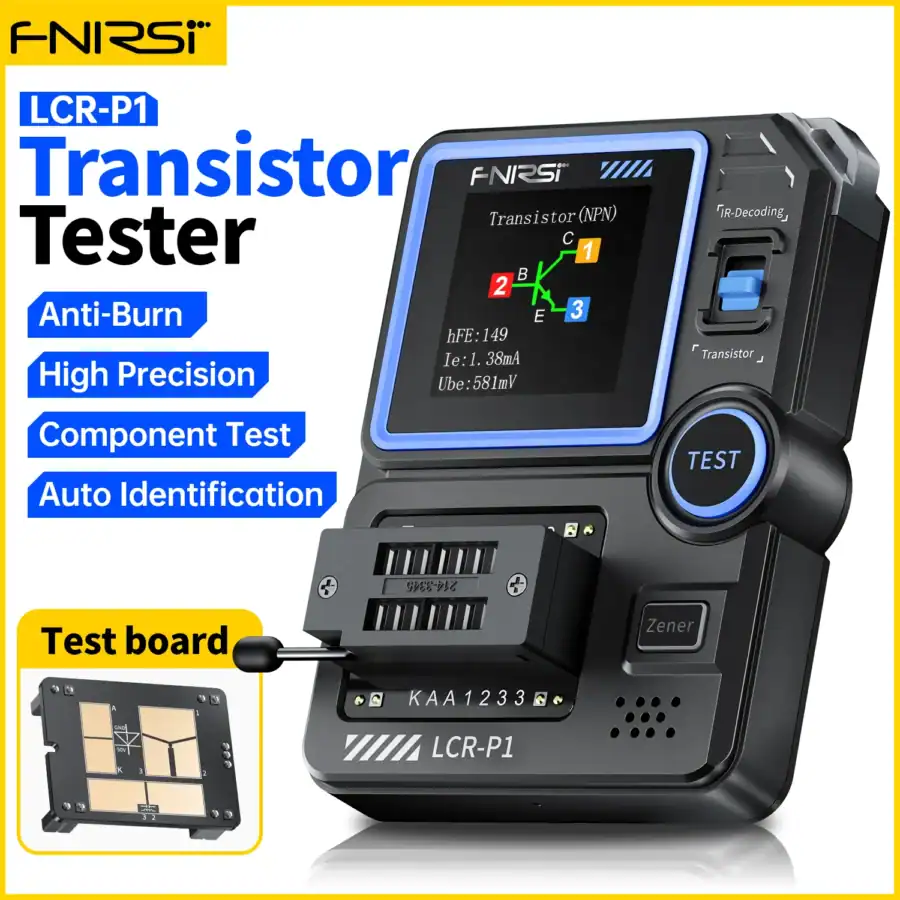
For transistors and MOSFETs, the tester determines whether the device is NPN, PNP, N-channel, or P-channel. It identifies base, collector, and emitter pins or gate, drain, and source pins automatically. Gain measurements indicate transistor health.
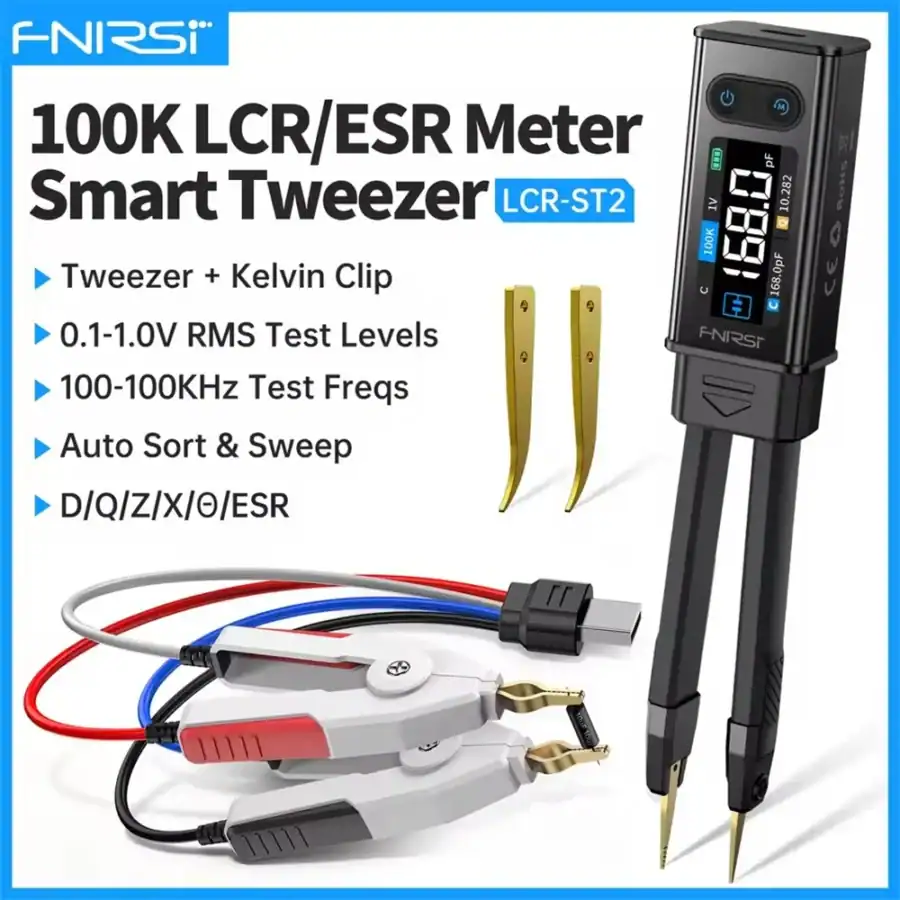
For capacitors, the tester measures capacitance value and equivalent series resistance. ESR measurement reveals degraded electrolytic capacitors that capacitance testing alone might miss. This identifies components that measure correct capacitance but fail under load.
For resistors and inductors, the tester measures resistance or inductance values directly. Accuracy depends on measurement range and component value.
Diodes display forward voltage drop and identify standard diodes, Zener diodes, and LED types. Multiple junction detection identifies transistors misidentified as back-to-back diodes.
Why Component Testing Matters
Unknown components become identifiable. Salvaged parts, unmarked devices, and components with rubbed-off markings reveal their identity under test. This enables reuse of recovered components and identification of mystery parts.
Counterfeit detection catches fake components. Transistors that measure as diodes, capacitors with incorrect values, and parts that simply fail testing indicate potential counterfeits before they cause circuit problems.
Quality verification confirms parts meet specifications. Batch variations, storage degradation, and handling damage affect component parameters. Testing before assembly catches out-of-spec parts.
Fault diagnosis identifies failed components. When circuits malfunction, testing individual parts locates the failure. ESR testing particularly helps find degraded capacitors in power supply repairs.
Sorting mixed components organises unknown parts. Component drawers accumulate unmarked resistors, unidentified transistors, and mystery capacitors. A component tester sorts these into usable, organised stock.
Who Uses Component Testers?
Electronics hobbyists verify components for Arduino, Raspberry Pi, and DIY projects. Quick testing confirms resistor values before installation. Transistor testing ensures correct part selection for amplifier stages.
Repair technicians diagnose faults in consumer electronics, appliances, and industrial equipment. Capacitor ESR testing locates failed electrolytics in power supplies. Transistor testing confirms semiconductor health in amplifier and switching circuits.
Students learning electronics develop understanding of component behaviour. Testing different transistors shows gain variations. Comparing capacitor types demonstrates ESR differences. Hands-on measurement reinforces theoretical knowledge.
Vintage equipment restorers verify aged components before reuse. Old capacitors often fail ESR tests despite measuring correct capacitance. Transistor testing confirms whether original semiconductors still function.
Kit builders verify components before assembly. Identifying unlabelled resistors prevents assembly errors. Testing transistors confirms correct devices before permanent installation.
Salvage enthusiasts recover usable parts from discarded equipment. Component testing separates working parts from failures. Building component stock from salvage requires reliable identification and verification.
Types of Component Testers
Transistor testers focus on semiconductor identification. These detect transistors, MOSFETs, diodes, and related devices. Basic models identify type and pinout. Advanced models measure gain, threshold voltage, and other parameters.
LCR meters measure inductance, capacitance, and resistance with high precision. These suit users needing accurate passive component measurement beyond basic verification. Models like the LCR-P1 achieve 0.1% accuracy for demanding applications.
ESR meters specialise in capacitor equivalent series resistance measurement. These excel at identifying degraded electrolytic capacitors in repair applications. Some measure capacitance simultaneously for complete capacitor evaluation.
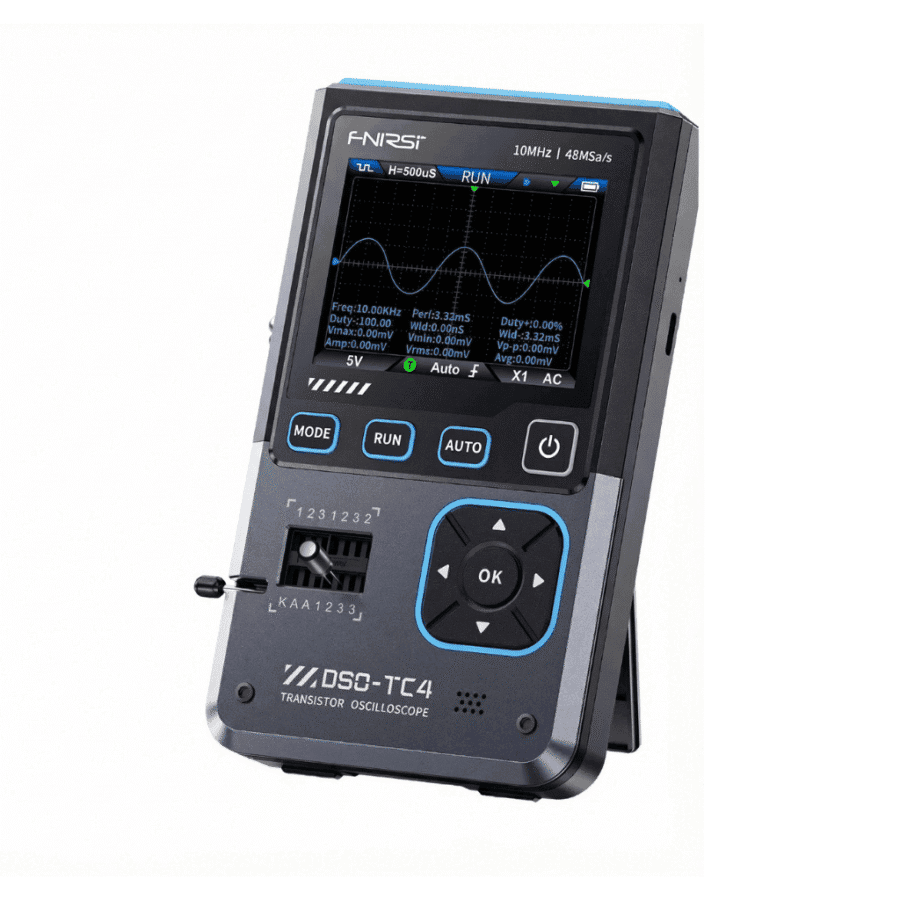
Multifunction testers combine component testing with other functions. The DSO-TC3 includes component testing alongside oscilloscope and multimeter capability. These reduce the number of separate instruments required.
For signal measurement alongside component testing, explore handheld oscilloscope multimeters combining waveform display with test functions.
Key Specifications to Consider
Component types supported vary between testers. Basic models identify transistors, diodes, capacitors, and resistors. Advanced models add MOSFETs, thyristors, triacs, inductors, and other device types. Check that your typical components are covered.
Measurement ranges determine which component values the tester handles. Capacitance ranges from picofarads to millifarads suit different applications. Resistance ranges should cover your typical component values.
Accuracy matters for precision work. Basic testers provide identification and approximate values. LCR meters offer specified accuracy percentages for calibrated measurement.
ESR measurement capability helps capacitor testing significantly. Not all component testers include ESR. For repair work involving electrolytic capacitors, ESR measurement proves invaluable.
Display type affects usability. Graphic displays show component symbols and pinout diagrams clearly. Larger screens improve readability. Backlit displays help in dim lighting.
Test socket design determines which component packages fit. ZIF sockets accept various lead configurations. Some testers include multiple socket types or external probe connections.
Measurement Applications
Transistor matching selects devices with similar gain for matched pairs. Differential amplifiers and current mirrors perform better with matched transistors. Testing multiple devices finds pairs with closest parameters.
Capacitor replacement selection verifies substitutes match original specifications. Capacitance and ESR both matter for proper circuit function. Testing confirms replacements meet requirements.
Inductor verification confirms values for filter and power supply applications. Unmarked inductors reveal their values under test. Damaged inductors show open or shorted readings.
Diode testing verifies forward voltage and identifies device types. Zener voltage measurement helps sort unmarked Zener diodes. LED testing confirms function and colour.
Unknown component identification reveals part types from salvage or unmarked stock. Insert the mystery component and let the tester determine what it is.
Pair With Other Test Equipment
Component testing complements circuit-level measurement. A digital multimeter measures voltage, current, and resistance in assembled circuits where component testers cannot reach.
Signal verification after assembly requires waveform analysis. A digital oscilloscope shows circuit behaviour with installed components under operating conditions.
Portable measurement setups benefit from handheld oscilloscopes alongside component testers for complete field diagnosis capability.
Circuit development needs controlled power. Bench power supplies provide adjustable voltage and current for testing circuits with verified components installed.
UK Delivery and Support
Orders ship from our UK warehouse within 1-2 business days. Royal Mail delivers to most UK addresses in 24-48 hours.
Every component tester includes a 12-month guarantee and 60-day easy return period. UK consumer protection applies to every purchase, with our policies fully compliant with Distance Selling Regulations. Customer service responds within 1 business day.
Every component tester we sell is genuine FNIRSI equipment with full manufacturer warranty coverage.
Shop now to find the component tester that matches your electronics work.
Frequently Asked Questions
Where can I find a budget component tester?
FNIRSI component testers deliver automatic identification and measurement at accessible prices. Our range includes basic transistor testers for hobbyist use through precision LCR meters for demanding applications. Features include automatic component detection, pinout identification, and ESR measurement on supported models. All testers ship from our UK warehouse with fast Royal Mail delivery, 12-month guarantee, and 60-day easy returns.
Can a component tester identify any electronic part?
Component testers identify common passive and semiconductor devices including transistors, MOSFETs, diodes, capacitors, resistors, and inductors. They cannot identify integrated circuits, microcontrollers, or complex multi-pin devices. Some specialised components like certain thyristors and triacs require advanced testers for proper identification. For most hobby and repair work, standard component testers cover the vast majority of parts you need to identify and verify.
What is ESR and why does it matter for capacitors?
ESR stands for equivalent series resistance, representing internal resistance within a capacitor. Ideal capacitors have zero ESR, but real capacitors always have some internal resistance. Electrolytic capacitors develop higher ESR as they age and degrade. A capacitor can measure correct capacitance while having ESR too high for proper circuit function. ESR testing catches these degraded capacitors that capacitance measurement alone would miss. This makes ESR measurement essential for power supply repair and reliability verification.