Fnirsi 1013D Review: Full Hands-On Evaluation
If you’re searching for a truly portable oscilloscope that you can carry into the garage, take to a friend’s workshop, or use anywhere without mains power, the Fnirsi 1013D deserves your attention. I’ve spent considerable time testing this tablet-style digital storage oscilloscope, and I want to give you a completely honest assessment of what this budget-friendly device can and cannot do.
The Fnirsi 1013D has generated significant discussion in the electronics community—praised by some for its portability and value, criticised by others for its exaggerated specifications. In this comprehensive review, I’ll cut through the marketing claims and show you exactly what you’re getting for your money, so you can decide if it’s the right tool for your needs.
Key Takeaways
- Actual bandwidth is 20-30 MHz (not 100 MHz as advertised)
- Real-time sampling rate is 200 MSa/s (not 1 GSa/s as claimed)
- 7-inch touchscreen tablet design with built-in 6000mAh battery
- Battery power provides ground isolation for safer automotive and SMPS work
- 50mV/div minimum sensitivity limits low-voltage measurements
- Ideal for automotive diagnostics, Arduino projects, and basic electronics
- Not suitable for professional precision work or signals above 20 MHz
Order your 1013D today – 2-day UK delivery, 60-day easy returns
Check the manual for 1013D
Overview of the Fnirsi 1013D Digital Oscilloscope
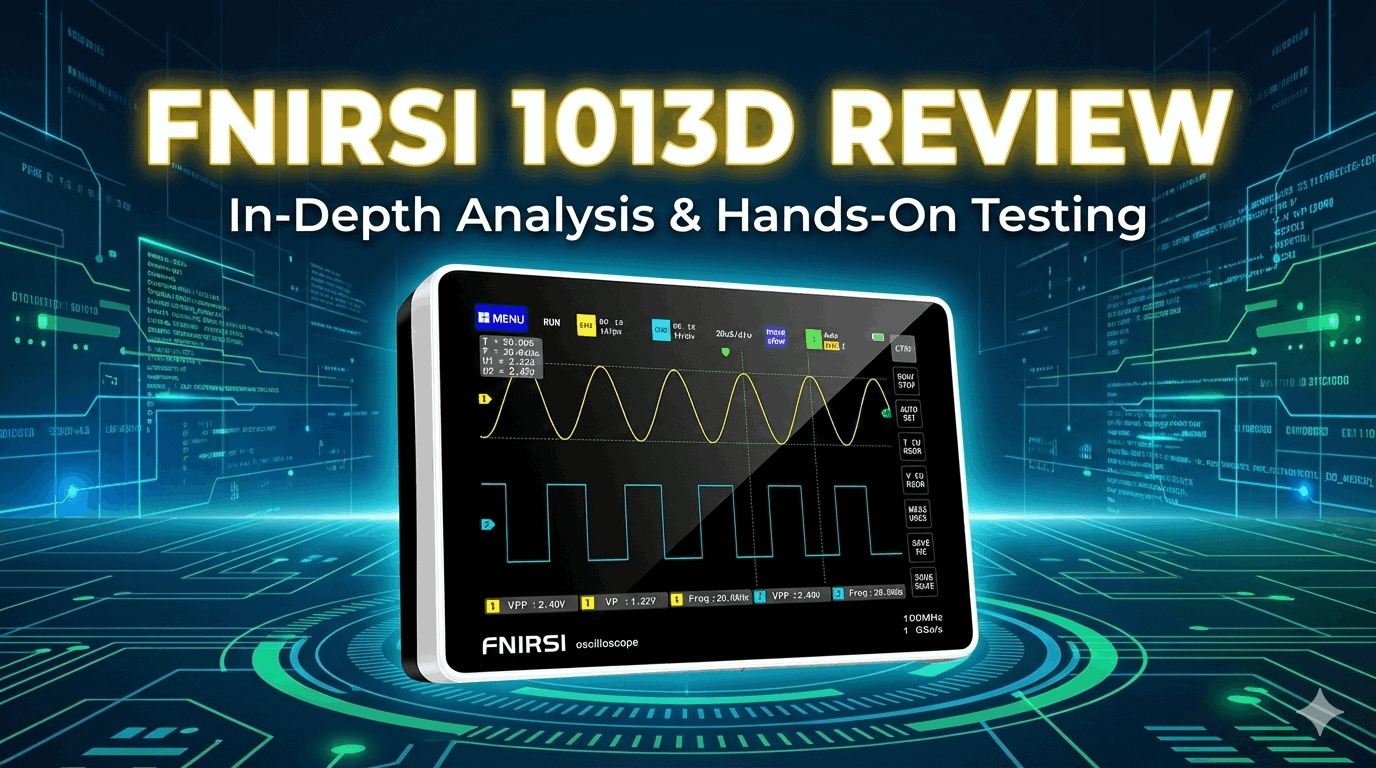
The Fnirsi 1013D positions itself as a portable, tablet-style oscilloscope aimed at hobbyists, automotive technicians, students, and field service engineers. What sets it apart from traditional benchtop oscilloscopes is its completely self-contained design—a 7-inch touchscreen, built-in battery, and no requirement for mains power.
At £125.00 from the FNIRSI Oscilloscope Store, it sits at the budget end of the portable oscilloscope market. For context, comparable handheld units from established brands like Owon or Micsig typically cost £200-400 or more.
The device features a large 7-inch capacitive touchscreen that dominates the front panel, giving it a modern tablet-like appearance. Unlike traditional oscilloscopes with physical knobs and buttons, the 1013D relies almost entirely on touch controls, with only a power switch as a physical control. This design choice makes it intuitive for beginners familiar with smartphones and tablets, though it takes some adjustment for those accustomed to conventional oscilloscope interfaces.
Key Specifications of the Fnirsi 1013D
Before diving into real-world performance, let me outline what Fnirsi claims this oscilloscope can do. As with other budget instruments, some specifications require careful interpretation, and I’ll explain exactly where reality differs from marketing.
Display and Interface
The 7-inch TFT LCD offers 800×480 pixel resolution with a capacitive touchscreen that responds quickly and accurately to touch inputs. The display is bright, clear, and genuinely impressive for this price point—you can easily read waveforms and measurement values even in well-lit environments.
The touch-based interface eliminates physical knobs entirely, which has both advantages and disadvantages. On the positive side, the screen is highly responsive and the gesture-based controls feel modern and intuitive. On the negative side, some functions require non-obvious gestures—for example, changing the time base requires tapping specific sides of the screen rather than using a slider or menu, which is difficult to discover without reading the manual.
The interface includes dedicated on-screen areas for channel controls, trigger settings, and measurements. You can track 12 parameters simultaneously (Vpp, Vavg, frequency, duty cycle, etc.) and use both horizontal and vertical cursors for manual signal analysis.
Channel Count, Bandwidth, and Sampling Rate
Here’s where I need to be completely transparent, because this is where the Fnirsi 1013D’s marketing becomes problematic.
What Fnirsi claims:
- 2 channels with 100 MHz bandwidth
- 1 GSa/s (GigaSample per second) sampling rate
What testing actually reveals:
- Actual usable bandwidth is closer to 20-30 MHz
- Real-time sampling rate is approximately 200 MSa/s, not 1 GSa/s
Let me explain why this matters. The “1 GSa/s” figure is achieved through equivalent-time sampling, which only works with stable, repetitive signals. For single-shot events or capturing glitches, you’re limited to the actual real-time rate of around 200 MSa/s. Expert testing, including analysis by Dave Jones of EEVBlog, confirms that the advertised specifications are significantly overstated.
Regarding bandwidth, while Fnirsi advertises 100 MHz, multiple independent tests show actual performance closer to 20-30 MHz. At 100 MHz, signals become so attenuated and distorted that the scope cannot accurately process them. The frequency counter becomes unreliable, and waveforms appear “wonky” or fail to trigger properly.
Hardware teardowns reveal the reason: the device uses two AD9288 ADC chips (often with their markings scratched off), which are typically rated for 100 MSPS each. Combined, they can achieve approximately 200 MSa/s—exactly one-fifth of the advertised specification.
Now, before dismissing the device entirely, consider this: for Arduino projects, automotive diagnostics, audio work, and basic electronics repair, you’ll rarely need to measure anything above 20 MHz. Most automotive sensors operate well below 1 MHz. Audio signals are comfortably within range. It’s only when you push into higher frequencies that the limitations become apparent.
Memory Depth and Triggering Features
The Fnirsi 1013D includes 1GB of internal storage, allowing you to save up to 1,000 screenshots and 1,000 sets of waveform data. This is generous for a portable device and means you can capture and review measurements later without needing external storage.
Triggering options include Auto, Single, and Normal modes with rising or falling edge detection. These are basic but functional for most hobbyist applications. However, the triggering menus are described as “clunky” and “hidden” compared to scopes with dedicated hardware buttons—you’ll need to navigate through touch menus rather than pressing a physical trigger button.
The device also supports XY mode for Lissajous figures and can display FFT (Fast Fourier Transform) on both channels simultaneously, which is useful for basic frequency-domain analysis.
Unboxing and First Impressions of the Fnirsi 1013D
When the Fnirsi 1013D arrives, you’ll find it reasonably well-packaged. Inside the box, you typically get:
- The oscilloscope unit itself
- Two switchable 1×/10× probes
- USB charging cable
- User manual
- Probe calibration tool
My first impression upon unboxing was genuinely positive. The tablet form factor feels solid and well-made in your hands. The 7-inch screen dominates the front panel, giving it a modern, professional appearance despite its budget price.
The device includes a built-in stand and handle for portability, though reviewers note these feel somewhat “plasticy” and can be prone to falling off with heavy use. It’s a minor complaint, but worth mentioning if you plan to use it extensively in the field.
The probes are standard budget fare—functional but nothing special. They’re adequate for getting started, though you may want to upgrade to higher-quality probes if you use the device regularly.
Setup and Calibration Guide
Getting the Fnirsi 1013D up and running is straightforward, though the touch-based interface requires a brief learning curve if you’re accustomed to traditional oscilloscopes.
Connecting Probes and Grounding
Connect your probes to the BNC inputs on the top of the device. The connectors are standard, so probes click securely into place. Set the probe switch to the appropriate attenuation (1× for low-voltage signals, 10× for higher voltages and better frequency response).
Important grounding note: The Fnirsi 1013D’s ground is isolated from mains earth when running on battery power. This is a significant safety advantage for automotive work and switch-mode power supply diagnosis, allowing “floating” measurements without risking ground loops or short circuits.
Quick Calibration Steps
Calibrating your probes ensures accurate measurements. Here’s the process I recommend:
- Connect your probe to Channel 1
- Attach the probe tip to the calibration output (typically a square wave test point)
- Set the scope to display a 1 kHz square wave
- Tap the Auto button to automatically configure the display
- Examine the square wave corners on screen
If the corners appear rounded (under-compensated) or show overshoot/ringing (over-compensated), the probe needs adjustment. Use the small calibration tool included in the box and insert it into the adjustment screw on the probe. Turn slowly while watching the screen until the square wave corners are sharp 90-degree angles.
Repeat for the second probe. I recommend recalibrating whenever you switch between 1× and 10× modes, after significant temperature changes, or every few months during regular use.
Performance Tests in the Fnirsi 1013D Review
I put the Fnirsi 1013D through various real-world tests to understand exactly what it can handle. Here’s what I found.
Signal Fidelity and Noise Floor
Signal clarity at typical hobbyist frequencies (under 10 MHz) is acceptable for basic visualisation and approximate measurements. The touchscreen displays waveforms smoothly, and the responsive interface makes adjusting settings straightforward.
However, I need to address a significant limitation: the 50mV/division minimum sensitivity. Most standard oscilloscopes offer 5mV/div or better, making the 1013D ten times less sensitive than typical entry-level bench scopes. This means very small signals—power supply ripple, low-level audio, or millivolt-scale sensor outputs—may be difficult or impossible to measure accurately.
The device appears to use an internal software “gate” that hides noise at its most sensitive settings. While this makes the display look cleaner, it has a major downside: signals below approximately 25mV peak-to-peak may not be detected at all. The scope simply shows a flat line, leading you to believe no signal is present.
Rise Time and Frequency Response
Testing reveals the Fnirsi 1013D handles signals up to about 20-30 MHz acceptably. Beyond this point, waveforms become attenuated and distorted, and the frequency counter becomes unreliable.
At 100 MHz (the advertised bandwidth), signals are so degraded that meaningful measurement is impossible. The device may display something on screen, but the readings shouldn’t be trusted for any serious work.
For the 1:5 rule that engineers typically use (your scope bandwidth should be 5× your maximum signal frequency), this means the Fnirsi 1013D is realistically suited for accurate measurements up to about 4-6 MHz, and general observation up to 20 MHz.
Trigger Stability and Capture Accuracy
The basic edge triggering works reliably for stable, repetitive signals under 20 MHz. The auto-trigger function quickly locks onto most signals and adjusts the display sensibly.
Where the 1013D struggles is with high-frequency signals and single-shot events. The limited real-time sampling rate (approximately 200 MSa/s) means you might miss brief events entirely or capture them with insufficient detail.
Aliasing warning: Due to the lower-than-advertised sampling rate, the 1013D is prone to aliasing—where high-frequency signals appear as completely different, lower-frequency waveforms. This can be dangerous for beginners because the aliased signal often looks perfectly stable and “nice.” To check for aliasing, increase the time base speed (zoom in). If the waveform transforms into something completely different, you were viewing an artifact, not the real signal.
User Interface and Controls
The touch-based user experience is one of the Fnirsi 1013D’s most distinctive features, setting it apart from traditional oscilloscopes.
Menu Navigation
The capacitive touchscreen responds quickly with no noticeable lag. Main functions are accessible through on-screen touch areas rather than physical buttons. The interface feels modern and intuitive for anyone familiar with smartphones or tablets.
However, some functions require non-obvious gestures. Changing the time base, for example, requires tapping specific sides of the screen—a feature that’s difficult to discover without consulting the manual. The trigger settings are described as “clunky” and “hidden” compared to scopes with dedicated hardware controls.
The learning curve is manageable. Within an hour or two, most users feel comfortable with the essential functions. Just be prepared to spend some time with the manual initially.
Waveform Display Options
You can display both channels simultaneously, adjust vertical and horizontal scales via touch gestures, and use on-screen cursors for precise measurements. The scope automatically calculates and displays key values including:
- Peak-to-peak voltage (Vpp)
- Average voltage (Vavg)
- RMS voltage
- Frequency
- Duty cycle
- Period
You select which parameters appear on screen, keeping the display uncluttered.
There’s also XY mode for Lissajous figures and FFT display on both channels simultaneously. The FFT is basic—you can’t zoom in or perform detailed frequency analysis—but it’s functional for simple harmonic analysis and more than I’d expect at this price.
What’s missing: There are no math functions (add, subtract, multiply channels), no protocol decoding (I2C, SPI, UART), and the averaging appears to be fixed rather than adjustable. These limitations are typical for budget instruments but worth noting if you need advanced analysis capabilities.
Battery Life and Portability
This is where the Fnirsi 1013D truly excels and offers something that traditional benchtop oscilloscopes simply cannot match.
The device contains a built-in 6000mAh lithium battery that provides approximately 4-6 hours of continuous operation. This genuine portability means you can:
- Work in a garage without trailing power cables
- Diagnose vehicle electrical systems at the roadside
- Take the scope to a friend’s workshop
- Work in locations without mains power
- Move freely around a workspace
The tablet form factor with integrated handle makes carrying the device comfortable and convenient. It’s genuinely a tool you can grab and go.
Why battery power matters beyond portability:
When running on battery, the oscilloscope’s ground is completely isolated from mains earth. This is incredibly valuable for safely measuring switch-mode power supplies, automotive electrical systems, and other circuits where the ground reference isn’t earth.
With a traditional mains-powered oscilloscope, connecting your probe ground to a “hot” ground creates a short circuit through the scope’s earth connection. This can damage your equipment, blow fuses, or create safety hazards. Professional engineers use expensive differential probes or isolation transformers to work around this.
The battery-powered Fnirsi 1013D simply floats at whatever potential the circuit is at, making it significantly safer for automotive diagnostics and SMPS troubleshooting—tasks that typically require much more expensive equipment.
Software and Firmware Updates
The Fnirsi 1013D runs on embedded software that controls all display and measurement functions. The hardware is based on an Allwinner F1C100s (ARM9) processor for the display and UI, with an Anlogic EF2L45LG144B FPGA for digital signal processing.
Firmware updates are released periodically to address bugs and improve performance. Updates are typically installed via USB connection—you download the firmware file from Fnirsi’s website, connect the oscilloscope to your computer, and copy the file to the device.
Before updating, I recommend backing up any saved waveforms or screenshots, as the update process may clear internal storage. Check Fnirsi’s website or user forums for the latest firmware version and any known issues before proceeding.
Comparison: Fnirsi 1013D vs Competitors
How does the Fnirsi 1013D stack up against other options in the portable oscilloscope market?
Value for Money
At £125.00 from the FNIRSI Oscilloscope Store, the 1013D offers remarkable value for a self-contained portable oscilloscope with a large touchscreen and built-in battery. You’re getting genuine portability and ground isolation at a price point that undercuts most competitors significantly.
Owon HDS242S (approximately £180-250): The Owon is widely considered to offer better accuracy and more honest specifications than the Fnirsi. It features a true 40 MHz bandwidth (honestly rated), better vertical accuracy, and includes a built-in multimeter function. If measurement precision matters more than screen size and pure portability, the Owon is worth the extra investment. Reviewers suggest it as the better choice when accuracy is paramount.
Micsig STO2002 (approximately £350-450): This represents a significant step up in performance and price. The Micsig offers genuine high bandwidth, professional-grade accuracy, and features like protocol decoding. If you’re serious about electronics work and need a portable scope you can trust for precision measurements, the Micsig is worth saving for. It’s in a different league from budget devices.
Fnirsi 1014D (£127.50): The 1014D is Fnirsi’s benchtop model with a similar 7-inch screen but USB power instead of battery. It includes a built-in function generator that the 1013D lacks. If you don’t need true portability (battery power) and would benefit from a signal generator, the 1014D offers slightly better value. However, the 1013D’s battery isolation makes it superior for automotive and field work.
Feature Comparison
| Feature | Fnirsi 1013D | Owon HDS242S | Micsig STO2002 | Fnirsi 1014D |
|---|---|---|---|---|
| Price | £125.00 | ~£200 | ~£400 | £127.50 |
| Bandwidth (actual) | ~20-30 MHz | 40 MHz | 100+ MHz | ~30 MHz |
| Battery Powered | Yes (6000mAh) | Yes | Yes | No (USB) |
| Touchscreen | Yes (7″) | Yes (3.5″) | Yes | No |
| Function Generator | No | No | No | Yes |
| Multimeter | No | Yes | No | No |
| Ground Isolation | Yes (battery) | Yes (battery) | Yes (battery) | Yes (USB bank) |
Pros and Cons from the Fnirsi 1013D Review
Pros:
- Exceptional value at £125.00 for a portable oscilloscope
- Large, clear 7-inch touchscreen display
- Responsive capacitive touch interface
- Built-in 6000mAh battery for 4-6 hours operation
- True portability with integrated handle
- Ground isolation when battery powered (safe for automotive/SMPS work)
- 1GB internal storage for screenshots and waveforms
- Solid, well-made build quality
- XY mode and FFT display included
- No cooling fan (completely silent operation)
- Ideal for automotive diagnostics and field work
Cons:
- Bandwidth and sampling rate significantly overstated in marketing
- Actual bandwidth approximately 20-30 MHz (not 100 MHz)
- Real-time sampling rate approximately 200 MSa/s (not 1 GSa/s)
- 50mV/div minimum sensitivity (10× worse than standard scopes)
- Internal noise gate may hide signals below 25mV
- Severe aliasing possible at higher frequencies
- No math functions or protocol decoding
- No function generator (unlike the 1014D)
- Touch-only interface lacks physical knobs
- Some menu functions are hidden or non-intuitive
- Stand and handle feel somewhat cheap
- Vertical accuracy described as “all over the place”
Typical Use Cases and Who Should Buy the Fnirsi 1013D
The Fnirsi 1013D is ideal for:
- Automotive diagnostics: This is arguably the 1013D’s strongest use case. Most automotive sensor signals stay well below 1 MHz, comfortably within the scope’s actual capabilities. The battery-powered isolation allows safe floating measurements in vehicle electrical systems, and the portability lets you work under the bonnet or inside the cabin. It’s highly effective for checking sensor outputs, PWM signals, and injector waveforms.
- Field service and mobile repair: The tablet form factor and 4-6 hour battery life mean you can work anywhere without mains power. Whether you’re a mobile electronics technician or just need to diagnose equipment at a remote location, the 1013D delivers genuine go-anywhere capability.
- Arduino and microcontroller projects: Checking GPIO outputs, PWM signals, and serial communications are well within the scope’s abilities. The responsive touchscreen makes quick measurements straightforward.
- Basic electronics learning: If you’re studying electronics or teaching yourself, this is an excellent first “real” oscilloscope that won’t break the bank. The touch interface feels familiar to smartphone users, lowering the learning curve.
- Audio electronics: Building amplifiers, testing filters, checking preamp stages—audio frequencies are comfortably within the accurate range.
- Hobbyist workshops: For general tinkering, basic repairs, and visualising signals, the 1013D provides more than enough capability at an accessible price.
Who should look elsewhere:
- Anyone requiring measurement precision: If accurate voltage readings matter for your work, the 1013D’s poor vertical accuracy and calibration issues make it unsuitable.
- Engineers working above 20 MHz: RF work, high-speed digital, and similar applications need a scope with genuine bandwidth.
- Low-voltage analog work: The 50mV/div sensitivity limit and internal noise gate make measuring small signals (power supply ripple, low-level sensors) difficult or impossible.
- Professional applications: If your livelihood depends on accurate measurements, invest in a properly specified instrument from Owon, Siglent, or Rigol.
Common Issues and Troubleshooting Tips
Through my testing and research into user experiences, several common issues emerge with the Fnirsi 1013D. Here’s what to watch for and how to address problems.
Aliasing and False Waveforms
If you see a stable, low-frequency signal when probing a circuit you know contains high-frequency components, you may be viewing an aliasing artifact. To check:
- Increase the time base speed (zoom in) rapidly
- If the waveform transforms into something completely different, you were seeing an alias
- If it simply expands horizontally showing the same signal, it’s real
Aliasing is particularly dangerous because the false signal often looks perfectly clean and stable. Always verify suspicious waveforms by adjusting the time base.
Signals Not Appearing on Screen
If you’re probing a known signal but the screen shows a flat line, several causes are possible:
- Signal too small: The 50mV/div minimum sensitivity and internal noise gate may block signals below approximately 25mV peak-to-peak
- Wrong probe setting: Ensure your probe switch matches the scope’s input attenuation setting
- Channel not enabled: Tap the channel button to ensure it’s active
- Trigger issues: Try switching to Auto trigger mode
10× Probe Sensitivity Problem
Using 10× probes (recommended for higher frequencies) creates a catch-22 situation:
- With 10× attenuation, the effective minimum sensitivity becomes 500mV/div
- Signals below 50mV become virtually unmeasurable
- You must choose between bandwidth (10× mode) or sensitivity (1× mode)
For signals below 50mV, you’re forced to use 1× mode, which limits bandwidth to approximately 5 MHz.
Touchscreen Responsiveness Issues
If the touchscreen becomes unresponsive or erratic:
- Clean the screen with a soft, dry cloth
- Ensure your fingers are clean and dry
- Try restarting the device
- Check for firmware updates that may address touch calibration
Battery Not Charging
If the device won’t charge:
- Try a different USB cable (use a data cable, not charge-only)
- Try a different USB power source (2A minimum recommended)
- Check the USB port for debris
- Allow the device to charge for at least 30 minutes before checking
Inaccurate Frequency Readings
If frequency readings seem wrong or unstable:
- You may be approaching the scope’s actual bandwidth limit
- Check for aliasing using the zoom-in test described above
- Ensure a stable trigger lock before trusting frequency measurements
Accessories and Optional Add-Ons
The included accessories get you started, but a few additions can improve your experience:
Recommended accessories:
- Quality replacement probes: While the included probes work, higher-quality 10× probes from brands like Hantek improve signal fidelity. Budget: £20-40 per probe.
- Protective carrying case: Essential if you’re using the portability features regularly. A padded case protects your investment during transport. Budget: £15-30.
- USB power bank: For extended field work beyond the 4-6 hour battery life, a power bank lets you recharge or run the scope indefinitely. Budget: £20-40.
- BNC adapters and cables: Useful for connecting to various signal sources or test equipment. Budget: £5-15.
- Automotive test leads: Specialised probe tips and clips designed for vehicle electrical systems make automotive diagnostics easier. Budget: £10-25.
- Screen protector: Given the 7-inch touchscreen is the primary interface, a screen protector prevents scratches during field use. Budget: £5-10.
Final Verdict: Is the Fnirsi 1013D Worth It?
After extensive testing, here’s my honest assessment: the Fnirsi 1013D is a genuinely useful portable tool with genuinely misleading specifications.
It is not a professional instrument. The vastly overstated bandwidth and sampling rate specifications are, frankly, dishonest marketing. The 50mV sensitivity limit, poor vertical accuracy, and aliasing issues mean serious engineers should look elsewhere.
However, for its intended purpose—portable field diagnostics and basic electronics visualisation—the Fnirsi 1013D delivers remarkable value. A self-contained tablet oscilloscope with battery power and ground isolation for £125.00 would have been unthinkable just a few years ago.
The device excels at automotive diagnostics. Most vehicle sensor signals operate well below the scope’s actual capabilities, and the battery-powered isolation provides safety features that would cost hundreds of pounds to achieve with a traditional mains-powered scope and differential probes.
My recommendation:
If you need a genuinely portable oscilloscope for automotive work, field service, or basic electronics where signals stay below 10-20 MHz, the Fnirsi 1013D at £125.00 is an excellent choice. Buy it with realistic expectations about its actual capabilities (not the marketing claims), and you’ll have a useful tool that punches above its weight for specific applications.
If measurement accuracy matters, or you work with higher-frequency signals, save for an Owon HDS242S or Micsig STO2002. And if you don’t need battery portability, consider the Fnirsi 1014D which adds a function generator at a similar price.
The Fnirsi 1013D is exactly what it is: a budget portable scope that’s ideal for automotive and field work, provided you understand its real-world limitations.
Where to Buy and Pricing Overview
The Fnirsi 1013D is available from multiple sources at varying prices:
FNIRSI Oscilloscope Store: £125.00 — The best price for UK customers with dedicated support.
Amazon UK: approximately £160-180 — Higher price but offers Amazon’s returns policy.
AliExpress: Variable — Prices fluctuate; watch for shipping times and import duties.
For UK buyers, the FNIRSI Oscilloscope Store offers the best combination of price and local support.
[Buy Now – £125.00 with UK Delivery]
Frequently Asked Questions (FAQ) About the Fnirsi 1013D
What is the maximum voltage for Fnirsi 1013D?
The Fnirsi 1013D input channels feature high-voltage protection modules designed to handle up to 400V. However, you should exercise caution with high-voltage measurements. For voltages exceeding the safe range of your probes, use appropriate 10× or 100× attenuation. Despite the 400V rating, experts advise against measuring spark plug or ignition leads directly—instead, tap into logic-level signals before they reach high-voltage stages to protect the scope’s solid-state circuitry.
Are FNIRSI oscilloscopes good for beginners?
Yes, FNIRSI oscilloscopes are excellent entry-level tools for beginners, with some important caveats. The 1013D’s touchscreen interface feels familiar to smartphone users, making it less intimidating than traditional scopes with complex button layouts. The price point (£125.00) allows beginners to learn oscilloscope fundamentals without a major investment. However, beginners should understand that the advertised specifications are overstated—the actual bandwidth is 20-30 MHz, not 100 MHz. For learning basic electronics, Arduino projects, and automotive diagnostics, it’s an excellent starting point that you’ll eventually outgrow.
What is the actual sampling rate of the Fnirsi 1013D?
While advertised at 1 GSa/s, the actual real-time sampling rate is approximately 200 MSa/s. The 1 GSa/s figure is only achieved through equivalent-time sampling, which requires stable, repetitive signals. Hardware teardowns reveal the device uses two AD9288 ADC chips rated for 100 MSPS each, confirming the 200 MSa/s real-time rate. This is adequate for signals under 20 MHz but means the scope may miss fast transients or display aliased waveforms at higher frequencies.
Is the 50mV sensitivity limit a problem for general electronics?
The 50mV/division minimum sensitivity is a significant limitation compared to standard oscilloscopes, which typically offer 5mV/div or better. For general hobbyist work with 3.3V or 5V logic signals, it’s usually adequate. However, it becomes problematic when measuring small signals like power supply ripple, low-level audio, or millivolt-scale sensor outputs. The device’s internal noise gate may completely block signals below approximately 25mV peak-to-peak. When using 10× probes (recommended for better bandwidth), the effective sensitivity drops to 500mV/div, making low-voltage measurements virtually impossible.
How do I check if a signal is aliased?
The most reliable test is to rapidly increase the time base speed (zoom in). If the waveform transforms into something completely different—revealing a much higher frequency—you were viewing an aliasing artifact. If it simply expands horizontally showing the same signal shape, it’s real. Be suspicious of signals that look “too nice” or perfectly stable when probing circuits you know contain high-frequency components.
How well does the 1013D handle automotive sensor signals?
Automotive diagnostics is one of the Fnirsi 1013D’s strongest applications. Most vehicle sensor signals operate well below 1 MHz—comfortably within the scope’s actual capabilities. The battery-powered ground isolation allows safe floating measurements without risking ground loops, and the portable tablet form factor is perfect for working in engine bays or vehicle cabins. It’s highly effective for checking sensor outputs, PWM signals, injector waveforms, and basic timing analysis. Just avoid measuring high-voltage ignition components directly.
How long does the battery last?
The built-in 6000mAh lithium battery provides approximately 4-6 hours of continuous operation, depending on screen brightness and usage patterns. This is sufficient for most field service tasks. For extended work sessions, you can recharge via USB while continuing to use the device, or carry a USB power bank for additional runtime.
Can I use the Fnirsi 1013D while charging?
Yes, you can operate the oscilloscope while it’s connected to USB power for charging. This effectively gives you unlimited runtime when a power source is available, while maintaining the option for portable battery operation when needed.
Does the 1013D have a function generator?
No, unlike the Fnirsi 1014D (the benchtop model), the 1013D does not include a built-in function generator. If you need signal generation capabilities, consider the 1014D at £127.50, though you’ll lose the battery-powered portability.
How do I save and export waveforms?
The 1013D includes 1GB of internal storage for screenshots and waveform data. You can save up to 1,000 screenshots and 1,000 waveform files. To export, connect the device to your computer via USB—it appears as a removable drive, allowing you to copy files without special software or drivers.
Is the Fnirsi 1013D better than the 1014D?
It depends on your priorities. The 1013D offers true battery-powered portability (4-6 hours), a touchscreen interface, and is ideal for automotive and field work. The 1014D includes a built-in function generator, uses USB power (can run from power banks), and is better suited for bench work. Both have similar actual bandwidth limitations. Choose the 1013D for portability and automotive work; choose the 1014D for bench use with signal generation needs.