Fnirsi 2D15P Review: Full Hands-On Evaluation
If you’re looking for a compact test instrument that combines multiple essential workshop tools into one affordable package, the Fnirsi 2D15P deserves serious consideration. I’ve spent considerable time testing this 3-in-1 device that brings together an oscilloscope, digital multimeter, and signal generator, and I want to give you an assessment of what this budget-friendly instrument can and cannot do.
The 2D15P has positioned itself as an affordable alternative to entry-level bench scopes from established brands like Rigol, targeting hobbyists, makers, and students who need portable, battery-powered test equipment. In this comprehensive review, I’ll cut through the marketing and show you exactly what you’re getting for your money.
Key Takeaways
- Versatile 3-in-1 device combining oscilloscope, multimeter, and signal generator
- 100 MHz bandwidth with 500 MSa/s sampling rate
- True RMS 20,000-count digital multimeter with excellent DC accuracy
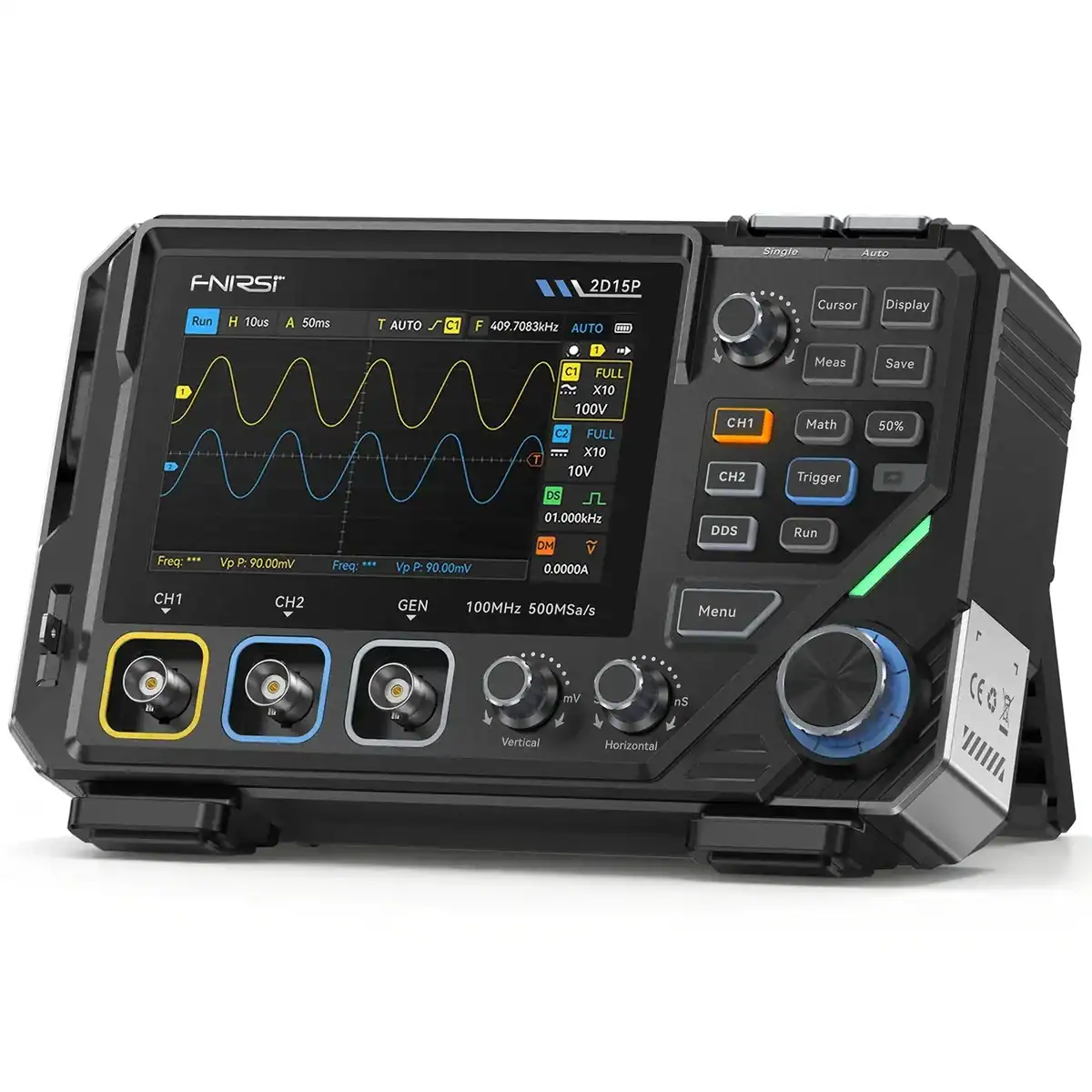
- 4.3-inch IPS touchscreen with physical rotary encoders
- Built-in 5,000mAh battery for portable operation
- Phosphor-style display with 128-level grayscale
- Signal generator limited to 3V peak-to-peak with stepped waveform output
- Shared ground between all functions requires careful circuit testing
- Firmware v2.0.0.7 significantly improves responsiveness
- Ideal for hobbyists, students, and general electronics repair
Order your 2D15P today – 2-day UK delivery, 60-day easy returns
Overview of the Fnirsi 2D15P Digital Oscilloscope
The Fnirsi 2D15P positions itself as a versatile 3-in-1 test instrument designed for hobbyists, makers, and students who need multiple measurement capabilities without cluttering their workspace or breaking the bank. What makes it stand out is the combination of a dual-channel oscilloscope, a true RMS digital multimeter, and a built-in signal generator—all in one compact, battery-powered unit.
This device is designed for those who need portable test equipment for fieldwork or have space-constrained benches where multiple separate instruments simply won’t fit. The roughly 30% weight reduction compared to traditional bench scopes makes it genuinely portable, while the 5,000mAh battery provides freedom from mains power.
The 2D15P features a 4.3-inch IPS touchscreen paired with physical rotary encoders—a hybrid interface that represents a significant improvement over previous Fnirsi models that relied solely on touch controls. This combination gives you the intuitive touch navigation modern users expect while maintaining the tactile precision that experienced engineers appreciate.
Key Specifications of the Fnirsi 2D15P
Before diving into real-world performance, let me outline what the Fnirsi 2D15P offers across its three main functions.
Display and Interface
The 4.3-inch IPS touchscreen offers good viewing angles and colour reproduction for a device in this price bracket. The display includes a phosphor-style mode with 128-level grayscale and colour temperature options, making waveform behaviour significantly easier to visualise compared to basic LCD displays.
The hybrid touch-and-button interface is highly praised for being intuitive. You get physical rotary encoders for precise adjustments—something that pure touchscreen devices often lack—while still benefiting from touch navigation for menu access and quick settings changes.
One minor ergonomic issue: the unit is light enough that it can be pushed around the bench when pressing the rotary encoders unless you hold it steady with your other hand. It’s a small annoyance rather than a major problem, but worth noting if you’re used to heavier bench equipment that stays put.
Channel Count, Bandwidth, and Sampling Rate
The oscilloscope section features:
Specifications:
- 2 channels with 100 MHz bandwidth
- 500 MSa/s sampling rate
- Memory depth up to 1M points
- Standard trigger modes (Auto, Normal, Single)
- Math functions (addition, subtraction, multiplication, division)
Unlike some budget oscilloscopes with heavily inflated specifications, the 2D15P’s 500 MSa/s sampling rate is more realistic for the price point. The 100 MHz bandwidth claim should be treated with appropriate caution—as with most budget instruments, actual usable bandwidth may be somewhat lower, but the device performs acceptably for typical hobbyist frequencies.
The inclusion of math functions (add, subtract, multiply, divide) sets the 2D15P apart from basic budget scopes like the Fnirsi 1013D and 1014D, which lack these capabilities entirely.
Memory Depth and Triggering Features
The device offers memory depth up to 1M points, which is respectable for this price category. However, some users have found navigating captured data difficult, noting that the documentation is basic and lacks detail on how to move through long captures effectively.
Triggering options include standard Auto, Normal, and Single modes with edge detection. These cover most hobbyist requirements, though professional users may find the options limited compared to higher-end equipment.
Multimeter Specifications
The built-in true RMS digital multimeter provides:
- 19,999/20,000 count resolution
- AC/DC voltage measurement up to 1,000V
- Current measurement up to 10A
- Resistance measurement
- Capacitance measurement
- Diode and continuity testing
Signal Generator Specifications
The DDS signal generator offers:
- 11 different waveforms
- Frequency range: 0 to 10 MHz
- Maximum output: 3V peak-to-peak
Unboxing and First Impressions of the Fnirsi 2D15P
When the Fnirsi 2D15P arrives, you’ll find it reasonably well-packaged. Inside the box, you typically get:
- The 2D15P main unit
- Oscilloscope probes (1×/10× switchable)
- Multimeter test leads
- USB-C charging cable
- User manual
- Calibration tool
My first impression upon unboxing was genuinely positive. The device feels well-constructed and surprisingly compact given the three functions it incorporates. The 4.3-inch IPS display is bright and clear, and the physical rotary encoders give the unit a more professional feel than pure touchscreen devices.
The roughly 30% weight reduction compared to traditional bench scopes is immediately noticeable. This is a device you can genuinely pick up with one hand and carry to wherever you need to work.
The 5,000mAh battery and USB-C charging port on the back make the unit truly portable. You’re not tethered to a mains outlet, which opens up possibilities for field service work, automotive diagnostics, or simply working in different areas of your workshop.
Setup and Calibration Guide
Getting the Fnirsi 2D15P up and running is straightforward, with the hybrid interface making initial setup intuitive for most users.
Connecting Probes and Grounding
Connect your oscilloscope probes to the BNC inputs on the unit. The connectors are standard, so probes click securely into place. Set the probe switch to the appropriate attenuation (1× for low-voltage signals, 10× for higher voltages and better frequency response).
For multimeter measurements, connect the test leads to the appropriate terminals—COM for ground, and the voltage/resistance or current terminals depending on your measurement type.
Critical safety note: The DMM, oscilloscope, and signal generator all share a common ground. This is extremely important to understand before testing circuits. You must be cautious not to create short circuits when feeding a test signal into a device while simultaneously measuring it with the oscilloscope or multimeter. Always consider ground paths before connecting multiple functions to the same circuit.
Quick Calibration Steps
The Fnirsi 2D15P includes an auto-calibration function that works well for the oscilloscope section. The “auto” function effectively calibrates horizontal and vertical resolution for various signals within seconds, making initial setup quick and painless.
For probe compensation:
- Connect your probe to Channel 1
- Attach the probe tip to the calibration output
- Press the Auto button to automatically configure the display
- Examine the square wave corners on screen
- If corners appear rounded or show overshoot, adjust the probe compensation screw until corners are sharp 90-degree angles
I recommend recalibrating probes whenever you switch between 1× and 10× modes, after temperature changes, or periodically during regular use.
Performance Tests in the Fnirsi 2D15P Review
I tested the Fnirsi 2D15P across all three of its functions to understand exactly what it can handle. Here’s what I found.
Signal Fidelity and Noise Floor
The oscilloscope section performs well for typical hobbyist frequencies. The phosphor-style display with 128-level grayscale makes visualising waveform behaviour significantly easier than basic LCD displays—you can see signal intensity and repetition patterns that would be invisible on simpler screens.
The auto function works effectively, calibrating the display for various input signals within seconds. This is particularly helpful for beginners who might struggle with manual horizontal and vertical scaling.
Signal clarity is acceptable for general electronics work, Arduino debugging, and audio frequency measurements. The 500 MSa/s sampling rate provides adequate detail for signals within the device’s practical bandwidth.
Rise Time and Frequency Response
The 100 MHz bandwidth specification should be treated with appropriate caution, as with any budget instrument. For practical hobbyist work—Arduino projects, audio electronics, basic repair tasks—the oscilloscope section performs adequately.
The math functions (addition, subtraction, multiplication, division) add genuine value for users who need to compare or combine channel signals, something that cheaper Fnirsi models lack entirely.
Trigger Stability and Capture Accuracy
The standard trigger modes (Auto, Normal, Single) work reliably for stable, repetitive signals. The auto-trigger function quickly locks onto most signals and configures the display sensibly.
Memory depth of up to 1M points is respectable, though navigating long captures can be challenging due to basic documentation. If you need to analyse extended signal captures, expect some trial and error learning the interface.
Multimeter Accuracy Testing
The true RMS multimeter section impressed me in testing. In side-by-side comparisons with high-end meters like the Fluke 87V, the 2D15P showed excellent agreement on DC voltage and current measurements. For a built-in multimeter in a budget 3-in-1 device, this level of accuracy is genuinely surprising.
However, there are important limitations:
- AC voltage accuracy: The AC voltage measurement accuracy rolls off quickly above 1 kHz, making the multimeter unsuitable for high-frequency AC work. For mains frequency measurements (50/60 Hz), it performs well, but don’t trust it for audio-frequency AC measurements.
- Continuity check: The continuity function is somewhat slow and less responsive with the stock probes. If you do a lot of continuity testing, this can become frustrating.
- Diode check: The diode test lacks an audible beep, which makes troubleshooting shorted components more tedious than with dedicated multimeters that provide audio feedback.
Signal Generator Performance
The DDS signal generator is the weakest of the three functions, and I need to be transparent about its limitations.
The stepped waveform problem:
The signal generator is essentially a Direct Digital Synthesis (DDS) step generator, which means the output waveforms—particularly sine waves—appear “stepped” or “jagged” rather than smooth and continuous.
This stepped appearance is caused by:
- Limited amplitude resolution: At lower signal levels (0.1V or 0.2V peak-to-peak), the discrete digital steps become very prominent and visible
- Loss of information at low levels: Small waveforms lose significant signal information, appearing “clipped” without sharp peaks and troughs
- Residual steps even at maximum output: Even at 3V peak-to-peak, the sine wave is visibly composed of “little tiny steps” with a potential “flat top” rather than a clean peak
- Jitter and harmonics: The output exhibits jitter and harmonics that further degrade signal purity
Practical implications:
The signal generator is unsuitable for sensitive audio testing where you need a clean sine wave to identify clipping or distortion. It’s adequate for basic frequency response testing, injecting test signals for troubleshooting, or educational purposes where waveform purity isn’t critical.
The 3V peak-to-peak maximum output may also be insufficient for some applications requiring higher amplitude signals.
Firmware doesn’t fix this:
Even with firmware version 2.0.0.7, the stepped waveform issue persists. This is a hardware limitation of the DDS architecture rather than a software bug that can be corrected through updates.
User Interface and Controls
The hybrid touch-and-button interface is one of the Fnirsi 2D15P’s genuine strengths, representing a significant improvement over previous Fnirsi models.
Menu Navigation
The combination of touchscreen navigation and physical rotary encoders gives you the best of both worlds. Touch controls make menu navigation quick and intuitive, while the rotary encoders provide precise adjustment of parameters like voltage scale, time base, and trigger level.
The interface is responsive, particularly with firmware version 2.0.0.7 installed, which significantly improves overall responsiveness and waveform quality. If you purchase this device, updating to the latest firmware should be your first action.
Menu organisation is logical, with separate sections for oscilloscope, multimeter, and signal generator functions. Switching between modes is straightforward, allowing you to quickly change measurement approaches as needed.
Waveform Display Options
The phosphor-style display with 128-level grayscale and colour temperature modes makes waveform behaviour easier to visualise than basic LCD displays. You can see signal intensity variations that indicate repetition frequency and identify intermittent events that might be invisible on simpler displays.
The oscilloscope displays standard measurements including voltage (peak-to-peak, RMS, average), frequency, and period. The math functions (add, subtract, multiply, divide) allow channel combination for more advanced analysis.
Screenshot capability:
You can capture screenshots by pressing the dedicated save button. Images are saved as BMP files at approximately 470×272 pixel resolution. To export these files, you must enable “USB sharing” in the settings menu, then connect the device to a computer via USB-C where it appears as a mass storage device.
The process works but feels somewhat “arcane” since you must tether the entire unit to a computer rather than simply inserting a USB drive.
Battery Life and Portability
The Fnirsi 2D15P excels at portability, offering genuine go-anywhere capability that traditional bench equipment cannot match.
The built-in 5,000mAh battery provides several hours of operation depending on usage patterns. Screen brightness, measurement frequency, and which functions you’re using all affect runtime. For typical bench work with occasional measurements, expect a full day of use between charges.
The USB-C charging port on the back allows charging from standard phone chargers, power banks, or laptop USB ports. You can also operate the device while charging for unlimited runtime when mains power is available.
Portability advantages:
- Roughly 30% lighter than traditional bench scopes
- Self-contained with no external power supply required
- Compact footprint saves bench space
- Can be used for field service, automotive work, or education
- Battery operation provides ground isolation for certain measurements
Why battery power matters:
When running on battery, the device’s ground can float relative to mains earth, providing some isolation for certain measurement scenarios. However, remember that all three functions (oscilloscope, multimeter, signal generator) share a common ground, so careful consideration of ground paths is still essential.
Software and Firmware Updates
The Fnirsi 2D15P runs embedded firmware that controls all functions. Firmware updates have made significant improvements to the device’s usability.
Firmware version 2.0.0.7 is highly recommended as it significantly improves:
- Overall interface responsiveness
- Waveform display quality
- General stability
The firmware update does not fix the signal generator’s stepped waveform issue, as this is a hardware limitation rather than a software bug.
To update firmware:
- Download the firmware file from Fnirsi’s website
- Connect the device to your computer via USB-C
- Enable “USB sharing” in the settings menu
- The device appears as a mass storage drive
- Navigate to the “Upgrade File” folder
- Copy the new firmware file into this folder
- Safely disconnect and power cycle the device
Note that firmware updates typically require a Windows computer. Check Fnirsi’s documentation for the latest update procedure.
Comparison: Fnirsi 2D15P vs Competitors
How does the Fnirsi 2D15P stack up against other options in the budget test equipment market?
Value for Money
The 2D15P offers remarkable value by combining three instruments into one compact package. Purchasing separate entry-level oscilloscope, multimeter, and signal generator would cost significantly more and take up far more bench space.
Fnirsi 1014D (£127.50): The 1014D is a 2-in-1 device (oscilloscope plus function generator) without the multimeter function. It has a larger 7-inch screen but lacks physical rotary encoders, relying on button controls instead. The 1014D’s function generator has a fixed 2.5V output compared to the 2D15P’s 3V. Choose the 1014D if you prioritise screen size and don’t need a built-in multimeter.
Fnirsi 1013D (£125.00): The 1013D is a tablet-style portable oscilloscope with touchscreen interface and built-in battery. It lacks both the multimeter and signal generator functions. The 1013D has a larger 7-inch screen but no physical controls. Choose the 1013D if you only need oscilloscope functionality and prefer a larger touchscreen interface.
Owon HDS242S (approximately £180-250): The Owon includes a built-in multimeter and offers more honest bandwidth specifications with better accuracy. It has a smaller screen but is known for more reliable measurements. If accuracy is your priority over features, the Owon is worth considering.
Rigol DS1054Z (approximately £350-400): This represents a step up to semi-professional equipment with genuine 50 MHz bandwidth (hackable to 100 MHz), much deeper memory, and protocol decoding options. If you’re serious about electronics and can stretch your budget, the Rigol offers significantly better measurement capability, though without the built-in multimeter or signal generator.
Feature Comparison
| Feature | Fnirsi 2D15P | Fnirsi 1014D | Fnirsi 1013D | Owon HDS242S |
|---|---|---|---|---|
| Price | Check store | £127.50 | £125.00 | ~£200 |
| Bandwidth | 100 MHz | ~30 MHz | ~20-30 MHz | 40 MHz |
| Sampling Rate | 500 MSa/s | 200 MSa/s | 200 MSa/s | 250 MSa/s |
| Channels | 2 | 2 | 2 | 2 |
| Screen | 4.3″ IPS | 7″ TFT | 7″ Touch | 3.5″ |
| Multimeter | Yes (20,000 count) | No | No | Yes |
| Signal Generator | Yes (10 MHz) | Yes (10 MHz) | No | No |
| Battery | Yes (5,000mAh) | No (USB) | Yes (6,000mAh) | Yes |
| Math Functions | Yes | No | No | Yes |
| Physical Encoders | Yes | No | No | Yes |
Pros and Cons from the Fnirsi 2D15P Review
Pros:
- Excellent 3-in-1 value combining oscilloscope, multimeter, and signal generator
- Hybrid touch and rotary encoder interface is intuitive and precise
- Phosphor-style display with 128-level grayscale improves waveform visualisation
- True RMS multimeter shows excellent DC accuracy comparable to high-end meters
- Math functions (add, subtract, multiply, divide) unavailable on cheaper models
- Built-in 5,000mAh battery for genuine portability
- USB-C charging from standard chargers or power banks
- Compact and roughly 30% lighter than traditional bench scopes
- Auto-calibration function works effectively
- Memory depth up to 1M points
- Firmware v2.0.0.7 significantly improves responsiveness
- Can export screenshots via USB mass storage mode
Cons:
- Signal generator produces stepped/jagged waveforms due to DDS architecture
- Signal generator limited to 3V peak-to-peak maximum output
- DMM, oscilloscope, and signal generator share common ground (safety consideration)
- AC voltage accuracy rolls off quickly above 1 kHz
- Continuity check is slow and less responsive
- Diode check lacks audible beep
- Unit light enough to slide on bench when pressing encoders
- Documentation is basic, particularly for navigating long captures
- Screenshot export requires tethering to computer (no USB-A port)
- Some professional reviewers consider it a “toy” for serious work
- 4.3-inch screen smaller than some competitors
Typical Use Cases and Who Should Buy the Fnirsi 2D15P
The Fnirsi 2D15P is ideal for:
- Hobbyists and makers: The 3-in-1 functionality means one device covers most measurement needs for Arduino projects, DIY electronics, and general tinkering. The compact size saves precious bench space.
- Students learning electronics: The combination of oscilloscope, multimeter, and signal generator provides all the tools needed for educational projects and laboratory exercises at an accessible price point.
- Field service technicians: Battery operation and compact size make the 2D15P genuinely portable for on-site diagnostics and repair work.
- Space-constrained workshops: If you simply don’t have room for three separate instruments, the 2D15P consolidates essential functions into one compact unit.
- General electronics repair: For troubleshooting consumer electronics, checking power supplies, and basic signal tracing, the 2D15P provides adequate capability.
- Audio hobbyists (with caveats): The oscilloscope and multimeter work well for audio frequency measurements, though the signal generator’s stepped output limits its usefulness for audio testing.
Who should look elsewhere:
- Professional engineers: If measurement accuracy and detailed specifications matter for your work, invest in dedicated professional equipment.
- High-frequency work: The practical bandwidth limitations and shared ground make the 2D15P unsuitable for RF or high-speed digital work.
- Precision audio testing: The stepped signal generator output is unsuitable for sensitive audio work requiring clean sine waves.
- Anyone needing high-frequency AC measurements: The multimeter’s AC accuracy rolls off above 1 kHz, limiting its usefulness for audio-frequency AC work.
- Those requiring detailed documentation: The basic user manual may frustrate users who need comprehensive guidance.
Common Issues and Troubleshooting Tips
Through my testing and research into user experiences, several common issues emerge with the Fnirsi 2D15P. Here’s what to watch for and how to address problems.
Stepped Signal Generator Output
The signal generator produces “jagged” or “stepped” waveforms, particularly noticeable on sine waves. This is a hardware limitation of the DDS architecture, not a defect:
- The issue is most visible at low output levels (0.1V-0.2V peak-to-peak)
- Even at maximum 3V output, slight stepping is visible
- Firmware updates do not fix this issue
- For applications requiring clean sine waves, use an external signal generator
Shared Ground Causing Short Circuits
All three functions share a common ground, which can cause problems:
- Never connect the signal generator output to a circuit while measuring the same point with the oscilloscope if ground paths could short
- Always trace ground connections before connecting multiple functions
- Consider the ground path when the circuit under test has its own ground reference
Slow Continuity Response
The continuity check is slower than dedicated multimeters:
- Allow slightly longer contact time when testing
- Consider upgrading to higher-quality test leads with sharper probe tips
- For high-volume continuity testing, a dedicated multimeter may be more efficient
Device Sliding on Bench
The lightweight design means the unit can move when pressing rotary encoders:
- Hold the device with your other hand when making adjustments
- Consider a non-slip mat under the device
- Some users add small rubber feet for additional grip
Screenshot Export Difficulties
Exporting screenshots requires USB connection to a computer:
- Enable “USB sharing” in the settings menu
- Connect via USB-C to your computer
- The device appears as a removable drive
- Navigate to “Screenshot File” folder
- Copy BMP images to your computer
The process works but requires the entire device to be tethered—there’s no option to save directly to a USB drive.
AC Voltage Accuracy Issues
For AC measurements above 1 kHz, accuracy degrades significantly:
- Trust DC measurements, which show excellent accuracy
- For mains frequency (50/60 Hz) AC, the multimeter performs well
- For audio-frequency AC measurements, use a dedicated meter or the oscilloscope’s measurement functions instead
Firmware Update Recommended
If your device feels sluggish or waveforms appear poor quality:
- Update to firmware version 2.0.0.7 or later
- The update significantly improves responsiveness and waveform quality
- Follow the USB mass storage update procedure carefully
Accessories and Optional Add-Ons
The included accessories get you started, but a few additions can improve your experience:
Recommended accessories:
- Quality replacement probes: Higher-quality oscilloscope probes improve signal fidelity and measurement accuracy. Budget: £20-40 per probe.
- Better multimeter leads: The stock leads are adequate but upgrading to leads with sharper probe tips improves continuity testing responsiveness. Budget: £10-20.
- Protective carrying case: Essential if you’re using the portability features regularly. A padded case protects your investment during transport. Budget: £15-30.
- USB power bank: For extended field work, a power bank lets you recharge without mains access. Budget: £20-40.
- Non-slip mat: Prevents the lightweight unit from sliding on your bench when operating the rotary encoders. Budget: £5-10.
- BNC adapters and cables: Useful for connecting to various signal sources. Budget: £5-15.
Final Verdict: Is the Fnirsi 2D15P Worth It?
After extensive testing, here’s my honest assessment: the Fnirsi 2D15P is a genuinely useful 3-in-1 tool that delivers impressive value, with some notable limitations you need to understand.
The multimeter section genuinely impressed me. Excellent DC accuracy comparable to high-end meters like the Fluke 87V is remarkable in a budget combination device. For DC voltage and current measurements, you can trust the readings.
The oscilloscope section is capable for typical hobbyist work. The phosphor-style display, math functions, and hybrid interface represent meaningful improvements over simpler budget scopes. It won’t replace a professional bench oscilloscope, but it handles Arduino debugging, audio work, and basic troubleshooting competently.
The signal generator is the weak link. The stepped waveform output limits its usefulness for precision work, and the 3V maximum amplitude may be insufficient for some applications. Consider it a convenient bonus feature rather than a serious signal source.
The shared ground between all functions is a critical consideration. You must understand ground paths and avoid creating shorts when using multiple functions on the same circuit.
My recommendation:
If you need a compact, portable test solution that combines essential measurement functions at an accessible price, the Fnirsi 2D15P delivers genuine value. It’s particularly well-suited for hobbyists with limited bench space, students learning electronics, or field technicians who need a capable all-in-one tool.
If you need precision measurements, clean signal generation, or professional-grade specifications, look to dedicated instruments from established brands.
The Fnirsi 2D15P is exactly what it is: an affordable 3-in-1 tool that punches above its weight for general electronics work, provided you understand and work within its limitations.
Where to Buy and Pricing Overview
The Fnirsi 2D15P is available from multiple sources:
FNIRSI Oscilloscope Store — Check current pricing for UK customers with dedicated support.
Amazon UK — Typically higher priced but offers Amazon’s returns policy.
AliExpress — Prices vary; watch for shipping times and import duties.
For UK buyers, the FNIRSI Oscilloscope Store offers dedicated support for Fnirsi products.
[Buy Now – Check Current Price with UK Delivery]
Visit: https://fnirsioscilloscopes.store/product/fnirsi-2d15p-benchtop-oscilloscope-multimeter-signal-generator/
Frequently Asked Questions (FAQ) About the Fnirsi 2D15P
What is the battery life of the Fnirsi 2D15P?
The Fnirsi 2D15P contains a built-in 5,000mAh battery that provides several hours of continuous operation. Actual runtime depends on screen brightness, measurement frequency, and which functions you’re actively using. For typical bench work with intermittent measurements, expect a full day of use between charges. The USB-C port allows charging from standard phone chargers, power banks, or laptop USB ports, and you can operate the device while charging for unlimited runtime when power is available.
Does the Fnirsi 2D15P have a shared ground?
Yes, this is a critical consideration. The DMM, oscilloscope, and signal generator all share a common ground. You must be cautious not to create short circuits when feeding a test signal into a device while simultaneously measuring it with another function. Always trace ground paths before connecting multiple functions to the same circuit. This shared ground is typical for combination instruments at this price point but requires careful attention during use.
Is the Fnirsi 2D15P multimeter accurate?
The true RMS multimeter shows excellent accuracy for DC voltage and current measurements. In side-by-side testing with high-end meters like the Fluke 87V, the 2D15P showed excellent agreement on DC measurements—impressive for a built-in multimeter in a budget 3-in-1 device. However, AC voltage accuracy rolls off quickly above 1 kHz, making it unsuitable for high-frequency AC work. For mains frequency (50/60 Hz) measurements, it performs well. The continuity check is somewhat slow, and the diode test lacks an audible beep.
Why does the signal generator produce stepped waveforms?
The Fnirsi 2D15P uses a Direct Digital Synthesis (DDS) system that essentially functions as a step generator. The stepped or “jagged” appearance is caused by limited amplitude resolution, particularly visible at low output levels. Even at maximum output (3V peak-to-peak), the sine wave is composed of visible “little tiny steps.” This is a hardware limitation of the DDS architecture, not a defect, and cannot be fixed through firmware updates. The signal generator is unsuitable for sensitive audio testing where clean sine waves are required.
What is the maximum output of the signal generator?
The signal generator has a maximum output of 3V peak-to-peak (approximately 1V RMS for sine waves). This may be insufficient for applications requiring higher amplitude signals. The generator can produce up to 11 different waveforms with a frequency range of 0 to 10 MHz, though waveform quality degrades at higher frequencies due to jitter and harmonics.
Can I export screenshots from the Fnirsi 2D15P?
Yes, you can capture and export waveform screenshots. Press the dedicated save button to capture the current display as a BMP image (approximately 470×272 pixels). To export files, enable “USB sharing” in the settings menu, then connect the device to your computer via USB-C. The device appears as a mass storage drive, and you can navigate to the “Screenshot File” folder to copy images. The process works but requires tethering the entire unit to a computer—there’s no USB-A port for direct thumb drive saving.
Is the Fnirsi 2D15P good for beginners?
Yes, the Fnirsi 2D15P is well-suited for beginners learning electronics. The hybrid touch-and-encoder interface is intuitive, the auto-calibration function works effectively, and having three instruments in one device means you can learn oscilloscope, multimeter, and signal generator fundamentals without purchasing separate equipment. The price point makes it accessible for students and hobbyists. However, beginners should understand the shared ground limitation and the signal generator’s stepped output to avoid confusion or safety issues.
How does the Fnirsi 2D15P compare to the 1014D?
The 2D15P is a 3-in-1 device (oscilloscope, multimeter, signal generator) while the 1014D is a 2-in-1 (oscilloscope, function generator only). The 2D15P has a smaller 4.3-inch screen versus the 1014D’s 7-inch display, but includes physical rotary encoders and math functions that the 1014D lacks. The 2D15P has built-in battery power while the 1014D requires USB power. Choose the 2D15P if you need the multimeter function and prefer physical encoders; choose the 1014D if screen size is your priority.
Does firmware v2.0.0.7 fix the signal generator issues?
No. Firmware version 2.0.0.7 significantly improves overall interface responsiveness and waveform display quality, but it does not fix the stepped waveform issue with the signal generator. The stepped output is a hardware limitation of the DDS architecture rather than a software bug. The firmware update is still highly recommended for improved general performance, but don’t expect it to resolve signal generator quality issues.
What is the memory depth of the Fnirsi 2D15P?
The oscilloscope offers memory depth up to 1M (1 million) points, which is respectable for this price category. However, some users find navigating captured data difficult due to basic documentation that lacks detail on how to move through long captures effectively. For most hobbyist applications, you won’t need the full memory depth, but it’s available for capturing extended events when required.
Have more questions about the Fnirsi 2D15P? Looking for the best deal for UK customers?
Get Your Fnirsi 2D15P – Shop Now at FNIRSI Oscilloscope Store