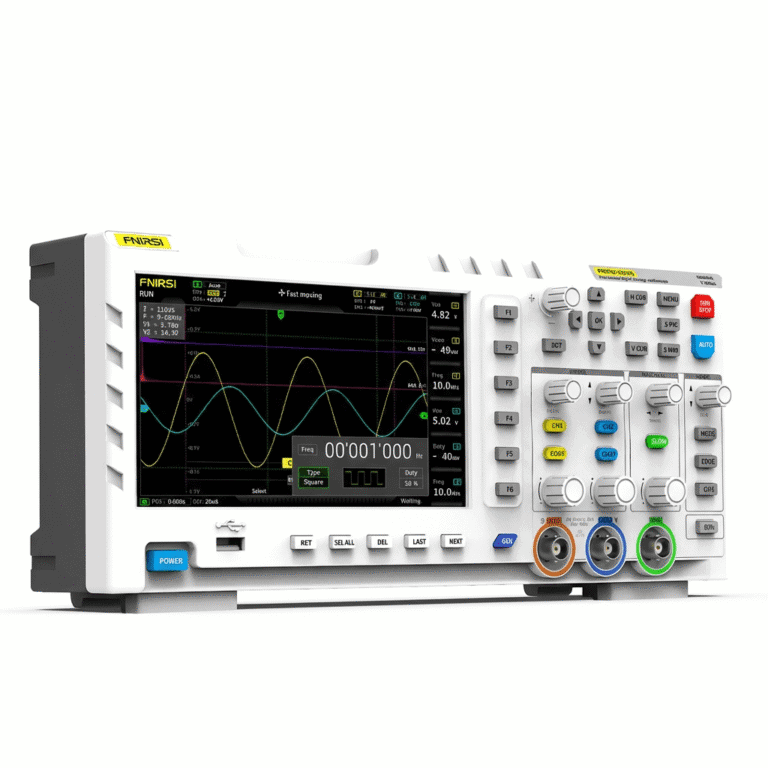
Fnirsi DPOS350P Review: Full Hands-On Evaluation
If you’re looking for a high-bandwidth tablet oscilloscope that bridges the gap between budget devices and professional laboratory equipment, the Fnirsi DPOS350P deserves serious consideration. I’ve spent considerable time testing this feature-packed “prosumer” oscilloscope, and I want to give you a completely honest assessment of what this ambitious device can and cannot do.
The Fnirsi DPOS350P has positioned itself as a 4-in-1 tool offering capabilities typically found in much more expensive equipment—350 MHz bandwidth, digital phosphor display, spectrum analyser, and frequency response analysis. In this comprehensive review, I’ll cut through the marketing and show you exactly what you’re getting for your money.
Key Takeaways
- 350 MHz bandwidth oscilloscope with 1 GSa/s sampling rate (single-channel only)
- Digital phosphor (DPOS) display mimics analog CRT intensity grading
- 7-inch high-resolution touchscreen (1024×600) with fast 3-second boot time
- 4-in-1 functionality: oscilloscope, signal generator, spectrum analyser, Bode plotter
- 8Ah battery provides 2-3 hours portable operation
- Bandwidth drops to 150 MHz per channel when both channels active
- Signal generator outputs up to 50 MHz sine waves with DC offset adjustment
- Spectrum analyser and Bode plotter features are functional but unrefined
- Software feels incomplete with various bugs and quirks
- Requires 12V QC3 USB charger (standard 5V USB won’t charge)
- Cooling fan is effective but conspicuously loud
- Excellent value for portable high-bandwidth oscilloscope needs
Order your DPOS350P today – 2-day UK delivery, 60-day easy returns
Check the manual for DPOS350P
Overview of the Fnirsi DPOS350P Digital Oscilloscope
The Fnirsi DPOS350P positions itself as a “prosumer” tablet oscilloscope—bridging the gap between low-end consumer devices and professional-grade laboratory equipment. At approximately £200-280, it offers an impressive suite of features typically found in oscilloscopes costing significantly more.
What makes the DPOS350P compelling is its combination of genuinely high bandwidth (350 MHz), digital phosphor display technology, and multiple integrated functions in a portable, battery-powered form factor. This is a device that aims to give hobbyists and semi-professional users capabilities previously reserved for expensive bench equipment.
The “4-in-1” designation refers to its integrated oscilloscope, signal generator, spectrum analyser, and frequency response analyser (Bode plotter). While the oscilloscope function is the primary strength, these additional capabilities add genuine value for troubleshooting and circuit analysis.
However, as with many ambitious budget devices, there’s a gap between marketing claims and real-world performance. The software feels incomplete in places, and some features work better than others. Understanding these limitations is crucial for deciding if the DPOS350P fits your needs.
Key Specifications
Before diving into real-world performance, let me outline what the Fnirsi DPOS350P offers.
Display and Interface
The 7-inch touchscreen display offers 1024×600 resolution—significantly crisper than many competitors in this class. The high-resolution screen makes reading measurements and observing waveform details genuinely pleasant.
The interface is entirely touch-based with no physical buttons beyond power. While the touchscreen is responsive with high refresh rates, the lack of physical controls means you must touch the screen even with dirty hands during bench work.
Boot time is impressively fast at just 3 seconds—significantly quicker than many tablet oscilloscopes that can take 30 seconds or more to become operational.
Channel Count, Bandwidth, and Sampling Rate
Specifications:
- 2 channels
- 350 MHz bandwidth (single-channel)
- 150 MHz bandwidth (dual-channel)
- 1 GSa/s sampling rate (approximately 950 MSa/s actual)
- 8-bit default resolution with oversampling up to 16-bit
Critical bandwidth consideration:
The 350 MHz bandwidth is only available when using a single channel. Enabling both channels automatically drops bandwidth to 150 MHz per channel because they share the ADC (Analog-to-Digital Converter) resources. This is not adjustable—the software automatically limits bandwidth when dual-channel mode is active.
Sampling rate reality:
While marketed at 1 GSa/s, independent measurements suggest the actual rate is approximately 950 MSa/s. This slight discrepancy is unlikely to affect most practical applications but is worth noting for transparency.
Oversampling trade-offs:
The scope offers oversampling modes up to 16-bit resolution for increased vertical detail. However, increasing bit depth causes bandwidth to drop sharply (e.g., approximately 17 MHz at 16-bit) and introduces software bugs where signal amplitude may drop to zero.
Memory Depth and Triggering Features
The DPOS350P includes standard triggering modes expected of a scope at this level. The digital phosphor display enhances trigger visualisation by showing signal intensity variations.
Digital Phosphor Technology
The standout feature is Digital Phosphor (DPOS) technology. Unlike standard digital scopes that show uniform trace brightness, the DPOS350P uses intensity grading to mimic analog CRT oscilloscopes:
- Brighter traces where the signal spends more time or passes the same point repeatedly
- Fainter traces where the signal moves quickly
- Colour temperature modes showing activity as heat maps (high activity appears red)
This provides significantly more visual information than standard digital displays, making it easier to identify modulation patterns, noise characteristics, and signal anomalies.
Integrated Functions
Signal Generator:
- Sine waves up to 50 MHz
- Complex waves (square, triangle, sawtooth) up to 10 MHz
- DC offset adjustment capability
- Maximum output amplitude 5V (3V in some modes)
Spectrum Analyser:
- FFT-based analysis from DC to 500 MHz
- Useful for basic troubleshooting (identifying FM radio bands, etc.)
- Limited features: no peak search, no adjustable resolution bandwidth
- Poor frequency resolution (approximately 31 kHz at best)
Frequency Response Analyser (Bode Plot):
- Uses signal generator to sweep circuits
- Plots magnitude and phase response
- Currently unrefined with inaccurate phase measurements
- Logarithmic scale alignment issues
Unboxing and First Impressions of the Fnirsi DPOS350P
When the Fnirsi DPOS350P arrives, you’ll find it reasonably well-packaged. Inside the box, you typically get:
- The DPOS350P main unit
- Two oscilloscope probes
- Signal generator output cable
- 12V QC3 USB charger
- User manual
My first impression upon unboxing was positive regarding build quality. The device features a solid metal frame with ABS plastic construction. Hard plastic corner bumpers provide some aesthetic protection, though these are not rubberised for serious drop protection.
The 7-inch display immediately impresses with its clarity and resolution. The 1024×600 screen is noticeably sharper than many competing tablet oscilloscopes, making waveform details and measurements easy to read.
The 3-second boot time is remarkable—the device is ready to use almost instantly, unlike many tablet scopes that require lengthy startup sequences.
Important power note: The DPOS350P requires a 12V USB source (QC3 standard) to charge. Standard 5V USB chargers will not work. Ensure you use the included charger or a compatible QC3 power source.
Setup and Calibration Guide
Getting the Fnirsi DPOS350P up and running is straightforward, though some aspects of the touch interface require familiarisation.
Connecting Probes and Grounding
Connect your oscilloscope probes to the two BNC input channels. The third BNC connector is the signal generator output. Set probe attenuation switches appropriately (1× or 10×) and ensure the scope’s probe compensation setting matches.
For probe compensation:
- Connect a probe to Channel 1
- Attach the probe tip to the calibration output
- View the square wave calibration signal
- Adjust probe compensation until square wave corners are sharp 90-degree angles
Quick Calibration Steps
The DPOS350P includes auto-calibration functions accessible through the settings menu. For best accuracy:
- Allow the device to warm up for a few minutes
- Run the internal calibration routine
- Verify calibration using a known reference signal
Understanding the Touch Interface
The entirely touch-based interface requires adjustment if you’re accustomed to physical controls:
- Pinch to zoom adjusts time base and voltage scale
- Drag moves traces and adjusts position
- Tap selects channels and accesses menus
Interface limitation: Common actions like recentering a trace lack dedicated shortcuts, requiring meticulous manual dragging. This can be frustrating during rapid troubleshooting.
Performance Tests in the Fnirsi DPOS350P Review
I tested the Fnirsi DPOS350P across its various functions to understand exactly what this ambitious device can handle. Here’s what I found.
Signal Fidelity and Noise Floor
The oscilloscope section performs well for a device at this price point. The digital phosphor display provides excellent visual feedback, making signal patterns and noise characteristics easy to identify.
The intensity grading genuinely helps with:
- Identifying modulated signal patterns (AM signals show visible “pinch points”)
- Distinguishing signal from noise (actual waveform remains prominent while noise is de-emphasised)
- Visualising signal stability and jitter
Rise Time and Frequency Response
Bandwidth verification:
Bench tests confirmed the scope is relatively accurate up to 350 MHz for sinusoidal waves, with the 3dB roll-off occurring around 400-403 MHz. This slightly exceeds the specification, which is positive.
However, some reviewers suspect digital compensation is used to “boost” the signal to reach these numbers. Whether this matters depends on your application—the practical result is usable bandwidth near the specification.
Front-end ringing issue:
Testing with a 10 MHz square wave revealed significant ringing/artifacts on the leading edge. Comparison with higher-end laboratory equipment confirmed this is an issue with the scope’s front-end circuitry, not the signal source. This affects the accuracy of rise time measurements and square wave analysis.
Trigger Stability and Capture Accuracy
The digital phosphor display enhances triggering visualisation significantly. You can see trigger stability issues as intensity variations rather than relying solely on numerical jitter measurements.
Aliasing concern:
At lower time bases, the scope can suffer from aliasing, displaying incorrect frequencies for signals like a 1 MHz carrier. Be aware of this limitation when working with repetitive signals at certain time base settings.
Dual-Channel Performance
When both channels are active, bandwidth automatically drops to 150 MHz per channel. This is a hardware limitation due to shared ADC resources and cannot be overridden.
For most hobbyist applications requiring dual-channel measurement, 150 MHz remains adequate. However, if you specifically need high-bandwidth dual-channel capture, this limitation matters.
Signal Generator Performance
The integrated signal generator is genuinely useful:
- Sine waves up to 50 MHz — adequate for most testing needs
- Complex waves up to 10 MHz — square, triangle, sawtooth
- DC offset adjustment — a feature often missing from integrated generators
- Maximum 5V output (3V in some modes)
The signal generator adds real value for circuit testing without requiring separate equipment.
Spectrum Analyser Performance
The FFT-based spectrum analyser covers DC to 500 MHz and is useful for basic troubleshooting tasks like identifying FM radio band interference or locating spurious signals.
Significant limitations:
- No peak search function
- No adjustable resolution bandwidth
- Poor frequency resolution (approximately 31 kHz at best)
- Rudimentary compared to dedicated spectrum analysers
Consider this a “bonus feature” for basic troubleshooting rather than a serious spectrum analysis tool.
Frequency Response Analyser (Bode Plot)
The Bode plot function uses the signal generator to sweep circuits and plot magnitude and phase response. In theory, this is valuable for filter characterisation and amplifier analysis.
Current issues:
- Logarithmic scale doesn’t align with decades unless specific start/stop frequencies are used
- Phase measurements are often inaccurate, jumping around significantly
- The feature feels unfinished and unreliable
This function has potential but requires firmware improvements to be genuinely useful.
User Interface and Controls
The touch-based interface is both a strength and weakness of the DPOS350P.
Menu Navigation
The touchscreen is responsive with high refresh rates, providing smooth interaction. Menus are logically organised, and most functions are accessible within a few taps.
The digital phosphor display modes include:
- Standard intensity grading
- Colour temperature (heat map) visualisation
- Adjustable persistence settings
Waveform Display Options
The 1024×600 resolution provides excellent waveform detail. The digital phosphor effect adds visual information that standard digital displays cannot provide:
- Signal intensity variations visible at a glance
- Noise characteristics clearly distinguished from signal
- Modulation patterns immediately apparent
Interface Limitations
No physical controls: The entirely touch-based interface means no quick-access buttons for common functions. With dirty hands during bench work, this becomes problematic.
Missing shortcuts: Common actions like recentering a trace require manual dragging rather than a dedicated button or gesture.
Learning curve: Users accustomed to traditional oscilloscopes with physical knobs may find the transition challenging.
Battery Life and Portability
The DPOS350P offers genuine portability with battery operation, though with some caveats.
Battery Performance
The 8Ah battery provides approximately 2-3 hours of operation. This is adequate for field work or portable use but may require charging during extended sessions.
Charging requirement: The device requires a 12V QC3 USB source to charge. Standard 5V USB chargers and power banks will not work. Plan accordingly for portable use—you’ll need a QC3-compatible power bank or the included charger.
Cooling Considerations
A small, high-powered cooling fan is built into the back. While it effectively prevents overheating, reviewers consistently note it is conspicuously loud and draws significant power, affecting battery life.
The fan noise may be distracting in quiet environments but is acceptable in workshop settings.
Portability Features
- Solid construction with metal frame withstands transport
- 7-inch form factor fits in equipment bags
- Fast 3-second boot means quick deployment
- Battery operation provides mains independence
Build Quality
The metal frame with ABS plastic provides solid construction. Hard plastic corner bumpers offer aesthetic protection but are not rubberised for serious impact resistance. Handle with appropriate care during transport.
Software and Firmware Updates
A recurring theme across reviews is that while the DPOS350P’s hardware is capable, the software feels incomplete.
Current Software Issues
Oversampling bugs: Increasing bit depth beyond 8-bit can cause signal amplitude to drop to zero—a significant bug affecting the usefulness of this feature.
Bode plotter issues: Phase measurements jump around, and logarithmic scaling doesn’t align properly with frequency decades.
Missing conveniences: No dedicated shortcut for trace recentering, requiring manual dragging.
Aliasing at certain settings: Lower time bases can display incorrect frequencies.
Firmware Update Potential
The DPOS350P’s issues appear to be largely software-related, meaning firmware updates could potentially address many limitations. Check FNIRSI’s website for the latest firmware versions and update instructions.
The hardware capability is present—it’s the software refinement that needs work. This suggests the device may improve over time with updates.
Comparison: Fnirsi DPOS350P vs Competitors
How does the Fnirsi DPOS350P stack up against other options?
Value for Money
At approximately £200-280, the DPOS350P offers remarkable specifications for the price. The 350 MHz bandwidth (single-channel) and digital phosphor display are features typically found in much more expensive equipment.
Fnirsi 1013D (£125.00): The 1013D is a tablet-style oscilloscope with touchscreen but offers only 20-30 MHz actual bandwidth and no digital phosphor. The DPOS350P provides significantly higher performance for users who need genuine high-frequency capability.
Fnirsi 1014D (£127.50): Similar limitations to the 1013D. The DPOS350P is in a different performance class with its 350 MHz bandwidth and digital phosphor technology.
Rigol DS1054Z (approximately £350-400): The Rigol offers 50 MHz bandwidth (hackable to 100 MHz), superior software stability, and professional build quality. It lacks the portability and digital phosphor display of the DPOS350P. Choose Rigol for software reliability; choose DPOS350P for bandwidth and portability.
Professional portable scopes (£1,000+): Devices from Keysight, Tektronix, or Rohde & Schwarz offer superior performance, reliability, and support but at 4-10× the price. The DPOS350P provides “prosumer” capability at a fraction of professional pricing.
Feature Comparison
| Feature | Fnirsi DPOS350P | Fnirsi 1013D | Rigol DS1054Z |
|---|---|---|---|
| Price | ~£250 | £125.00 | ~£375 |
| Bandwidth | 350 MHz (1ch) / 150 MHz (2ch) | ~20-30 MHz | 50 MHz (100 MHz hacked) |
| Sampling Rate | ~950 MSa/s | ~200 MSa/s | 1 GSa/s |
| Display | 7″ 1024×600 | 7″ 800×480 | 7″ 800×480 |
| Digital Phosphor | Yes | No | No |
| Signal Generator | Yes (50 MHz) | No | Optional |
| Spectrum Analyser | Yes (basic) | No | No |
| Bode Plotter | Yes (unrefined) | No | No |
| Battery Powered | Yes (2-3 hrs) | Yes (4-6 hrs) | No |
| Software Stability | Needs improvement | Basic | Excellent |
Pros and Cons from the Fnirsi DPOS350P Review
Pros:
- Genuine 350 MHz bandwidth (single-channel) at budget price
- Digital phosphor display provides excellent visual feedback
- High-resolution 7-inch 1024×600 touchscreen
- Fast 3-second boot time
- 4-in-1 functionality (scope, generator, spectrum, Bode)
- Signal generator up to 50 MHz with DC offset adjustment
- Battery-powered portability (2-3 hours)
- Solid metal frame construction
- High display refresh rate for smooth operation
- Intensity grading helps identify signal patterns
- Colour temperature (heat map) display mode
Cons:
- Bandwidth drops to 150 MHz when both channels active
- Software feels incomplete with various bugs
- Oversampling modes buggy (amplitude can drop to zero)
- Bode plotter phase measurements inaccurate
- Spectrum analyser lacks professional features
- Front-end ringing affects square wave accuracy
- Cooling fan is conspicuously loud
- Requires 12V QC3 charger (standard USB won’t work)
- No physical controls (touch-only interface)
- Corner bumpers not rubberised for drop protection
- Aliasing possible at lower time bases
- Missing shortcuts for common actions like trace recentering
Typical Use Cases and Who Should Buy the Fnirsi DPOS350P
The Fnirsi DPOS350P is ideal for:
- High-frequency hobbyist work: Anyone working with RF, fast digital signals, or communications circuits who needs genuine high-bandwidth capability without professional equipment pricing.
- Portable high-bandwidth measurement: Field service, on-site troubleshooting, or mobile workbench setups where battery operation and portability matter alongside bandwidth.
- Signal visualisation enthusiasts: The digital phosphor display provides insights that standard digital scopes cannot, making it excellent for understanding signal behaviour.
- Multi-function tool seekers: Users who want oscilloscope, signal generator, and basic spectrum analysis in one portable device.
- Educational and training: Learning about high-frequency signals, RF concepts, and signal analysis with capable equipment at accessible pricing.
- Semi-professional troubleshooting: Repair technicians and advanced hobbyists who need more capability than basic scopes offer but can’t justify professional equipment costs.
Who should look elsewhere:
- Users needing software reliability: If you require rock-solid, bug-free operation, the current firmware limitations may frustrate you.
- Serious Bode plot analysis: The frequency response analyser needs significant improvement to be useful for precision work.
- Quiet environments: The cooling fan is conspicuously loud and may be distracting.
- Those without QC3 charging: If you can’t accommodate the 12V charging requirement, portable use becomes problematic.
- Professional/production use: For mission-critical measurements, invest in established professional brands with better support and reliability.
- Users prioritising dual-channel bandwidth: The 150 MHz dual-channel limitation may be insufficient for some high-frequency applications.
Common Issues and Troubleshooting Tips
Through my testing and research into user experiences, several common issues emerge with the Fnirsi DPOS350P. Here’s what to watch for and how to address problems.
Oversampling Mode Amplitude Bug
When increasing bit depth beyond 8-bit, signal amplitude may drop to zero:
- This is a known software bug
- Return to 8-bit mode to restore normal operation
- Check for firmware updates that may address this issue
- Avoid oversampling modes for critical measurements until fixed
Bandwidth Limitation with Dual Channels
Bandwidth automatically drops to 150 MHz when both channels are active:
- This is a hardware limitation, not adjustable
- Use single-channel mode when maximum bandwidth is required
- Plan measurements accordingly—capture high-frequency signals one channel at a time if needed
Charging Issues
The device won’t charge from standard 5V USB:
- You must use a 12V QC3-compatible charger
- The included charger provides correct voltage
- For portable power bank use, ensure QC3 compatibility
- Standard phone chargers will not work
Aliasing at Lower Time Bases
Incorrect frequencies may display at certain settings:
- Be aware of aliasing when using lower time base settings
- Verify frequencies using alternative methods if suspect
- Adjust time base to confirm signal frequency is genuine
Front-End Ringing on Square Waves
Significant ringing/artifacts appear on square wave leading edges:
- This is a hardware limitation of the front-end circuitry
- Not fixable through settings or firmware
- Be aware when measuring rise times or analysing square wave integrity
- Use this scope for frequency/amplitude rather than precise edge analysis
Bode Plotter Inaccuracy
Phase measurements jump around and logarithmic scaling doesn’t align:
- The feature is currently unrefined
- Use specific start/stop frequencies that align with decades
- Don’t rely on phase measurements for precision work
- Consider this feature experimental until firmware improvements
Loud Cooling Fan
The fan is conspicuously loud:
- This is normal operation—the fan prevents overheating
- No user adjustment available
- Accept as trade-off for thermal management
- May be distracting in quiet environments
Accessories and Optional Add-Ons
The Fnirsi DPOS350P comes with essential accessories, but a few additions can enhance your experience:
Included accessories:
- Two oscilloscope probes
- Signal generator output cable
- 12V QC3 USB charger
- User manual
Recommended additions:
- Quality replacement probes: Higher-bandwidth probes may better utilise the 350 MHz capability. Budget: £30-60.
- QC3-compatible power bank: For extended portable operation. Ensure 12V QC3 output support. Budget: £40-80.
- Protective carrying case: The device is portable but needs protection during transport. Budget: £20-40.
- BNC adapters and cables: For connecting to various signal sources. Budget: £10-25.
- Screen protector: Given the touch-only interface requires constant screen contact. Budget: £5-10.
- External attenuators: For extending input voltage range or matching impedances. Budget: £15-30.
Technical Terms Explained
To help you understand the DPOS350P’s specifications and features, here are key technical terms:
Digital Phosphor (DPOS): Display technology that uses intensity grading to mimic analog CRT oscilloscopes. Brighter traces indicate where signals spend more time; fainter traces show fast-moving portions.
Intensity Grading: Varying trace brightness based on signal dwell time at each point, providing visual information about signal behaviour that uniform-brightness displays cannot show.
ADC (Analog-to-Digital Converter): The component that converts analog input signals to digital data for processing and display. Shared ADC resources cause the bandwidth drop in dual-channel mode.
3dB Roll-off: The frequency at which signal amplitude drops to approximately 70.7% of its low-frequency value, defining the practical bandwidth limit.
Oversampling: Sampling at rates higher than necessary and averaging results to increase effective vertical resolution (bit depth) at the cost of bandwidth.
FFT (Fast Fourier Transform): Mathematical process used to convert time-domain signals into frequency-domain representation for spectrum analysis.
Bode Plot: Graph showing a circuit’s frequency response—magnitude and phase versus frequency—useful for filter and amplifier characterisation.
QC3 (Quick Charge 3.0): USB charging standard that negotiates higher voltages (up to 12V) for faster charging. Required for the DPOS350P.
Front-End Ringing: Oscillation artifacts caused by the oscilloscope’s input circuitry, visible as overshoots on fast signal edges.
Final Verdict: Is the Fnirsi DPOS350P Worth It?
After extensive testing, here’s my honest assessment: the Fnirsi DPOS350P is a highly capable oscilloscope with impressive specifications for the price, let down by unfinished software that needs refinement.
The hardware is genuinely impressive. True 350 MHz bandwidth (single-channel), digital phosphor display technology, and a beautiful high-resolution screen are features typically found in much more expensive equipment. The fast boot time, integrated signal generator, and portable battery operation add real practical value.
The digital phosphor display is the standout feature. The intensity grading provides visual information that standard digital oscilloscopes simply cannot match, making signal analysis more intuitive and revealing patterns that would otherwise be hidden.
However, the software feels incomplete. The oversampling bugs, unreliable Bode plotter, and various interface quirks suggest the device was released before it was fully ready. These issues are potentially fixable through firmware updates, but current users must work around limitations.
My recommendation:
If you need a portable, high-bandwidth oscilloscope and can accept software limitations, the DPOS350P offers exceptional value. The core oscilloscope functionality works well, and the digital phosphor display genuinely enhances signal analysis.
If you require rock-solid reliability, polished software, or depend on the secondary features (spectrum analyser, Bode plotter), wait for firmware improvements or consider alternatives.
The DPOS350P is best viewed as a capable high-bandwidth oscilloscope with bonus features that need maturation. Buy it for the scope; consider the extras as potential future value as firmware improves.
Where to Buy and Pricing Overview
The Fnirsi DPOS350P is available from multiple sources:
FNIRSI Oscilloscope Store — Check current pricing for UK customers with dedicated support.
Amazon UK — Typically offers quick delivery with Amazon’s returns policy.
AliExpress — Prices vary; watch for shipping times and import duties.
For UK buyers, check the FNIRSI Oscilloscope Store for current pricing and availability.
[Buy Now – Check Current Price with UK Delivery]
Frequently Asked Questions (FAQ) About the Fnirsi DPOS350P
What is digital phosphor and why does it matter?
Digital phosphor (DPOS) technology uses intensity grading to mimic traditional analog CRT oscilloscopes. Unlike standard digital displays that show uniform trace brightness, digital phosphor shows brighter traces where signals spend more time and fainter traces where they move quickly. This provides significantly more visual information—you can instantly see modulation patterns, distinguish signal from noise, and identify anomalies that uniform-brightness displays would hide.
Why does the bandwidth drop when using both channels?
The DPOS350P’s two channels share internal ADC (Analog-to-Digital Converter) resources. When only one channel is active, it utilises the full 1 GSa/s sampling rate, enabling 350 MHz bandwidth. Enabling the second channel splits these resources, dropping to approximately 500 MSa/s per channel and automatically limiting bandwidth to 150 MHz per channel. This is a hardware design trade-off and cannot be overridden.
What charger do I need for the DPOS350P?
The device requires a 12V USB source using the QC3 (Quick Charge 3.0) standard. Standard 5V USB chargers and most phone chargers will not charge the device. Use the included charger or ensure any replacement/portable power bank specifically supports 12V QC3 output. This is a critical consideration for portable use.
How does the digital phosphor compare to standard digital displays?
Standard digital displays show uniform trace brightness regardless of signal behaviour. Digital phosphor intensity-grades the trace—areas where the signal dwells longer appear brighter, while fast-moving portions appear fainter. This “analog feel” makes it easier to identify modulated signals (AM signals show bright “pinch points”), distinguish signal from noise (actual waveform remains prominent while noise fades), and visualise signal stability. It’s a significant visual improvement for analysis.
Is the spectrum analyser useful?
For basic troubleshooting—identifying FM radio interference, locating spurious signals, or quick frequency domain checks—yes. However, it’s rudimentary compared to dedicated spectrum analysers. It lacks peak search, adjustable resolution bandwidth, and has poor frequency resolution (approximately 31 kHz). Consider it a bonus feature for simple tasks, not a serious spectrum analysis tool.
Are the Bode plotter issues fixable with firmware?
Potentially. The phase measurement inaccuracies and logarithmic scale alignment problems appear to be software issues rather than hardware limitations. Firmware updates could address these problems. Check FNIRSI’s website for updates, but currently, don’t rely on this feature for precision frequency response analysis.
What’s the actual sampling rate?
While marketed at 1 GSa/s, independent measurements suggest approximately 950 MSa/s actual rate. This slight discrepancy is unlikely to affect practical applications but represents typical budget device specification optimism.
Why is the cooling fan so loud?
The device includes a small, high-powered cooling fan to prevent overheating. While effective, it’s conspicuously loud and draws significant power (affecting battery life). This is a design trade-off—the processing power required for 350 MHz bandwidth and digital phosphor generates heat that must be managed. The fan noise is normal operation.
How long does the battery last?
The 8Ah battery provides approximately 2-3 hours of operation, depending on usage patterns and whether the cooling fan runs continuously. For extended portable sessions, keep the QC3 charger handy or use a QC3-compatible power bank.
Is the front-end ringing fixable?
No. The ringing/artifacts visible on square wave leading edges are caused by the scope’s front-end circuitry design, not software. This is a hardware characteristic that cannot be changed through settings or firmware. Be aware of this limitation when analysing fast edges or measuring rise times.
How does it compare to the Fnirsi 1013D or 1014D?
The DPOS350P is in a significantly higher performance class. While the 1013D and 1014D offer 20-30 MHz actual bandwidth, the DPOS350P provides 350 MHz (single-channel). The digital phosphor display, integrated spectrum analyser, and Bode plotter are unique to the DPOS350P. Choose the lower-cost models for basic work; choose the DPOS350P for genuine high-frequency capability.