Fnirsi 2C53T Review: Full Hands-On Evaluation
If you’re looking for a truly pocket-sized test instrument that combines multiple essential workshop tools into one compact package, the Fnirsi 2C53T deserves serious consideration. I’ve spent considerable time testing this handheld 3-in-1 device that brings together a dual-channel oscilloscope, digital multimeter, and signal generator, and I want to give you a completely honest assessment of what this portable powerhouse can and cannot do.
The Fnirsi 2C53T positions itself as an upgrade to the earlier 2C23T model, targeting electronics enthusiasts, students, and field technicians who need a “compact lab” that genuinely fits in a pocket. In this comprehensive review, I’ll cut through the marketing and show you exactly what you’re getting for your money.
Key Takeaways
- Compact 3-in-1 handheld device combining oscilloscope, multimeter, and signal generator
- Dual-channel oscilloscope with 50 MHz bandwidth and 250 MSa/s sampling rate
- 20,000-count True RMS multimeter with 0.5% basic DC accuracy
- Built-in signal generator with 13 waveforms (limited to 50 kHz maximum)
- 2.8-inch TFT colour display (320×240 pixels)
- 3,000mAh battery provides 4.5-6 hours continuous operation
- Includes two 100 MHz oscilloscope probes and semi-rigid carrying case
- Sampling rate shared between channels (125 MSa/s each when both active)
- Excellent value for hobbyists and field technicians
- Not suitable for high-frequency or laboratory-grade precision work
Overview of the Fnirsi 2C53T Digital Oscilloscope
The Fnirsi 2C53T positions itself as the ultimate portable test solution—a genuine “lab in your pocket” that combines three essential measurement tools into one handheld device. What sets it apart from larger 3-in-1 instruments is its truly compact form factor, designed to be carried in a tool bag or even a large pocket.
This device targets electronics enthusiasts, students, and field technicians who need capable test equipment without the bulk of traditional bench instruments. It’s positioned as an upgrade to the earlier Fnirsi 2C23T model, with significant improvements to the oscilloscope section while making some trade-offs in the signal generator capabilities.
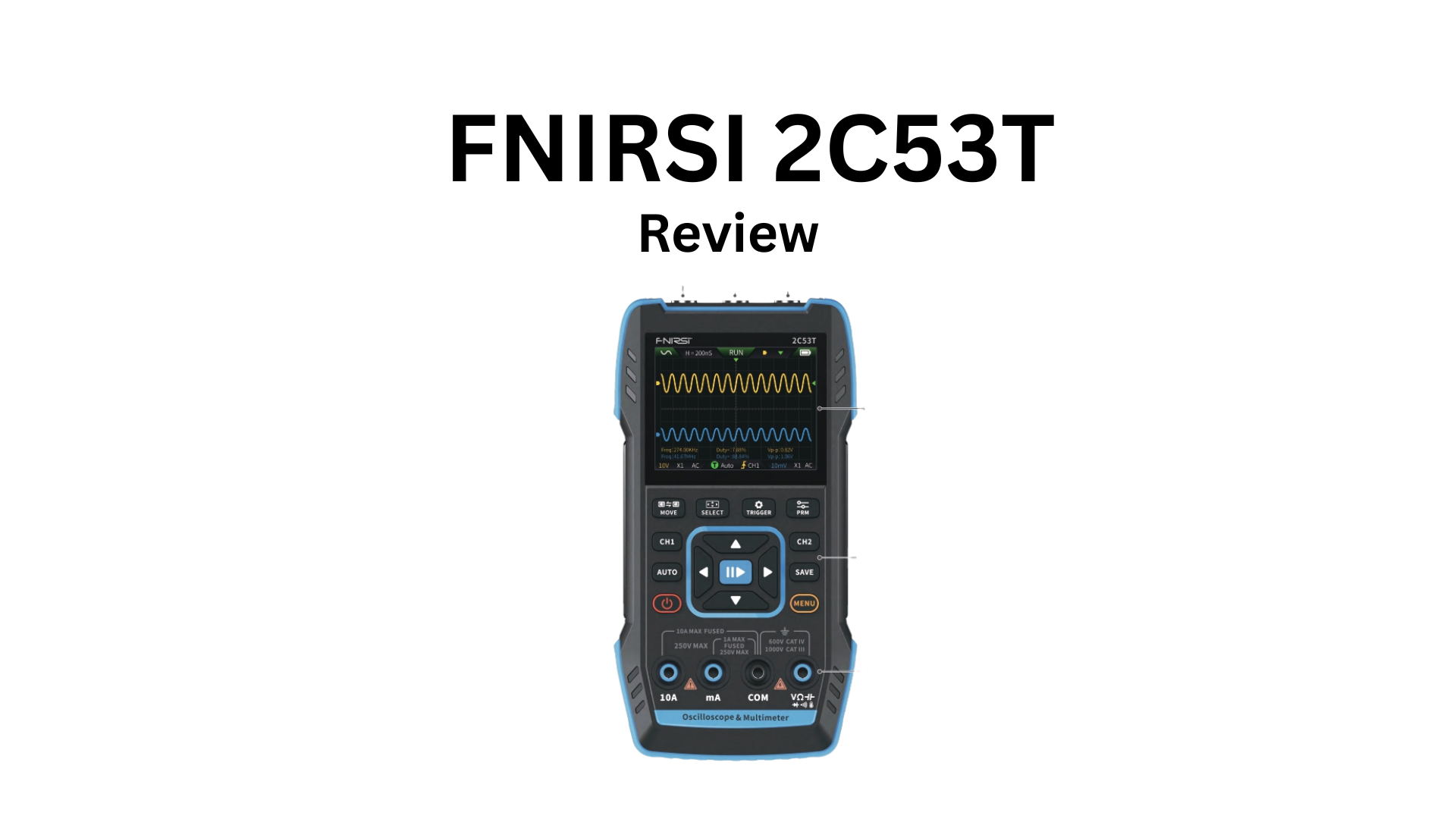
The 2C53T features a 2.8-inch TFT colour display, hardware controls with a flip-out stand, and a rechargeable lithium battery for true portable operation. Unlike tablet-style oscilloscopes, this device emphasises compactness over screen size—you sacrifice display real estate for genuine pocket portability.
Order your 2C53T today – 2-day UK delivery, 60-day easy returns
Check the manual for 2C53T
Key Specifications of the Fnirsi 2C53T
Before diving into real-world performance, let me outline what the Fnirsi 2C53T offers across its three main functions.
Display and Interface
The 2.8-inch TFT colour display offers 320×240 pixel resolution. While compact, the screen is bright and intuitive, though it can feel crowded when displaying multiple measurement parameters simultaneously. For a handheld device, the display quality is acceptable, but don’t expect the clarity of larger tablet-style oscilloscopes.
The interface relies on physical buttons rather than touchscreen controls. This includes a 90-degree flip-out stand for hands-free bench use and dedicated buttons for navigation and parameter adjustment. Four recessed probe ports at the bottom serve the multimeter, while three BNC connectors at the top handle the oscilloscope and signal generator connections.
The button-based interface works but can feel “fiddly” for certain operations, particularly cursor adjustments. Users accustomed to rotary encoders or touchscreens may find the navigation less intuitive initially.
Channel Count, Bandwidth, and Sampling Rate
The oscilloscope section features:
Specifications:
- 2 channels with 50 MHz bandwidth
- Maximum 250 MSa/s sampling rate
- XY mode for Lissajous figures
- FFT analysis capability
- Persistence display (mimics CRT phosphor glow)
- 14 measurement parameters per channel
- Cursor measurements (X and Y)
Critical consideration—shared sampling rate:
The 250 MSa/s sampling rate is shared between both channels. When only one channel is active, it receives the full sampling rate. However, when both channels are enabled, this drops to 125 MSa/s per channel. This has significant implications for high-frequency dual-channel measurements, which I’ll discuss in the performance section.
Memory Depth and Triggering Features
The device supports standard oscilloscope triggering modes and includes cursor measurements for both time (X) and voltage (Y) axes. The 14 measurement parameters per channel provide comprehensive automatic measurements including frequency, period, duty cycle, and voltage parameters.
The persistence function is a notable addition, mimicking the phosphor “glow” of traditional cathode ray tube oscilloscopes. This helps visualise signal behaviour over time and identify intermittent events.
Multimeter Specifications
The built-in True RMS digital multimeter provides:
- 20,000-count resolution (upgraded from 10,000 on previous model)
- 0.5% basic DC accuracy
- DC/AC voltage measurement
- Current measurement up to 10A
- Resistance measurement
- Capacitance measurement
- Frequency measurement
- Temperature measurement
- Continuity and diode testing
Signal Generator Specifications
The DDS signal generator offers:
- 13 different waveforms (sine, square, sawtooth, Lorentz, and more)
- Frequency range: up to 50 kHz maximum
- Maximum output: 3V peak-to-peak
- Output is positive relative to ground (no bipolar output)
Important note: The signal generator frequency has been significantly reduced from the 2 MHz capability of the previous 2C23T model to just 50 kHz on this version.
Unboxing and First Impressions of the Fnirsi 2C53T
When the Fnirsi 2C53T arrives, you’ll find it well-packaged with a comprehensive accessory kit. Inside the box, you typically get:
- The 2C53T main unit
- Two 100 MHz oscilloscope probes
- Multimeter test leads
- USB-C charging cable
- Semi-rigid carrying case
- User manual
My first impression upon unboxing was genuinely positive. The device feels sturdy despite its compact size, with a hard plastic case protected by blue rubber-like material on the corners to withstand knocks and drops. This is clearly designed for field use where equipment takes a beating.
The inclusion of two 100 MHz oscilloscope probes is excellent—you can use both channels immediately without additional purchases. The semi-rigid carrying case is high quality and protects the device along with all accessories during transport.
The 90-degree flip-out stand is a thoughtful addition, allowing hands-free operation on a bench. The overall build quality suggests this device is built to last despite its budget-friendly price point.
One ergonomic note: the BNC connectors at the top are recessed and spaced tightly together. If you have larger fingers, plugging and unplugging probes can be fiddly. It’s a minor annoyance but worth mentioning.
Setup and Calibration Guide
Getting the Fnirsi 2C53T up and running is straightforward, with the compact interface requiring a brief familiarisation period.
Connecting Probes and Grounding
Connect your oscilloscope probes to the BNC inputs at the top of the device. The connectors are standard but recessed, so take care when connecting. Set probe attenuation switches appropriately (1× or 10×) and ensure the oscilloscope’s probe setting matches.
For multimeter measurements, connect test leads to the four recessed ports at the bottom of the unit. The ports are labelled for voltage/resistance, current, and common connections.
Grounding consideration: Like most combination instruments, be aware of ground connections when using multiple functions simultaneously. The oscilloscope ground and multimeter common share connections internally, so consider ground paths when testing circuits.
Quick Calibration Steps
For oscilloscope probe compensation:
- Connect a probe to Channel 1
- Attach the probe tip to the calibration output
- View the square wave calibration signal
- If corners appear rounded or show overshoot, adjust the probe compensation screw
- Repeat until square wave corners are sharp 90-degree angles
The multimeter section is factory calibrated and doesn’t require user adjustment. Testing shows accuracy often exceeds the stated 0.5% specification for DC measurements.
Performance Tests in the Fnirsi 2C53T Review
I tested the Fnirsi 2C53T across all three functions to understand exactly what this compact device can handle. Here’s what I found.
Signal Fidelity and Noise Floor
The oscilloscope section performs well for a handheld device at this price point. The 50 MHz bandwidth is honestly specified, and signal clarity is acceptable for typical hobbyist frequencies.
The persistence function, which mimics traditional CRT phosphor glow, is genuinely useful for visualising signal behaviour and identifying intermittent events. The FFT analysis adds value for frequency-domain work, though the small screen limits detailed analysis.
The internal construction reveals quality attention to EMI shielding. Teardowns show a metal “can” (likely mu-metal) covering the oscilloscope inputs to reduce electromagnetic interference and noise for more accurate signal capture.
Rise Time and Frequency Response
The 50 MHz bandwidth provides adequate performance for audio work, basic digital debugging, and general electronics troubleshooting. For typical hobbyist applications—Arduino projects, audio amplifiers, basic repair work—the oscilloscope section handles most tasks competently.
Trigger Stability and Capture Accuracy
Triggering works reliably for stable, repetitive signals within the device’s bandwidth. The cursor measurements (X and Y) provide manual measurement capability, though adjusting cursors via the button-based interface can be “fiddly” compared to traditional rotary encoders.
The shared sampling rate issue:
This is the most significant limitation of the oscilloscope section. When both channels are active, the 250 MSa/s sampling rate splits to 125 MSa/s per channel. This has real practical consequences:
- A 40 MHz signal receives only about 3 samples per waveform in dual-channel mode
- Waveforms that appear clean in single-channel mode become distorted when the second channel is enabled
- Aliasing risk increases significantly at higher frequencies with both channels active
- For accurate high-frequency measurements, disable the second channel to regain full sampling capability
For most hobbyist work at lower frequencies, this limitation is manageable. But if you regularly need dual-channel measurements of faster signals, be aware of this trade-off.
Multimeter Accuracy Testing
The True RMS multimeter section genuinely impressed me. The 20,000-count resolution (upgraded from 10,000 on the previous model) provides excellent measurement detail.
Accuracy highlights:
- 0.5% basic DC accuracy is honestly specified
- Testing shows the device often performs better than stated specifications
- Voltage and resistance measurements are highly reliable
- Comparison with professional-grade equipment shows excellent agreement
Speed considerations:
- Continuity testing is nearly instantaneous in manual mode
- The “Smart” auto-detection mode introduces a two-second lag
- For rapid continuity checks, use manual mode for best responsiveness
The multimeter is genuinely capable for a built-in function, rivalling many standalone budget multimeters in accuracy and features.
Signal Generator Performance
The signal generator is the most limited of the three functions, with significant trade-offs compared to the previous 2C23T model.
The 50 kHz frequency limitation:
The maximum frequency has been reduced from 2 MHz (on the 2C23T) to just 50 kHz on this model. Reviewers describe this as a potential “deal-breaker” if the 2C53T is your primary testing tool. While suitable for:
- Basic amplifier stage testing
- Audio waveform generation
- Low-frequency filter testing
It’s entirely insufficient for:
- High-frequency circuit testing
- RF applications
- Matching the oscilloscope’s 50 MHz bandwidth with native test signals
Signal quality issues:
- Waveforms show visible “staircase” patterns (quantization steps) when examined closely
- Sine waves appear flattened at the bottom
- Maximum amplitude limited to 3V peak-to-peak
- Output is entirely positive relative to ground (no bipolar output capability)
The signal generator is best viewed as a convenient bonus feature for basic testing rather than a precision signal source.
User Interface and Controls
The button-based interface is functional but requires adjustment if you’re accustomed to touchscreens or rotary encoders.
Menu Navigation
Navigation uses physical buttons with clear labelling. The interface is logical once learned, but certain operations—particularly cursor adjustments and trigger settings—can feel cumbersome compared to devices with rotary controls.
The “Smart” auto-detection mode for the multimeter is convenient but introduces lag. For faster operation, manual mode selection is recommended.
The 2.8-inch screen can feel crowded when displaying multiple parameters simultaneously. The trade-off for pocket portability is reduced screen real estate for information display.
Waveform Display Options
The oscilloscope supports:
- Dual-channel simultaneous display
- 14 automatic measurement parameters per channel
- Cursor measurements (X and Y axes)
- XY mode for Lissajous figures
- FFT frequency analysis
- Persistence display mode
The persistence function is particularly useful, providing visual indication of signal stability and repetition that basic LCD displays cannot show.
Battery Life and Portability
True pocket portability is the Fnirsi 2C53T’s defining feature, and it delivers genuinely impressive mobile capability.
The built-in 3,000mAh lithium battery provides approximately 4.5 to 6 hours of continuous operation with both the oscilloscope and signal generator active. For typical intermittent use, expect a full working day between charges.
Portability advantages:
- Genuinely pocket-sized form factor
- Lightweight with protective corner bumpers
- 90-degree flip-out stand for bench use
- Semi-rigid carrying case included
- USB-C charging from standard chargers or power banks
Battery details:
- Charges via USB-C port
- LED indicator changes from red to green when fully charged
- Battery is cable-connected internally, making eventual replacement relatively straightforward
- 3,000mAh capacity (11.1 Wh)
The compact size makes this device genuinely portable in ways that larger tablet-style oscilloscopes cannot match. It’s a tool you can carry in a tool bag, glove box, or large pocket for field work.
Software and Firmware Updates
The Fnirsi 2C53T runs embedded firmware controlling all functions. The device is generally responsive, though some users note minor interface lag in certain modes.
Firmware updates may be available from Fnirsi to address bugs or improve functionality. Check the manufacturer’s website for the latest version and update instructions.
Comparison: Fnirsi 2C53T vs Competitors
How does the Fnirsi 2C53T stack up against other options in the portable test equipment market?
Value for Money
At under £100, the 2C53T offers exceptional value for a 3-in-1 handheld device. The inclusion of two 100 MHz oscilloscope probes and a quality carrying case adds significant value to the package.
Fnirsi 2C23T (previous model): The older model offered 2 MHz signal generator capability versus the 2C53T’s 50 kHz limit. However, the 2C53T has an upgraded oscilloscope section with XY mode, FFT analysis, and persistence display. The multimeter is also improved to 20,000 counts from 10,000. Choose the 2C53T for better oscilloscope features; consider finding a 2C23T if signal generator frequency is critical.
Fnirsi 2D15P: The 2D15P is a larger benchtop-style 3-in-1 with a 4.3-inch screen, rotary encoders, and 100 MHz oscilloscope bandwidth. It offers a 10 MHz signal generator (versus 50 kHz) but is significantly larger and less pocket-portable. Choose the 2D15P for better specifications and interface; choose the 2C53T for true pocket portability.
Fnirsi 1013D (£125.00): The 1013D is a tablet-style oscilloscope only (no multimeter or signal generator) with a 7-inch touchscreen. It offers larger display but fewer functions. Choose the 1013D for a bigger screen and dedicated oscilloscope use; choose the 2C53T for 3-in-1 functionality in a smaller package.
Owon HDS242S (approximately £180-250): The Owon offers a built-in multimeter with better accuracy and more honest specifications. It lacks a signal generator but provides more reliable measurements. Choose the Owon for measurement accuracy; choose the 2C53T for signal generator inclusion and lower price.
Feature Comparison
| Feature | Fnirsi 2C53T | Fnirsi 2D15P | Fnirsi 1013D | Owon HDS242S |
|---|---|---|---|---|
| Price | Under £100 | Check store | £125.00 | ~£200 |
| Bandwidth | 50 MHz | 100 MHz | ~20-30 MHz | 40 MHz |
| Sampling Rate | 250 MSa/s | 500 MSa/s | 200 MSa/s | 250 MSa/s |
| Channels | 2 | 2 | 2 | 2 |
| Screen | 2.8″ TFT | 4.3″ IPS | 7″ Touch | 3.5″ |
| Multimeter | Yes (20,000 count) | Yes (20,000 count) | No | Yes |
| Signal Generator | Yes (50 kHz) | Yes (10 MHz) | No | No |
| Battery | Yes (3,000mAh) | Yes (5,000mAh) | Yes (6,000mAh) | Yes |
| Form Factor | Handheld | Benchtop | Tablet | Handheld |
| Probes Included | 2× 100 MHz | Standard | Standard | Standard |
Pros and Cons from the Fnirsi 2C53T Review
Pros:
- Exceptional value at under £100 for a 3-in-1 device
- Genuinely pocket-portable form factor
- Includes two 100 MHz oscilloscope probes
- High-quality semi-rigid carrying case included
- 20,000-count True RMS multimeter with excellent DC accuracy
- Dual-channel oscilloscope with XY mode, FFT, and persistence display
- Sturdy build with protective corner bumpers
- 3,000mAh battery provides 4.5-6 hours operation
- USB-C charging for convenience
- Well-constructed internally with good EMI shielding
- Continuity testing is instantaneous in manual mode
- 90-degree flip-out stand for hands-free use
Cons:
- Signal generator limited to 50 kHz maximum (down from 2 MHz on previous model)
- Signal generator output shows visible quantization steps
- Sampling rate shared between channels (125 MSa/s each when both active)
- 2.8-inch screen can feel crowded with multiple parameters
- BNC connectors recessed and tightly spaced (difficult for larger fingers)
- Button-based cursor adjustment is fiddly
- “Smart” auto-detection mode introduces two-second lag
- Sine wave output appears flattened at bottom
- Signal generator output is positive-only (no bipolar capability)
- Manufacturer has sanded off IC markings internally
- Not suitable for high-frequency or precision laboratory work
Typical Use Cases and Who Should Buy the Fnirsi 2C53T
The Fnirsi 2C53T is ideal for:
- Field service technicians: The genuinely pocket-portable size and comprehensive 3-in-1 functionality make this perfect for on-site diagnostics where carrying multiple instruments isn’t practical.
- Electronics students: Learning oscilloscope, multimeter, and signal generator fundamentals with one affordable device that can be carried to class or lab sessions.
- Hobbyists with limited space: If your workspace can’t accommodate multiple bench instruments, the 2C53T provides essential functions in a minimal footprint.
- Mobile repair technicians: Automotive, appliance, or electronics repair work where portability matters more than laboratory precision.
- Secondary/backup instrument: Experienced engineers who need a portable backup to their main bench equipment for quick field checks.
- Audio frequency work: The 50 kHz signal generator and 50 MHz oscilloscope handle audio-frequency testing competently.
- Arduino and basic microcontroller projects: General debugging and signal verification well within the device’s capabilities.
Who should look elsewhere:
- Anyone needing high-frequency signal generation: The 50 kHz limit is severely restrictive for RF or high-speed digital work.
- Users requiring precision waveforms: The stepped/quantized signal generator output is unsuitable for precision analog testing.
- High-frequency dual-channel measurements: The shared sampling rate significantly degrades performance when both channels are active at higher frequencies.
- Those preferring larger displays: The 2.8-inch screen is adequate but cramped for detailed analysis.
- Laboratory-grade precision requirements: This is a capable field tool, not a precision laboratory instrument.
Common Issues and Troubleshooting Tips
Through my testing and research into user experiences, several common issues emerge with the Fnirsi 2C53T. Here’s what to watch for and how to address problems.
Shared Sampling Rate Affecting Dual-Channel Measurements
When both channels are active, sampling rate drops from 250 MSa/s to 125 MSa/s per channel:
- High-frequency signals may appear distorted in dual-channel mode
- For critical high-frequency measurements, disable the second channel
- Be aware of increased aliasing risk with both channels active
- Signals that look clean single-channel may become unclear dual-channel
Slow Response in Smart Auto-Detection Mode
The multimeter’s “Smart” mode introduces approximately two-second lag:
- Switch to manual mode for faster measurements
- Manual continuity testing is nearly instantaneous
- Use Smart mode only when convenience outweighs speed requirements
Fiddly BNC Connector Access
The recessed, tightly-spaced BNC connectors can be difficult to use:
- Take your time when connecting/disconnecting probes
- Consider probes with smaller BNC shells if this is a frequent frustration
- The tight spacing is a trade-off for compact size
Signal Generator Quantization Visible
Waveforms show “staircase” stepping when examined closely:
- This is normal for DDS signal generators at this price point
- Accept this limitation for general testing
- Use external signal generator for precision analog work
- The sine wave’s flattened bottom is a known characteristic
Screen Feels Crowded
The 2.8-inch display can be overwhelming with multiple parameters:
- Reduce displayed measurements to essential parameters
- Use cursor measurements selectively rather than continuously
- Accept the trade-off for pocket portability
Button Interface Learning Curve
Cursor and trigger adjustments via buttons can be cumbersome:
- Spend time learning the button combinations
- The interface becomes more natural with practice
- Consider this device as a field tool where quick adjustments matter less
Accessories and Optional Add-Ons
The Fnirsi 2C53T comes well-equipped with accessories, but a few additions can enhance your experience:
Included accessories (excellent value):
- Two 100 MHz oscilloscope probes (ready for dual-channel use)
- Multimeter test leads
- Semi-rigid protective carrying case
- USB-C charging cable
Recommended additions:
- Higher-quality multimeter leads: The stock leads are adequate, but sharper probe tips improve continuity testing responsiveness. Budget: £10-20.
- BNC adapters: For connecting to various signal sources or test equipment. Budget: £5-15.
- USB power bank: For extended field work beyond the 4.5-6 hour battery life. Budget: £20-40.
- Probe tip accessories: Hook clips and grabbers make hands-free probing easier. Budget: £10-20.
- External signal generator: If the 50 kHz limitation proves restrictive, a dedicated signal generator addresses this weakness. Budget: £30-100.
Final Verdict: Is the Fnirsi 2C53T Worth It?
After extensive testing, here’s my honest assessment: the Fnirsi 2C53T is a genuinely impressive pocket-sized 3-in-1 tool that delivers exceptional value with clearly understood limitations.
The multimeter section is the standout performer. The 20,000-count True RMS capability with 0.5% DC accuracy rivals standalone budget multimeters, and testing shows it often exceeds stated specifications. For a built-in function, this is remarkable.
The oscilloscope section is capable for its intended purpose. The 50 MHz bandwidth, persistence display, XY mode, and FFT analysis represent meaningful improvements over the previous model. The shared sampling rate between channels is a limitation for high-frequency dual-channel work, but for typical hobbyist applications, it performs well.
The signal generator is the weak link. The reduction from 2 MHz (previous model) to 50 kHz is significant, and the stepped waveform output limits precision applications. Consider it a convenience feature for basic testing rather than a serious signal source.
My recommendation:
If you need a genuinely pocket-portable 3-in-1 tool for field service, mobile repair, or general electronics work where carrying multiple instruments isn’t practical, the Fnirsi 2C53T at under £100 represents exceptional value. The inclusion of two 100 MHz probes and a quality carrying case adds to the package.
If you need high-frequency signal generation, precision waveforms, or laboratory-grade measurements, look to larger devices like the Fnirsi 2D15P or dedicated instruments.
The Fnirsi 2C53T is exactly what it claims to be: a compact lab in your pocket that handles most hobbyist-level diagnostics competently, provided you understand and work within its limitations.
Where to Buy and Pricing Overview
The Fnirsi 2C53T is available from multiple sources:
FNIRSI Oscilloscope Store — Check current pricing for UK customers with dedicated support.
Amazon UK — Typically offers quick delivery with Amazon’s returns policy.
AliExpress — Prices vary; watch for shipping times and import duties.
For UK buyers, check the FNIRSI Oscilloscope Store for current pricing and availability.
[Buy Now – Check Current Price with UK Delivery]
Frequently Asked Questions (FAQ) About the Fnirsi 2C53T
What is the battery life of the Fnirsi 2C53T?
The built-in 3,000mAh lithium battery provides approximately 4.5 to 6 hours of continuous operation with both the oscilloscope and signal generator active. Actual runtime depends on which functions you’re using and screen brightness. The device charges via USB-C, and a small LED indicator changes from red to green when fully charged. For typical intermittent field use, expect a full working day between charges.
How does the shared sampling rate affect measurements?
The Fnirsi 2C53T’s 250 MSa/s sampling rate is shared between both oscilloscope channels. When only one channel is active, it receives the full sampling rate. When both channels are enabled, this drops to 125 MSa/s per channel. This significantly affects high-frequency signal reconstruction—a 40 MHz signal receives only about 3 samples per waveform in dual-channel mode. For accurate high-frequency measurements, disable the second channel to regain full sampling capability.
Why is the signal generator limited to 50 kHz?
The Fnirsi 2C53T’s signal generator maximum frequency has been reduced from 2 MHz (on the previous 2C23T model) to 50 kHz on this version. This appears to be a design trade-off to improve other aspects of the device, particularly the oscilloscope section. While suitable for audio-frequency testing and basic amplifier work, it’s insufficient for high-frequency circuit testing. If signal generator frequency is critical to your work, consider the 2C23T or a device like the 2D15P with 10 MHz capability.
How does the reduced 50 kHz signal generator limit practical circuit testing?
The 50 kHz limitation restricts the signal generator to low-frequency applications only. It’s suitable for testing basic amplifier stages, audio circuits, and low-frequency filters. However, it’s entirely insufficient for high-frequency or RF testing, and cannot provide test signals matching the oscilloscope’s 50 MHz bandwidth. Additionally, the digitally-generated waveforms show visible quantization steps, the sine wave appears flattened at the bottom, and the output is limited to 3V peak-to-peak with positive-only output relative to ground.
Is the Fnirsi 2C53T multimeter accurate?
Yes, the True RMS multimeter section is impressively accurate. It offers 20,000-count resolution with 0.5% basic DC accuracy, and testing shows it often performs better than stated specifications. Voltage and resistance measurements show excellent agreement with professional-grade equipment. The continuity tester is nearly instantaneous in manual mode, though the “Smart” auto-detection mode introduces a two-second lag.
What’s included in the box?
The Fnirsi 2C53T comes with excellent accessories: the main unit, two 100 MHz oscilloscope probes (allowing immediate dual-channel use), multimeter test leads, USB-C charging cable, a high-quality semi-rigid carrying case, and user manual. The inclusion of two quality probes represents significant added value.
How does the 2C53T compare to the previous 2C23T model?
The 2C53T improves on the 2C23T with: upgraded 20,000-count multimeter (from 10,000), added XY mode, FFT analysis, and persistence display for the oscilloscope. However, the signal generator frequency has been significantly reduced from 2 MHz to 50 kHz. Choose the 2C53T for better oscilloscope features; consider the 2C23T if signal generator frequency is more important.
Is the build quality good?
Yes, the Fnirsi 2C53T demonstrates good build quality for its price point. It features a sturdy hard plastic case with protective blue rubber-like corner bumpers. Internal teardowns reveal clean construction with dual ceramic fuse protection, good EMI shielding (metal can over oscilloscope inputs), and quality components. The manufacturer has sanded off IC markings to prevent competitor identification, but this doesn’t affect functionality.
Can I replace the battery?
The 3,000mAh lithium battery is connected via a cable internally rather than being soldered directly to the board, making eventual replacement relatively straightforward for someone comfortable opening electronic devices. This is a thoughtful design choice for long-term serviceability.
Is the Fnirsi 2C53T good for beginners?
Yes, the Fnirsi 2C53T is well-suited for beginners learning electronics. The combination of oscilloscope, multimeter, and signal generator in one affordable, portable package provides all essential tools for learning. The under £100 price point makes it accessible for students. However, beginners should understand the shared sampling rate limitation and signal generator restrictions to avoid confusion during learning.