Fnirsi DPS-150 Review: Full Hands-On Evaluation
If you’re looking for a portable programmable power supply that can replace bulky benchtop units for field work and general electronics, the Fnirsi DPS-150 deserves serious consideration. I’ve spent considerable time testing this pocket-sized DC power supply, and I want to give you a completely honest assessment of what this compact device can and cannot do.
The Fnirsi DPS-150 has positioned itself as a serious alternative to traditional bench power supplies, offering impressive specifications in a form factor that fits in your hand. In this comprehensive review, I’ll cut through the marketing and show you exactly what you’re getting for your money.
Key Takeaways
- Compact programmable DC power supply rated for 30V/5A (150W maximum)
- Exceptional 96.3% full load efficiency with excellent voltage accuracy
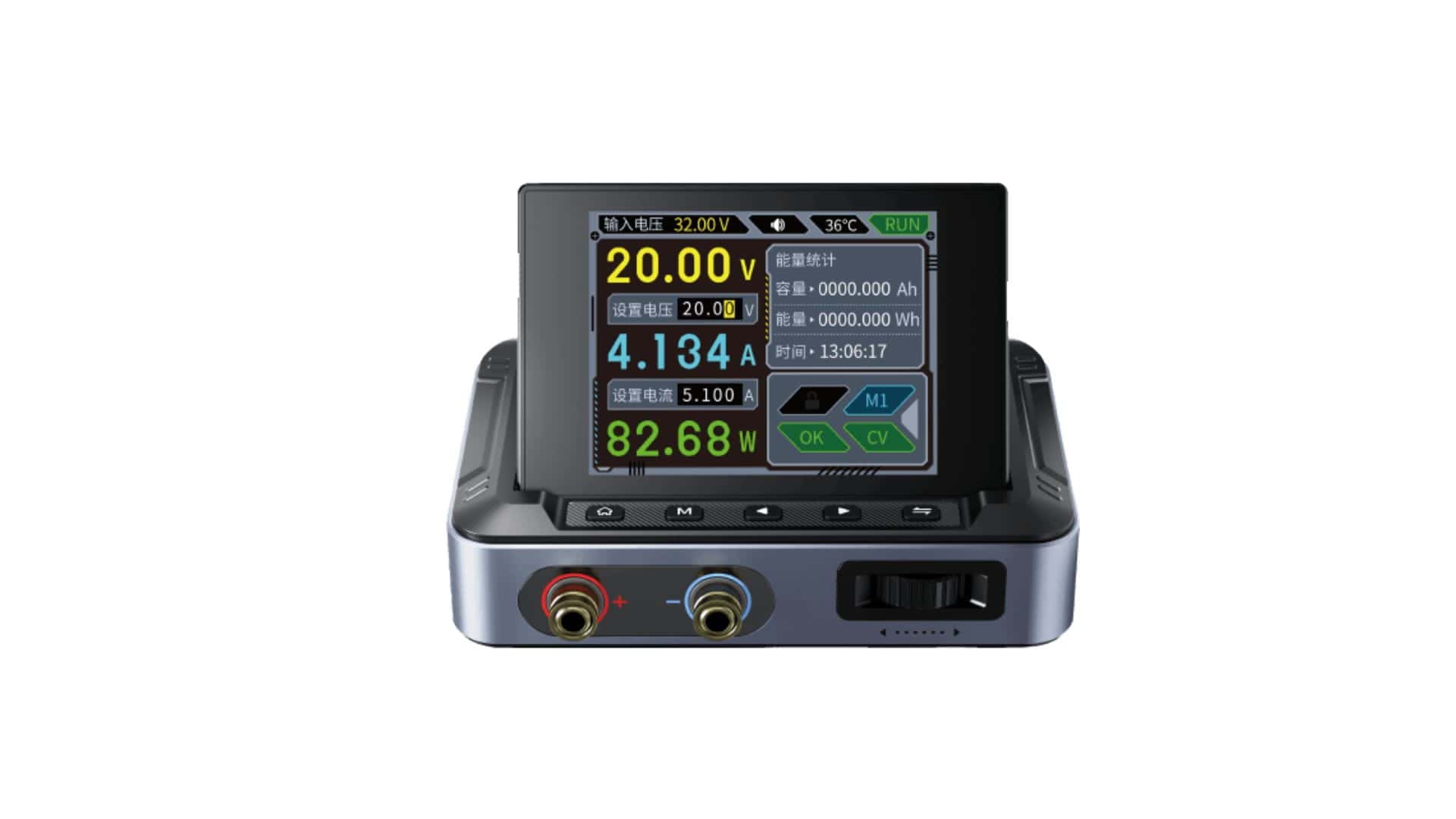
- 2.8-inch IPS colour display that tilts up to 90 degrees
- Dual input options: USB-C Power Delivery or DC barrel jack
- Waveform display mode plots voltage and current over time
- PC software integration for remote control and automated testing
- Six preset storage groups for quick recall
- AC ripple varies significantly based on input source (193mV AC vs 2.25mV battery)
- Software-based protection has slow 400-650ms response time
- Excellent for automotive diagnostics and general hobbyist work
- Not recommended for sensitive computer module programming without battery input
Overview of the Fnirsi DPS-150 Programmable Power Supply
The Fnirsi DPS-150 positions itself as a pocket-sized replacement for traditional benchtop power supplies. It functions as a buck converter—a device that steps down a higher input voltage to a lower, regulated output voltage—packed into a compact, portable form factor.
What makes the DPS-150 compelling is its combination of serious power delivery (up to 150W) with genuine portability. You can power it from a USB-C PD charger or laptop adapter, making it ideal for field work, automotive diagnostics, or workspaces where a full-sized bench supply isn’t practical.
The device targets automotive technicians, electronics hobbyists, and anyone who needs precise, programmable DC power without the bulk and expense of traditional laboratory equipment. With features like waveform display, PC integration, and preset storage, it punches well above what you’d expect from its compact size.
Order your DPS-150 today – 2-day UK delivery, 60-day easy returns
Check the manual for DPS 150
Key Specifications of the Fnirsi DPS-150
Before diving into real-world performance, let me outline what the Fnirsi DPS-150 offers.
Display and Interface
The standout 2.8-inch IPS colour display can tilt up to 90 degrees for better visibility at different angles—a thoughtful ergonomic feature for bench or field use. The screen is bright, clear, and shows all essential parameters at a glance.
Navigation is handled through five tactile buttons and a rotary encoder. The rotary encoder is a dial that allows precise, clicking adjustments of values like voltage and current. This combination provides intuitive control without the complexity of touchscreen menus.
The interface includes a waveform display mode that plots voltage and current over time, similar to an oscilloscope. This is invaluable for monitoring power delivery during testing and identifying transient issues.
Power Specifications
Output ratings:
- Maximum voltage: 30V
- Maximum current: 5A
- Maximum power: 150W
- Voltage resolution: 10mV
- Current resolution: 1mA
- Voltage accuracy: 0.1%
Input options:
- USB-C Power Delivery (PD)
- DC barrel jack (traditional adapter)
The dual input options significantly enhance portability. You can power the unit from a laptop charger, high-capacity power bank, or traditional DC adapter depending on your situation.
Advanced Features
- Waveform display: Real-time voltage and current plotting
- PC integration: Remote control via micro-USB and free software
- Preset storage: Six groups of voltage/current settings
- Protection modes: OVP (Over-Voltage Protection) and OCP (Over-Current Protection)
- Energy metering: mAh and mWh tracking for charge monitoring
Unboxing and First Impressions of the Fnirsi DPS-150
When the Fnirsi DPS-150 arrives, you’ll find it well-packaged. Inside the box, you typically get:
- The DPS-150 main unit
- USB-C power cable
- Micro-USB data cable (for PC connection)
- Test leads with banana plugs
- User manual
My first impression upon unboxing was genuinely positive. The robust aluminium case feels premium and durable—this is clearly built for field use where equipment takes a beating. The tilting IPS display is bright and readable from various angles.
The rotary encoder has a satisfying click with each detent, making precise adjustments intuitive. The five tactile buttons are well-positioned and responsive.
One minor ergonomic issue: The output banana jacks are not spaced at the industry-standard 19mm, meaning some dual-plug accessories won’t fit. You’ll need to use the included leads or single banana plugs rather than dual-spaced connectors.
The overall build quality suggests serious engineering went into this device despite its compact size and budget-friendly price point.
Setup and Calibration Guide
Getting the Fnirsi DPS-150 up and running is straightforward.
Connecting Power Input
You have two options for powering the unit:
USB-C Power Delivery:
- Connect a USB-C PD charger or power bank to the USB-C port
- Ensure your power source supports sufficient wattage for your intended output
- The unit negotiates power delivery automatically
DC Barrel Jack:
- Connect a suitable DC adapter (check voltage requirements)
- This option may provide cleaner power depending on adapter quality
Important consideration: Your input power source significantly affects output noise and ripple. Battery or high-quality power bank input provides much cleaner output than typical AC adapters.
Basic Operation
- Power on the unit using the power button
- Use the rotary encoder to adjust voltage (press to switch between voltage and current)
- Set your desired output voltage and current limit
- Press the output enable button to activate power delivery
- Monitor real-time values on the display
Setting Up Presets
The DPS-150 can store six preset configurations:
- Set your desired voltage and current values
- Navigate to the preset storage menu
- Save to one of six available slots
- Recall presets quickly during work
PC Software Connection
- Connect the micro-USB port to your computer
- Install the free FNIRSI PC software
- The software provides remote control, data logging, and automated testing capabilities
Performance Tests in the Fnirsi DPS-150 Review
I tested the Fnirsi DPS-150 across various scenarios to understand exactly what this compact power supply can handle. Here’s what I found.
Voltage Accuracy and Stability
The DPS-150’s voltage accuracy is exceptional for a device at this price point. In side-by-side testing with calibrated multimeters, the output voltage was virtually “spot-on,” typically matching within 0.01V to 0.1V.
The 0.1% accuracy specification is genuine—this is precision you’d expect from much more expensive equipment. The 10mV resolution allows fine adjustments for applications requiring specific voltages like 1.8V, 3.3V, or 5V logic levels.
Load Regulation
Load regulation—the ability to maintain constant voltage despite changes in current draw—is excellent. Testing shows less than 20mV drop when shifting from no load to a 2.5A load. This stability is crucial for powering sensitive electronics that require consistent voltage regardless of their current consumption.
Conversion Efficiency
The DPS-150 achieves an impressive 96.3% full load efficiency. This means very little energy is wasted as heat, which is particularly important in a compact device without active cooling. High efficiency also means longer runtime when powered from battery sources.
Ripple and Noise Performance
This is where the DPS-150’s performance varies dramatically based on your input source.
AC adapter input (typical scenario): Under a 3.3A load with AC power, ripple measured at 193mV. This is acceptable for general automotive work (maximum acceptable is typically 250mV) but too high for sensitive computer modules (which often require below 50mV).
Battery/high-quality input: When powered by a battery or high-quality power bank, ripple drops dramatically to as low as 2.25mV. At this level, the DPS-150 performs comparably to professional linear laboratory power supplies—the gold standard for clean, low-noise power.
Why the difference?
AC adapters are switching power supplies that turn electricity on and off rapidly (thousands of times per second) to change voltage efficiently. This rapid switching creates noise that can bleed through to the DPS-150’s output. The device may lack sufficient internal capacitance to filter all this noise under heavy loads.
Batteries provide steady, chemical-based electricity without high-frequency switching, naturally producing a much “quieter” signal. Battery power also eliminates ground loops—unwanted current flows through ground wires when multiple devices share the same outlet.
Protection Response Speed
The DPS-150 includes OVP (Over-Voltage Protection) and OCP (Over-Current Protection) safety features. However, these protections are implemented in software rather than hardware.
Response time: Testing reveals 400ms to 650ms delay before shutdown after a fault is detected.
The concern: In microelectronics, half a second is a long time. This delay is “enough to damage most sensitive equipment” before power actually cuts off. A hardware-based protection system would respond virtually instantaneously.
Additional bug: Some tests revealed a potential issue where protection only triggers once. After a trip, the unit might require a full power cycle (turning off and on) to reactivate safety features.
For general hobbyist work, these limitations are acceptable. For high-stakes bench programming of sensitive modules, the slow protection response is a genuine concern.
User Interface and Controls
The button-and-encoder interface is well-designed for the device’s purpose.
Physical Controls
- Rotary encoder: Primary adjustment for voltage and current values with satisfying click feedback
- Five tactile buttons: Power, output enable, menu navigation, and function selection
- Tilting display: Adjusts up to 90 degrees for optimal viewing angle
Display Modes
Standard mode: Shows voltage, current, power, and status information in clear digital readouts.
Waveform mode: Plots voltage and current over time like an oscilloscope, invaluable for:
- Monitoring power delivery stability
- Identifying transient spikes or drops
- Visualising load behaviour over time
Menu System
The menu provides access to:
- Protection settings (OVP/OCP thresholds)
- Preset storage and recall
- Display brightness and themes
- System information and calibration
Navigation is intuitive once you learn the button functions, though the small screen means some menu diving is required for less common settings.
Battery Life and Portability
True portability is the Fnirsi DPS-150’s defining advantage over traditional bench supplies.
Power Input Flexibility
The dual input options (USB-C PD and DC barrel jack) make the unit genuinely field-ready:
- USB-C PD: Powers from laptop chargers, phone chargers, or power banks
- DC barrel jack: Traditional adapter for bench use
- Power bank operation: Provides isolation from mains and cleaner output
Portable Use Cases
- Automotive diagnostics: Test sensors and modules at the vehicle
- Field service: Bring programmable power anywhere
- Mobile workbench: Full power supply capability without bulk
- Educational settings: Easy to transport between locations
Size and Weight
The aluminium case is robust yet compact—genuinely pocket-sized for a 150W power supply. The tilting display and tactile controls work well for handheld or bench-mounted operation.
Software and PC Integration
The Fnirsi DPS-150 transforms into a sophisticated automated testing tool when connected to a computer.
Connection and Setup
- Connect via micro-USB port to your computer
- Install the free FNIRSI PC software
- The software communicates via serial connection
Remote Control Features
The PC software provides:
- Full remote control of voltage and current settings
- Real-time monitoring with live chart display
- Data logging for long-term recording
- Preset management from computer interface
Automated Testing Capabilities
Custom profiles and sequences: Program the unit to follow automated voltage/current changes over time. For example: 5V for ten seconds, jump to 12V for five seconds, then drop to 3.3V—all automatic.
Voltage and current sweeps: Automatically sweep through a range of values (e.g., 1V to 10V in 0.1V increments) to find circuit trip points or characterise component behaviour.
Arbitrary voltage curves: Create custom waveforms to simulate real-world conditions, such as fluctuating car battery voltage during engine cranking, to stress-test hardware.
Data logging: Record every measurement over time for later analysis. Essential for catching transient events too fast for human observation.
These capabilities transform the DPS-150 from a simple power supply into a powerful tool for quality control, fault diagnosis, and automated testing.
Comparison: Fnirsi DPS-150 vs Competitors
How does the Fnirsi DPS-150 stack up against other portable power supply options?
Value for Money
The DPS-150 offers exceptional value for a programmable power supply with PC integration, waveform display, and 150W output capability in a pocket-sized form factor.
Traditional bench supplies (£100-300+): Full-sized bench supplies offer better protection response times, lower noise (especially linear supplies), and often higher power. However, they’re bulky, heavy, and not portable. The DPS-150 trades some performance for genuine portability.
USB-C PD trigger boards (£10-30): Simple trigger boards provide basic voltage selection from USB-C sources but lack current limiting, protection features, precision adjustment, or monitoring capabilities. The DPS-150 is a proper programmable supply, not just a voltage selector.
Other portable programmable supplies: Similar devices exist from various manufacturers. The DPS-150’s combination of 150W output, waveform display, and PC integration at its price point is competitive. Check current pricing and feature sets when comparing.
Feature Comparison
| Feature | Fnirsi DPS-150 | Bench Supply | USB Trigger |
|---|---|---|---|
| Price | Budget | Mid-High | Very Low |
| Max Power | 150W | Varies (often higher) | Limited by source |
| Portability | Excellent | Poor | Excellent |
| Voltage Accuracy | 0.1% | Varies | Basic |
| Ripple (AC input) | 193mV | Often lower | Depends on source |
| Ripple (Battery) | 2.25mV | Comparable | Depends on source |
| Protection Speed | Slow (software) | Fast (hardware) | Often none |
| PC Integration | Yes | Sometimes | No |
| Waveform Display | Yes | Rarely | No |
| Presets | 6 groups | Varies | No |
Pros and Cons from the Fnirsi DPS-150 Review
Pros:
- Genuinely pocket-sized 150W programmable power supply
- Exceptional 96.3% conversion efficiency
- Excellent voltage accuracy (0.1%, often matching calibrated meters)
- Outstanding load regulation (less than 20mV drop at 2.5A)
- Tilting 2.8-inch IPS colour display
- Dual input options (USB-C PD and DC barrel jack)
- Waveform display mode for real-time monitoring
- PC software integration for remote control and automation
- Six preset storage groups
- Robust aluminium construction
- Battery input provides exceptionally clean 2.25mV ripple
- Energy metering (mAh/mWh) for charge tracking
- Rotary encoder allows precise adjustments
Cons:
- High ripple (193mV) when powered from AC adapters
- Software-based protection has slow 400-650ms response time
- Protection may only trigger once without power cycling (potential bug)
- Output banana jacks not at standard 19mm spacing
- Not suitable for sensitive module programming without battery input
- May lack sufficient internal capacitance for noise filtering
- Micro-USB for PC connection (not USB-C)
Typical Use Cases and Who Should Buy the Fnirsi DPS-150
The Fnirsi DPS-150 is ideal for:
- Automotive diagnostics and sensor simulation: The portable form factor, precision output, and acceptable ripple levels make it excellent for testing sensors, simulating signals, and powering modules at the vehicle. The 193mV ripple under AC power is within automotive acceptable limits (250mV max).
- General electronics hobbyist work: Powering projects, testing circuits, and bench work where laboratory-grade noise levels aren’t critical. The precision and features exceed typical hobbyist requirements.
- Field service and mobile repair: True portability with USB-C power bank operation enables work anywhere. Battery power also provides isolation and cleaner output.
- Educational and learning: Affordable entry into programmable power supplies with advanced features like waveform display and PC integration for learning.
- Automated testing (with PC software): The ability to program sequences, sweeps, and arbitrary curves makes it valuable for quality control and characterisation work.
- LiPo battery charging (with extreme caution): The device supports CC/CV modes required for lithium battery charging, but the slow protection response creates safety risks. Only for experienced users who never leave it unattended.
Who should look elsewhere:
- Sensitive computer module programming: The high AC ripple and slow protection response create real risks of damaging expensive modules. Use battery input if you must, or invest in a proper bench supply.
- Anyone requiring fast protection response: The 400-650ms software delay is insufficient for protecting sensitive components from fault conditions.
- Users needing extremely low noise: For precision analog work requiring sub-50mV ripple, use battery input or choose a linear bench supply.
- High-current applications: The 5A maximum may be insufficient for some applications.
Common Issues and Troubleshooting Tips
Through my testing and research into user experiences, several common issues emerge with the Fnirsi DPS-150. Here’s what to watch for and how to address problems.
High Output Ripple/Noise
If you’re seeing excessive noise on your output:
- Switch to battery input: Ripple drops from 193mV (AC) to 2.25mV (battery)
- Use a high-quality USB-C PD charger: Cheap chargers produce more switching noise
- Add external capacitance: Additional filtering capacitors on the output can help
- Keep leads short: Long test leads can pick up environmental interference
- Avoid noisy environments: LED lighting and nearby electronics can induce noise
Protection Not Triggering Reliably
If OVP/OCP seems inconsistent:
- Power cycle the unit: The protection may only trigger once without restart
- Verify settings: Check OVP/OCP thresholds in the system menu before each session
- Don’t rely solely on device protection: For sensitive work, use external protection or monitoring
Dual Banana Plugs Don’t Fit
The non-standard 19mm jack spacing means:
- Use the included test leads
- Use single banana plugs connected individually
- Avoid dual-spaced accessories designed for standard bench supplies
PC Software Connection Issues
If the software won’t connect:
- Ensure micro-USB cable supports data (not charge-only)
- Try different USB ports
- Check device manager for serial port recognition
- Reinstall software if necessary
Inaccurate Readings Under Certain Conditions
Environmental factors can affect measurements:
- Allow the unit to warm up for a few minutes
- Keep away from strong magnetic fields or RF interference
- Use quality test leads and connections
Accessories and Optional Add-Ons
The Fnirsi DPS-150 comes with essential accessories, but a few additions can enhance your experience:
Included accessories:
- USB-C power cable
- Micro-USB data cable
- Test leads with banana plugs
- User manual
Recommended additions:
- High-quality USB-C PD power bank: Provides clean, isolated power with portability. Look for 65W+ capacity for full 150W output potential. Budget: £30-60.
- Quality test leads: Better probes and clips improve connection reliability and reduce noise pickup. Budget: £10-25.
- External filtering capacitors: For applications requiring cleaner output than AC input provides. Budget: £5-15.
- Carrying case: Protect the unit during transport. Budget: £10-20.
- Single banana plug adapters: Since dual-spaced plugs don’t fit, quality single banana accessories are useful. Budget: £5-15.
Technical Terms Explained
To help you understand the DPS-150’s specifications and performance, here are key technical terms:
Buck Converter: A device that steps down a higher input voltage to a lower, regulated output voltage efficiently using switching technology.
Load Regulation: The ability of a power supply to maintain constant voltage despite changes in current draw. Lower mV drop = better regulation.
Ripple: Small, residual periodic variation in the DC output—like tiny waves on a smooth pond. Measured in millivolts (mV). Lower is cleaner.
OVP (Over-Voltage Protection): Safety feature that shuts down power if voltage exceeds a preset limit to prevent damage.
OCP (Over-Current Protection): Safety feature that shuts down power if current exceeds a preset limit to prevent damage.
USB-C PD (Power Delivery): A USB standard that allows negotiation of higher voltages and currents for charging and powering devices.
Ground Loop: Unwanted current flow between devices sharing common ground connections, creating electrical noise.
Isolated/Potential-Free Power: Power source completely disconnected from mains ground, eliminating ground loops.
CC/CV (Constant Current/Constant Voltage): Charging modes required for lithium batteries—CC first, then CV as the battery approaches full charge.
Final Verdict: Is the Fnirsi DPS-150 Worth It?
After extensive testing, here’s my honest assessment: the Fnirsi DPS-150 is an impressive pocket-sized power supply that delivers exceptional precision and features, with important limitations you need to understand.
The voltage accuracy and load regulation are genuinely excellent—matching or exceeding what you’d expect from much larger, more expensive equipment. The 96.3% efficiency, tilting IPS display, waveform monitoring, and PC integration add real value.
The portability is transformative. Being able to carry a proper programmable power supply powered by a USB-C battery pack opens up possibilities that traditional bench supplies simply cannot match.
However, the ripple performance with AC input and the slow software-based protection are genuine concerns for certain applications. For sensitive computer module programming or work requiring fast fault protection, these limitations matter.
My recommendation:
For automotive diagnostics, general hobbyist work, field service, and educational use, the Fnirsi DPS-150 offers exceptional value. The precision is excellent, the features are comprehensive, and the portability is unmatched.
For sensitive electronics work, power the unit from a battery to achieve the low ripple performance it’s capable of (2.25mV). Be aware that protection response is slow—don’t rely on it to save sensitive components from fault conditions.
The DPS-150 is not a replacement for a professional linear bench supply when you need laboratory-grade noise performance and fast protection. But for portable, precision power delivery at a budget price, it’s remarkably capable.
Where to Buy and Pricing Overview
The Fnirsi DPS-150 is available from multiple sources:
FNIRSI Oscilloscope Store — Check current pricing for UK customers with dedicated support.
Amazon UK — Typically offers quick delivery with Amazon’s returns policy.
AliExpress — Prices vary; watch for shipping times and import duties.
For UK buyers, check the FNIRSI Oscilloscope Store for current pricing and availability.
[Buy Now – Check Current Price with UK Delivery]
Frequently Asked Questions (FAQ) About the Fnirsi DPS-150
What is the maximum output of the Fnirsi DPS-150?
The DPS-150 can output up to 30V and 5A, with a maximum power of 150W. The actual maximum depends on your input power source—you need sufficient input wattage to achieve full output capability. The device functions as a buck converter, stepping down higher input voltage to your desired output.
Does using a battery input actually reduce the electrical noise?
Yes, dramatically. When powered by AC adapters, ripple can reach 193mV under load. When powered by a battery or quality power bank, ripple drops to as low as 2.25mV—comparable to professional linear laboratory supplies. Battery power eliminates switching noise from AC adapters and removes ground loops, providing much cleaner output for sensitive applications.
Can I use this for sensitive computer module programming?
With caution. The 193mV ripple when AC-powered exceeds the 50mV threshold many sensitive modules require. However, using battery input reduces ripple to 2.25mV, which is acceptable. The bigger concern is the slow protection response (400-650ms)—if something goes wrong, the delay could damage expensive modules before power cuts off. For high-stakes programming, battery input is essential, but a professional bench supply with fast hardware protection is safer.
Is it safe to charge LiPo batteries with this unit?
Technically possible but not recommended without significant experience. The DPS-150 supports CC/CV charging modes and provides energy metering (mAh/mWh) for monitoring. However, the slow software-based protection (400-650ms) and potential one-trip bug create real safety risks with volatile lithium batteries. If you choose to use it: never leave unattended, verify protection settings before each session, and use battery input for cleanest power.
Why is the ripple so different between AC and battery power?
AC adapters are switching power supplies that turn electricity on and off thousands of times per second, creating switching noise. The DPS-150 may lack sufficient internal capacitance to filter all this noise. Batteries provide steady, chemical-based electricity without high-frequency switching, producing naturally cleaner output. Battery power also eliminates ground loops—unwanted currents flowing between devices sharing mains connections.
How fast is the protection response?
Testing shows 400ms to 650ms response time for OVP and OCP. This is software-controlled protection—the processor must detect the fault and then command shutdown. Hardware-based protection (used in professional supplies) responds virtually instantaneously. The software delay is “enough to damage most sensitive equipment” before power cuts. Additionally, a bug may cause protection to only trigger once until power cycled.
Can I use the PC software for automated testing?
Yes, the PC software transforms the DPS-150 into a powerful automated testing tool. You can: program custom voltage/current sequences that run automatically, perform voltage sweeps to characterise components, create arbitrary waveforms to simulate real-world conditions (like fluctuating car battery voltage), and log all data for later analysis. Connect via micro-USB using the free FNIRSI software.
Why don’t my dual banana plugs fit?
The output banana jacks are not spaced at the industry-standard 19mm, meaning dual-spaced accessories designed for standard bench supplies won’t fit. Use the included test leads with single banana plugs, or purchase accessories with individual (non-dual) banana connections.
What’s the voltage accuracy like?
Excellent. The DPS-150 is rated at 0.1% accuracy, and testing confirms it often matches calibrated multimeters within 0.01V to 0.1V. The 10mV resolution allows precise adjustment for applications requiring specific voltages. This precision is remarkable for a portable device at this price point.
How does the waveform display work?
The waveform mode plots voltage and current over time, similar to an oscilloscope. This allows you to: monitor power delivery stability during testing, identify transient spikes or drops that would be invisible on digital readouts, visualise how loads behave over time, and catch issues too fast for human observation of numbers. It’s accessed through the display mode settings.