FNIRSI DST-210 Technical Review
Order your DST-210 today – 2-day UK delivery, 60-day easy returns
Check the manual for DST 210
DST-210 Multi-Function Device Review
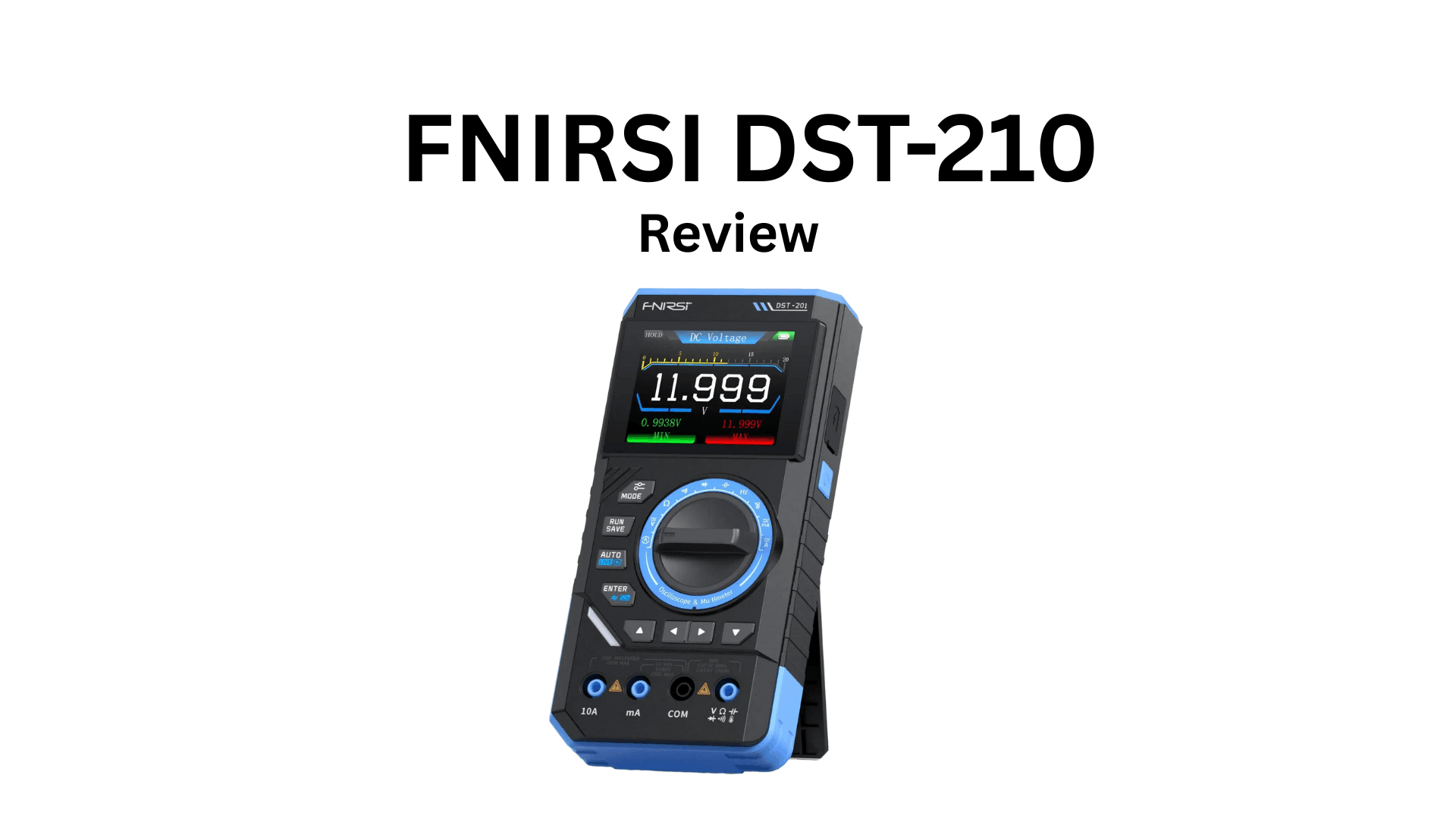
A portable oscilloscope, multimeter, and signal generator combined into one compact handheld tool for hobbyists and repair technicians.
Multimeter
20,000 CountsBandwidth
10 MHzSampling Rate
48–50 MSa/sBattery Life
~9 HoursUnderstanding the Technical Terms
Before diving into the review, it’s worth understanding what these specifications actually mean in practical terms. Here’s a breakdown of the key concepts:
The maximum frequency at which the oscilloscope can accurately measure a signal. At the stated limit (10 MHz), the measured amplitude typically drops by 3dB—roughly 30% lower than the actual value. Think of it as the device’s “speed limit” for reading signals.
How many “snapshots” of an electrical signal the device captures per second. The DST-210 takes 48–50 million samples every second. Higher sampling rates mean cleaner, more accurate waveform displays, especially for fast-changing signals.
This describes the multimeter’s display resolution. A 20,000-count meter can show readings up to 19,999, allowing for more precise digits. For example, it can display 1.9999V rather than just 1.99V—a meaningful improvement for accurate measurements.
An internal component used to measure electrical current. When measuring high currents (such as 10A), this resistor heats up due to its compact size, causing the measurement to gradually “drift” and become less accurate over time.
The industry-standard method for defining an oscilloscope’s true bandwidth. It’s the frequency where the measured signal power drops to half its actual value. Every oscilloscope uses this benchmark, making it easy to compare devices.
In a square wave signal, this represents the percentage of time the signal is “on” versus “off”. A 50% duty cycle means the signal spends equal time in its high and low states.
Multimeter Functions
🔧 Core Performance
The multimeter is the primary feature of the DST-210, using a traditional rotary dial that many users find more intuitive than button-only interfaces. With its 20,000-count resolution, it offers high precision readings suitable for most hobbyist and repair work.
Accuracy: The device specifies DC accuracy at 0.5% ± 3 counts, and it performed admirably during voltage standards testing. For everyday troubleshooting, this level of precision is more than adequate.
Continuity Testing: The continuity “bleep” is impressively fast and responsive—essential when you’re probing circuits quickly. However, there’s a slight quirk: the screen display can lag 1–2 seconds behind the audible beep.
Notable Limitation: No “Relative” Mode
A significant drawback is the absence of a “REL” (Relative) button. Without this feature, you cannot “zero out” the resistance of your test leads. This makes it difficult to accurately measure very low resistances (under 1Ω) or small capacitances—a frustrating omission for precision work.
🌡️ Current Measurement & Heat Issues
During high-current testing (approaching 10A), the readings tend to creep upward over time. This happens because the internal shunt resistor heats up quickly due to its compact size. If you’re measuring sustained high currents, be aware that accuracy will degrade after the first minute or so.
Oscilloscope Functions
📈 Bandwidth Performance
The oscilloscope is a single-channel tool rated at 10 MHz bandwidth. Testing confirms it genuinely reaches this specification for sine wave signals. However, pushing beyond 10 MHz produces increasingly unstable and distorted readings.
Square Wave Limitation: For square waves, performance is more restricted. The device can only maintain a clean, recognisable square shape up to approximately 2 MHz. Beyond this, the sharp edges become rounded and the waveform loses definition.
🛠️ Real-World Applications
This oscilloscope excels at “quick look” diagnostics rather than precision analysis. It’s genuinely useful for tasks such as:
• Checking if a power supply has entered “burst mode” operation
• Verifying whether a motherboard crystal oscillator is functioning
• Identifying modified sine wave output from power inverters
• Basic signal presence/absence checks during repairs
💾 Interface & Features
The interface includes a useful Persistence mode—helpful for catching rare signal glitches that might otherwise flash by unnoticed. You can also save screenshots as BMP files to a computer via USB, which is handy for documentation or sharing findings.
Signal Generator
〰️ Waveform Capabilities
The built-in generator outputs 13 different waveform types, including sine, square, sawtooth, and triangle waves. The maximum frequency is capped at 50 kHz—adequate for audio testing and basic circuit verification, but limiting for RF work.
Signal Quality: At lower frequencies, you may notice subtle “quantization artifacts”—tiny stair-step patterns in the waveform caused by the digital-to-analogue converter’s resolution. These are minor but visible if you’re looking closely.
Usability Quirk: An annoying design choice: the device resets the frequency to 1 kHz every time you exit and re-enter the signal generator mode. This means repeatedly dialling in your desired frequency during extended testing sessions.
Build Quality & Ergonomics
🛡️ Physical Protection
The device features rubber bumpers for drop protection, but their coverage is asymmetrical—the top and sides lack full protection. A fall onto the wrong corner could cause damage. Additionally, the main rotary dial protrudes significantly; if the meter falls face-down, the dial will absorb the impact.
📱 Display Characteristics
Indoors, the screen is bright and highly readable with excellent clarity. However, the glossy finish creates heavy reflections that make outdoor use in direct sunlight extremely difficult. If you work primarily outdoors, this could be a significant limitation.
🔌 Additional Notes
The test leads are gold-plated and of good quality—a pleasant surprise at this price point. The 3000mAh lithium battery provides approximately 9 hours of runtime, sufficient for a full day’s work without recharging.
DST-210 vs DST-201: Which to Choose?
FNIRSI offers two versions of this device. While they appear identical and share the same multimeter and signal generator, the oscilloscope specifications differ significantly:
| Feature | DST-201 (Standard) | DST-210 (Upgraded) |
|---|---|---|
| Oscilloscope Bandwidth | 1 MHz | 10 MHz |
| Sampling Rate | 5 MSa/s | 48–50 MSa/s |
| Multimeter Resolution | 20,000 Counts | 20,000 Counts |
| Signal Generator | 50 kHz max | 50 kHz max |
| Typical UK Price | ~£42 | ~£50–55 |
Our Recommendation
Unless you exclusively work with very basic audio circuits, the DST-210 offers substantially better value. The DST-201’s 1 MHz bandwidth is genuinely restrictive for an oscilloscope—most modern electronics repair work benefits from the 10 MHz capability. The roughly £8–10 price difference is well worth paying.
Summary: Strengths & Weaknesses
✓ Strengths
- High-precision 20,000-count multimeter
- Fast, responsive continuity beeper
- Oscilloscope accurately reaches 10 MHz rating
- Useful persistence mode for catching glitches
- 13 waveform types in signal generator
- Intuitive rotary dial interface
- Quality gold-plated test leads included
- Strong 9-hour battery life
- Excellent value at £50–55
✗ Weaknesses
- No “Relative” mode for zeroing leads
- Current readings drift at 10A due to heat
- Oscilloscope unstable above 10 MHz
- Square waves distort above ~2 MHz
- Signal generator limited to 50 kHz
- Frequency resets when exiting generator mode
- Very poor outdoor screen visibility
- Incomplete rubber bumper protection